|
“... the legend also has
it that when a priest dies his soul was transmigrated into the body of
a cat and upon the cat’s death the priest’s soul’s transition into heaven
has been accomplished..."
" .......The
reincarnation of souls and a deep respect and love for the
priests is the basis of the legend of the Sacred Cats of Burma......
"
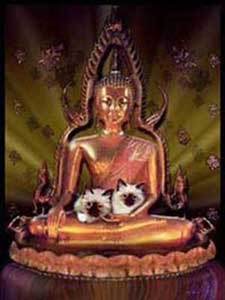
Also called the Sacred Cat of Burma, the
Birman has been around for centuries. Its true origin is shrouded in
mystery; few breeds have the aura of enchantment that this breed enjoys. The
Birman’s beautiful colorpoint pattern, long, silky fur, brilliant blue eyes,
and pure white gloves make the breed a lovely addition to the cat fancy. The
sweet, devoted personality makes the Birman a terrific companion as well.
The breed is often favored by those who love the pointed pattern of the
Himalayan but don’t care for the flattened facial type and grooming needs.
The origins of this legend lie with the Kittah priests of Khmer, who had by
all accounts been relentlessly pursued and massacred since around the early
1700's. Their enemies were the Indian Brahmins and in order to escape their
attacks fled to North Burmah where they founded the subterranean Temple of
Lao-Tsun (The Abode of the Gods).
According to Buddhist legend the Birman
breed was created by a Burmese goddess. The legend tells of a colony of
white cats white amber eyes living in a Buddhist temples of Burma (now
Myanmar) dedicated to the Goddess of transmutation Tsim-Kyan-Kse, was
worshiped in these temples, represented by a golden statue with glowing
sapphire eyes.
A most venerable priest known as Mun-Ha was living in the Temple of Lao-Tsun.
Mun-Ha had lived his entire life in contemplation of Tsun-Kyankse, the
goddess with sapphire eyes who presided over the transmutation of souls.
Apparently Mun-Ha had an oracle who dictated his decisions and this oracle
was highly revered by the Kittahs - the oracle was his cat Sinh. Sinh sat
alongside her master and also lived in contemplation of the goddess, her
yellow eyes gazing into the sapphire eyes of the
goddess. Each evening Mun-Ha, prayed in front of the statue of Tsim-Kyan-Kse
with Sinh by his side.
One day, marauders raided the temple and
struck down Mun- Ha. As Mun-Ha lay dying in front of the statue, Sinh
climbed onto his chest and purred to comfort and prepare him for his soul’s
journey. When Mun-Ha died, his soul flowed into Sinh, and a miraculous
transformation took place. Sinh’s amber eyes changed to the sapphire blue of
the statue’s. Her white coat turned a golden hue like the statue’s gold. Her
face, ears, tail and legs darkened to the color of the earth on which Mun-Ha
lay. Where Sinh’s paws touched the priest, however, there remained a
dazzling white, a symbol of Mun-Ha’s pure spirit. The next morning, all the
temple cats had undergone the same transformation. For the next seven days
Sinh refused all food and finally died, carrying Mun-Ha’s spirit into
paradise. From then on the priests guarded their sacred golden cats,
believing them to have custody of the souls of the priests.
It is said, that when a sacred cat dies in
the temple of Lao-Tsun, the soul of a Kittah re-enters. A warning too, for
those who (even accidentally) hasten the end of one of these venerable cats
- the most dreadful torments are reserved for them, that the soul in pain
may be appeased.
The
story may be mythical but the Birman is considered to have originated in
Burma, developed by Burmese priests. When the priests were forced to flee
their native country they were assisted by the English and French military.
In gratitude a pair of Birman cats were sent to France as a gift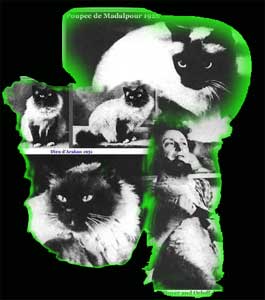
In 1919, a pair of Birman cats arrived in
France from the temple of Lao-Tsun. The male cat, Maldapour, died on the
way, but the female, Sita, arrived pregnant with Maldapour’s offspring and
became the European foundation of the Birman breed. Sita produced a kitten
named Poupee de Madalpour.
In 1925 it is recorded beyond doubt that the Federation Feline FranSais
recognized the Sacre de Birmanie as a championship breed. A photograph taken
in 1930 shows a male of the day named Dieu d'Arakan which became the
blue-print for the breed. He was owned by M. Baudoin- Crevoisier, well known
as a breeder of Birmans at that time. Later Dieu d'Arakan was sold, together
with six other Birmans, to Princess Ratibor and she subsequently left them
in her will to the Duke d'Aosta.
Eventually
their ownership was transferred to the Countess
Giriode Panissera and their pedigree line became famous worldwide. During
the war M. Baudoin- Crevoisier managed to keep a few cats entire. His
champion male Orlaff de Kaabaa and his female Xenia de Kaabaa became the
breed's foundation cats.
In 1959, the first Birman pair arrived in the United States, and in 1967,
the breed was officially recognized in America. Since then, the Birman has
flourished in the United States and is the third most popular longhair,
according to the CFA’s registration totals. The breed has continued to be
developed in Europe and has spread around the world. The Birman were
introduced to Australia in 1967.
Most Breeders follow an old
French tradition, of naming kittens alphabetically by the year they are born
in, for example, 2002 is "Z", 2003 is "A", 2004 is "B",
2005 is "C" and so on. By
following this tradition it is easy to tell a cat's age just from its name.
(Note: the first word in a cats name is the breeders cattery, then the cats
name, then if required the current owners cattery.
The name Birman is from the
French spelling for Burma.
"Birmanie."
Birman (English);
Sacre de Birmanie (French);
Heilige Birmaan (Dutch).
 |