|
The
information on this page may Shock, disturb or even upset certain viewers.
Please note this page I have set up to educate viewers on the disturbing
facts about De-clawing your cats.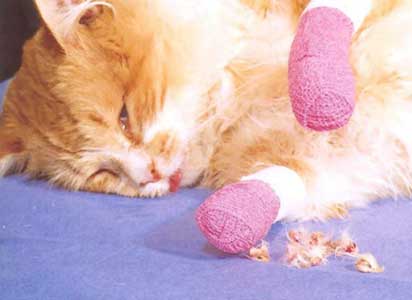
The above photo is a cat immediately after a de-clawing operation,
this cat lies next to the grisly evidence of bone, claw, and fur.
(photo/caption by Discovery Communications,
Inc. 1999)
Photo Courtesy Declaw info Site
If You Love Your Cat, Don't Declaw!
I
have to admit that I'd actually never heard
of this until I joined with the Birman emailing group and only to find
myself devastated and in disbelief that there are people out there who
would do such a thing perhaps because they are not educated enough about the
consequences.
I understand for a health or medical reason that would be acceptable BUT to
remove your pet cats nails for the sake of your furniture, then you should
spend some time reading about the trauma this effect put your cat through.
Please read
the following information and find out the risks of performing such a horrible event to the one you
love.
Please find this information as a teaching mechanism and not criticism!
Please please for the sake of your cat Don't De claw it's one of the
cruelest things I've ever
heard.
Please say NO to Declawing your cat.
This is a cruel and inhumane act. Cats are meant to have
their claws like we are our fingernails, provide your cat
with the correct scratching materials such as scratching
posts and you’ll never have problems.
I use two old chairs and my
cats know that those chairs are for their scratching while
the remaining furniture remains in tact. Cats are just as
easily taught as dogs, especially birmans, commanding your
kitten a stern NO and squirting it with water will quickly
teach your cat that NO means NO!
I have to
admit that I'd actually never heard of de-clawing until I
joined with the Birman emailing group and only to find
myself devastated and in disbelief that there are people out
there who would do such a thing perhaps because they are not
educated enough about the consequences.
I understand for a health
or medical reason that people don’t consider other avenues
such as claw caps, BUT to remove your pet cats nails for the
sake of your furniture, then you should spend some time
reading about the trauma this effect put your cat through.
Please find this
information as a teaching mechanism and not criticism!
Please please for the sake
of your cat Don't De claw it's one of the cruelest things
you can do to the one you love.
The Cat’s
Claws
Unlike most mammals who
walk on the soles of the paws or feet, cats are digit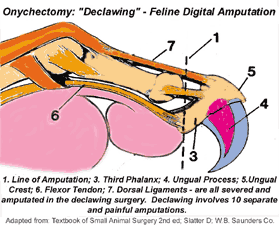 igrade,
which means they walk on their toes. Their back, shoulder,
paw and leg joints, muscles, tendons, ligaments and nerves
are naturally designed to support and distribute the cat's
weight across its toes as it walks, runs and climbs. A cat's
claws are used for balance, for exercising, and for
stretching the muscles in their legs, back, shoulders, and
paws. They stretch these muscles by digging their claws into
a surface and pulling back against their own clawhold -
similar to isometric exercising for humans. This is the only
way a cat can exercise, stretch and tone the muscles of its
back and shoulders. The toes help the foot meet the ground
at a precise angle to keep the leg, shoulder and back
muscles and joints in proper alignment. Removal of the last
digits of the toes drastically alters the conformation of
their feet and causes the feet to meet the ground at an
unnatural angle that can cause back pain similar to that in
humans caused by wearing improper shoes. igrade,
which means they walk on their toes. Their back, shoulder,
paw and leg joints, muscles, tendons, ligaments and nerves
are naturally designed to support and distribute the cat's
weight across its toes as it walks, runs and climbs. A cat's
claws are used for balance, for exercising, and for
stretching the muscles in their legs, back, shoulders, and
paws. They stretch these muscles by digging their claws into
a surface and pulling back against their own clawhold -
similar to isometric exercising for humans. This is the only
way a cat can exercise, stretch and tone the muscles of its
back and shoulders. The toes help the foot meet the ground
at a precise angle to keep the leg, shoulder and back
muscles and joints in proper alignment. Removal of the last
digits of the toes drastically alters the conformation of
their feet and causes the feet to meet the ground at an
unnatural angle that can cause back pain similar to that in
humans caused by wearing improper shoes.
The following information was written by Veterinarian, Dr. Christianne Schelling
If you are considering
declawing your cat, please read this. It will only take a
moment, and it will give you valuable information to help
you in your decision.
First, you should know that
declawing is pretty much an American thing, it's something
people do for their own convenience without realizing what
actually happens to their beloved cat. In England declawing
is termed "inhumane" and "unnecessary mutilation." I agree.
In many European countries it is illegal. I applaud their
attitude.
Before you make the decision
to declaw your cat, there are some important facts you
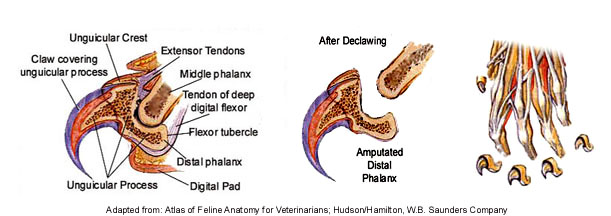
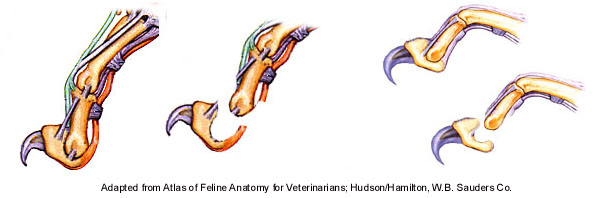
should know. Declawing is not like a manicure. It is serious
surgery. Your cat's claw is not a toenail. It is
actually closely adhered to the bone. So closely adhered
that to remove the claw, the last bone of your the cat's
claw has to be removed. Declawing is actually an amputation
of the last joint of your cat's "toes". When you envision
that, it becomes clear why declawing is not a humane act. It
is a painful surgery, with a painful recovery period. And
remember that during the time of recuperation from the
surgery your cat would still have to use its feet to walk,
jump, and scratch in its litter box regardless of the pain
it is experiencing. Wheelchairs and bedpans are not an
option for a cat.
No cat lover would doubt
that cats--whose senses are much keener than ours--suffer
pain. They may, however, hide it better. Not only are they
proud, they instinctively know that they are at risk when in
a weakened position, and by nature will attempt to hide it.
But make no mistake. This is not a surgery to be taken
lightly.
Your cat's body is perfectly
designed to give it the grace, agility and beauty that is
unique to felines. Its claws are an important part of this
design. Amputating the important part of their anatomy that
contains the claws drastically alters the conformation of
their feet. The cat is also deprived of its primary means of
defense, leaving it prey to predators if it ever escapes to
the outdoors.
I have also had people tell
me that their cat's personality changed after being
declawed. Although, the medical community does not recognize
this as potential side effect.
Okay, so now you realize
that declawing is too drastic a solution, but you're still
concerned about keeping your household furnishings intact.
Is there an acceptable solution? Happily, the answer is yes.
A big, joyful, humane YES! Actually there are several. The
following information is where you can obtain a scratching
post for you cat (insert Sammy’s and funkycat furniture
contact details). You can trim the front claws.
(Which I have been doing to your baby, to get it adjusted to
having their nails trimmed)
You can also employ
aversion methods. One of the best solutions I've found is
Soft Paws®.
Soft Paws are lightweight
vinyl nail caps that you glue on the cat's front claws.
They're great for households with small children and are
extremely useful for people who are away from home all day
and can't exercise the watchfulness necessary to train a cat
to use a scratching post. Soft Paws® are easy to apply and
last about four to six weeks. They come in clear or
colors--which are really fun. Now that's a kitty
manicure! The colored caps look spiffy on Tabby or Tom and
have the added advantage of being more visible when one
finally comes off. Then you simply replace it. You can find
Soft Paws® by surfing on the internet.
You need to remember,
though, that the caps and nail trimming should only be used
on indoor cats who will not be vulnerable to the dangers of
the outdoors.
Many vets and clinic staff
deliberately misinform and mislead clients into believing
that declawing removes only the claws in the hopes that
clients are left with the impression that the procedure is a
"minor" surgery comparable to spay/neuter procedures and
certainly doesn't involve amputation (partial or complete)
of the terminal-toe bone, ligaments and tendons. Some vets
rationalize the above description by saying that since the
claw and the third phalanx (terminal toe bone) are so firmly
connected, they simply use the expression "the claw" to make
it simpler for clients to "understand". Other vets are
somewhat more honest and state that if they used the word
"amputation", most clients would not have the surgery
performed! Onychectomy in the clinical definition involves
either the partial or total amputation of the terminal bone.
That is the only method. What differs from vet to vet is the
type of cutting tool used (guillotine-type cutter, scalpel
or laser).
Please
find the following Links as a learning tool
NOTE: Some pictures are gruesome and may
Shock!
(Just think how your cat would feel)
DECLAWING
What You Need to Know. ...
Written by Veterinarian, Dr. Christianne Schelling.
If you are considering declawing your cat, please read this. ...
DECLAWING
Declawing robs a cat of an
integral means of movement and defense.
Amby's DECLAWING CATS
Issues & Alternatives
includes factual information and training suggestions; how to trim nails and
build
scratching posts. ... Declawing! ...
Declawing! What You Need To Know. ...
The
Facts About Declawing©
(Feline Digital Amputation
- "Onychectomy") What You Really Need To Know. ... The consequences of
declawing are often pathetic. ...
THE
DECLAWING INFORMATION SITE
Immediately after a
declawing operation, this cat lies next to the grisly evidence of bone,
claw, and fur. ...
Declawing of Cats CFA Guidance Statement. ...
At the October 1996
meeting, the CFA Board unanimously approved a guidance statement on the
declawing of cats. ...
IS
DECLAWING CRUEL?
David ... humans. Remember,
declawing is radical surgery that involves amputating the first joint of a
cat's toes. ...
What
About Declawing?
.. I'm concerned that
people think - because declawing is apparently such a common practice - that
it is
a good and safe and reasonable thing to do. ...
Alternatives to Declawing, Nail Caps for Cats...
An Effective, Safe and
Humane Alternative to Declawing! The Purrfect Solution for Problem Cat
Scratching. Your Cat will Love You For It!
 |