 Indeed,
Bangkok is a capital city with distinctive cultural and natural
attractions which could not be described in a few pages. The
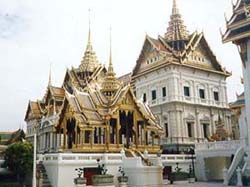
following are recommended places to visit; The Grand Palace
or the Emerald Buddha Temple. It has been described as one
of the most memorable Asian architectural fantasies in colour,
shape, designs and artistry. On the west side of Sanam Luang, is
the National Museum which is said to be one of the
largest and most comprehensive museums in Southeast Asia.
Standing beside the Grand Palace itself is Wat Po or Temple
Reclining Buddha which is Bangkok's oldest and largest
temple. The temple is also regarded as the first centre of
public education and is sometimes called, "Thailand's first
University".
Indeed,
Bangkok is a capital city with distinctive cultural and natural
attractions which could not be described in a few pages. The
following are recommended places to visit; The Grand Palace
or the Emerald Buddha Temple. It has been described as one
of the most memorable Asian architectural fantasies in colour,
shape, designs and artistry. On the west side of Sanam Luang, is
the National Museum which is said to be one of the
largest and most comprehensive museums in Southeast Asia.
Standing beside the Grand Palace itself is Wat Po or Temple
Reclining Buddha which is Bangkok's oldest and largest
temple. The temple is also regarded as the first centre of
public education and is sometimes called, "Thailand's first
University".
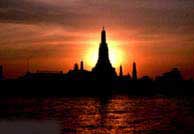 Located
on the west bank of the Chao Phraya River on the Thonburi side
is Wat Arun or the Temple of Dawn. It is one of Bangkok's
most memorable landmarks and always appears in all tourist
brochures. The most attractive structure in temple is the 82
metre high pagoda or Phra Prang in Thai.
Located
on the west bank of the Chao Phraya River on the Thonburi side
is Wat Arun or the Temple of Dawn. It is one of Bangkok's
most memorable landmarks and always appears in all tourist
brochures. The most attractive structure in temple is the 82
metre high pagoda or Phra Prang in Thai.
Not far
from Chitrlada Palace, home of the King, standing on Si
Ayutthaya� Road is Wat Benchamabophit or the Marble
Temple. It is well known because its main chapel is a prime
example of modern Thai architecture. The courtyard behind the
main chapel exhibits 53 Buddha images, most of which are copies
of famous images and styles from all over Thailand and other
Buddhist countries.
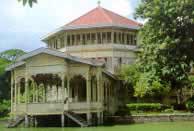 Off
U-thong Nai Road next to the National Assembly across from the
west side of the Dusit Zoo is Phra Thi Nang Wimanmek (or
Vimanmek Teak Mansion). which is the world's largest,
beautiful L-shape and three storey mansion made entirely of
golden teak. It was the home of King Rama V. The interior of the
mansion contains various personal effects of the king and a
number of art objects.
Off
U-thong Nai Road next to the National Assembly across from the
west side of the Dusit Zoo is Phra Thi Nang Wimanmek (or
Vimanmek Teak Mansion). which is the world's largest,
beautiful L-shape and three storey mansion made entirely of
golden teak. It was the home of King Rama V. The interior of the
mansion contains various personal effects of the king and a
number of art objects.
Located
at the end of Soi Kasemsan 2 opposite the National Stadium on
Rama I Road is Jim Thompson's Thai House. This remarkable
Thai style house was the work of Mr. Jim Thompson, an American
who came to Thailand at the end of the Second World War and
revived the Thai silk industry. On display in the main house are
his splendid, small Asian art collection and his personal
belongings.
Finally,
another places which should not be missed are Thai boxing
stadiums. In fact, Muay Thai or Thai boxing can be seen at two
boxing stadiums, Lumpini or Ratchadamnoen. Thai boxing is
both a sport and self defence as the boxers are allowed to use
almost any part of their bodies. It is a most exciting show
indeed.
These are
the tourist attractions in Bangkok in brief. Another places left
without mentioning are the Weekend Market, Dusit Zoo and China
Town etc.� If possible, visitors to the Thai kingdom
are also advised to visit other places of interest outside
Bangkok e.g. Wat Phailom. This temple is a sanctuary of
the open bill storks. It is located on the bank of the Chao
Phraya River in Pathumthani Province. From December to June,
thousands of these storks come to nest in the temple area.
Another
recommended place of interest in the Ancient City in
Samut Prakan Province. This is the world's largest outdoor
museum, also in this province is the Crocodile Farm. It
is a very large farm with over 30,000 crocodiles, both fresh and
salt water crocodiles can be seen here.�
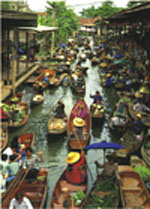 Then,
going down south west of Bangkok about 80 kms is the Damnoen
Saduak Floating Market, here small boats laden with all
kinds of tropical fruits and vegetables and other produce from
the orchards or nearby communities assemble for business. Going
up north of Bangkok in about 76 kms is Ayutthaya
Province.
Here the magnificient ruins of the old city still remain and
some have been renovated.
Then,
going down south west of Bangkok about 80 kms is the Damnoen
Saduak Floating Market, here small boats laden with all
kinds of tropical fruits and vegetables and other produce from
the orchards or nearby communities assemble for business. Going
up north of Bangkok in about 76 kms is Ayutthaya
Province.
Here the magnificient ruins of the old city still remain and
some have been renovated.
Due to
her richness of cultural heritage and beautiful natural
attractions, visitors to Thailand will not be disappointed as it
is well worth the journey. They will be greeted with a warm
welcome and receive hospitality extended to� them by local
people. They will realise that is their home away from home.
Everybody is welcome to Thailand, a land of smiles. It is better
to see with their own eyes than reading from the tourist
brochures.
Getting
around
Public
transportation: Public buses are plentiful and cheap and�
bus maps are readily available, but because the network includes
so many different lines, the fare schedule can be very
confusing. The fare for most non-air-conditioned buses (red and
white or red and cream colored) is Bt3.50, rising to Bt5 after
11 p.m. New white emission-con trolled buses-- supposedly the
wave of the future-- have recently been introduced with a fare
of Bt5.
Air-conditioned
bus
There are
three types of air-conditioned buses--the large blue and orange
ones owned by the city, and the red and gray Microbuses, owned
by a private company and operated by contract with the city.
Fare on the blue air-conditioned buses range from Bt6 to Bt16
and orange air-conditioned range from Bt8 to Bt18 depending on
the length of your trip, and fare for Microbuses is Bt25 (down
from Bt30 since the onset the economic crisis to offset fewer
customers). Microbuses are among the fastest means of public
transport because of their relatively high fare and a policy of
not stopping for additional passengers once the seats are all
filled (no standees allowed!). We highly recommend them
(although there have been rumours that service will be
discontinued beginning in January 1999).
Taxis
Taxis and
tuk-tuks: Hotels taxis and airport limousine services have fixed
tariffs. Taxis cruising the streets of Bangkok and designated
"taxi-meters" charge Bt35 for the first two kilometers
and approximately Bt5 for every kilometer thereafter. Some
taxi-meter drivers think they can still get away with fleecing
unsuspecting tourists and when flagged down, will
"suggest" a fare when told what the destination is. If
this happens to you, ask the driver to turn on the meter (point
if you have to.) If he refuses, gently slam the door in his face
and flag down the next taxi. Luckily, taxi-meters are plentiful
on the streets of Bangkok so if you encounter a recalcitrant
driver, it shouldn't be difficult to flag down a more
accommodating, law-abiding driver. Just before we went to
publication, it was discovered (by a passenger who happened to
be a police officer) that some taxi drives have modified their
meters to illegally increase the rate at which the fare is
clocked. To prevent this happening keep an eye on the driver to
see if he seems to be fiddling with the meter in any way during
the drive. (One the driver has turned the meter on, there should
be no reason for him to touch it again until the destination is
reached.) There are also still non-taxi-meters roaming the
streets of Bangkok although they're supposed to be eased out of
circulation within the next few years. It's better to just avoid
these taxi.
Tuk-Tuks
Tuk-Tuks,
or open three wheeled taxis, were once ubiquitous on the streets
of Bangkok, but the appearance of taxi-meters a few years ago
have nearly put them out of business. They are still quite
popular among both Thais and tourists for short journeys around
the city -- for longer journeys, the enclosed, air-conditioned
taxi-meters are a much better idea. Fares for Tuk-Tuks can range
anywhere from about Bt30 to Bt200, depending on the destination,
and must be bargained for with the driver.
River
taxi
Many
boats paly the Chao Phaya River. Some are basically ferries that
criss-cross between landings on opposite banks (the fare is
usually about Bt2) while the Chao Phaya Express boats travel up
and down stream with fares ranging from Bt5 to Bt15, again
depending on distance traveled.
Activities
in Bangkok
Like
almost any capital in the world, Bangkok has a wide selection of
commonplace sporting facilities including stadiums, tennis
courts, driving ranges, golf courses and fitness clubs, just to
mention a few.
But it
also has other facilities that you might not expect. Among them
are rock-climbing walls, several ice-skating rinks (and even one
ice hockey club, located at major shopping malls), a go-kart
track (behind the Season Square shopping complex on Srinakarin
Road), a cable-skiing lake for water skiiers (off Bangna-Trat
Hwy at km13) and muay Thai Boxing schools.
Tourism Authority of Thailand.
Head office : Le concorde building 202 Ratchadaphisek Rd, Huai Khwang, Bangkok 10310 Thailand. Tel: (66 2) 694-1222 (80 lines) Fax : (66 2) 694-1220-1
TAT Office : 4 Ratchadamnoen Nok Avenue, Bangkok, 10100 Thailand. Tel : (66 2) 282-8774-6
www.tat.or.th, www.tourism.thailand.org
