|
Geography��� Climate�� People��� Religion��� Language��� Food&Fruits�� Hill tribes��� Thai Boxing |
||
|
Bangkok & Around Andaman Sea Gulf of Thailand Northern Northeastern |
� ����������� One of the eras of Thai history was during the period from 1350 to 1767 when Ayutthaya was the capital. The former capital was founded in 1350 by King U- Thong, later crowned King Ramathibodi I, who led� his men from U -Thong where there was an outburst of cholera. The city was named for Ayutthaya, the home of Rama in the Indian epic Ramayana which mean "Undefeatable". In fact, Ayutthaya was a thriving town before it was founded as the Thai capital by King U Thong. Before the arrival of the invading Thais, the area was occupied by the Khmers or Cambodians who ruled Lavo or Lopburi. The city was situated on an island which was the confluence of three rivers, the Chao Phraya, the Pa Sak and the Lopburi. Thus, it was the centre of trade and communications. The area, well conserved as a historical park, has been included in UNESCO's list of World Heritage since 13 December 1991. Ayutthaya remained the Thai capital for 417 years and was reigned by 33 kings of five Siamese dynasties until it was conquered by the Burmese in 1767. The defeated capital was left in the jungle for over a hundred years when it was wrested out of the jungle again. Ayutthaya covers an area of 2,556 square kilometers and is administratively divided into 16 districts : Phra Nakhon Si Ayutthaya, Ban Phraek, Bang Ban, Bang Pahan, Bang Pa-in, Amphoe Bang Sai, Bang Sai, Lat Bua Luang, Maha Rat, Makhon Luang, Phachi, Phak Hai, Sena, Tha Rua, Uthai and Wang Noi. Ayutthaya is 85 kms north of Bangkok and is accessible by road, river and railway. Magnificient� ruins of principal temple and palaces of the old capital still remain to give a clue to the city's former glory. Place of Attractions Ayutthaya Historical Study Centre Located on Rochana Road, this is a national research institute devoted to the study of Ayutthaya, especially during the period when it was the capital of Thailand. The centre also exhibits reconstructions of Ayutthaya from the past with modern illustration techniques and supports an information service and a library. It is open daily from 9.00 a.m. to 4.00 pm. Located on Rochana Road, this is a national research institute devoted to the study of Ayutthaya, especially during the period when it was the capital of Thailand. The centre also exhibits reconstructions of Ayutthaya from the past with modern illustration techniques and supports an information service and a library. It is open daily from 9.00 a.m. to 4.00 pm. Chao Sam Phraya National Museum Located on Rochana Road, opposite the city wall, this museum houses various antique bronze Buddha images, famous carved panels and local artefacts. A receptacle at the Thai pavilion contains relics of Lord Buddha and objects of art more than 500 year old. It is open from Wednesdays to Sundays from 9.00 a.m. to 4.00 p.m. Khun Phan House This Thai style house near Wihan Phra Mongkhon Bophit conforms to descriptions in a popular Thai literary work. Ancient forts and Fortresses. There are many forts along the city wall and fortresses around the outer circle. As found in historical records, these include Pom Mahachai, Pom Phet, Pom Ho Ratchakhru, Pom Chidkop, Pom Champaphon, and Pom Yai. Most of them are situated at waterway intersections. Grand Palace. Currently called " Ancient Palace ", this residential palace of every Ayutthaya king is located close to the city wall. The palace was originally built by King U-Thong. During the region of King Borom Trailokkanat and the later kings, several buildings were added. Most pavilions were completely destroyed in 1767, leaving only brick foundations, porticoes and walls. The Tri Muk Pavilion, a wooden structure with a brick foundation, was rebuilt in its original style at the command of King Rama V in 1907
Wihan Phra Mongkhon Bophit. Phra Mongkhon Bophit , a large bronze cast Buddha image was originally enshrined in the open area outside the Grand Palace and later covered by a building in the region of King Songtham. During the fall of Ayutthaya, the building was badly destroyed by fire. The one currently seen was reconstructed, but does not have a beautiful craftsmanship as the previous one. the open area east of the sanctuary was where the royal cremation ceremonies took place.
Wat Phra Mahathat. This temple is on the corner of Chi Kun Road and Naresuan Road. A tall pagoda was built by King Ramesuan in 1384. A buried treasure chest containing valuables including a relic of Lord Buddha, several golden Buddha images and many other objects in gold, ruby and crystal was found during the excavation in 1956.
Suan Somdet. This public park is situated on U-Thong Road to the southwest of the city. The area, full of plants referred to in Thai literature, houses many archaeological ruins. Chankasem or Front Palace. On the bank of the Pasak River, this palace was built during the reign of King Maha Thammaraja, the 17th Ayutthayan monarch, for his son's residence ( King Naresuan ). Like other ruins. The palace was destroyed by the Burmese and left unrepaired for a long time. King Rama IV of the present Chakri dynasty ordered reconstruction of this palace for use as a residence during his occasional visits to Ayutthaya. The palace is now a national museum displaying Chinaware, ancient weapons, King Rama IV's personal belongings for daily life, Buddha images, sculptures and votive tablets of different times. It is open from Wednesdays to Sundays. from 9.00 a.m. to 4.00 p.m. Wat Senasanaram. This ancient temple is behind the Chankasem palace and houses two Buddha images that were transferred from Vientiane. Wat Suwandararam Ratchaworawihan. This temple is located on U-Thong Road, southeast of the city The mural paintings in the Ubosot depict the gathering deities and jataka stories. The murals on the front wall show a picture of Buddha subduing evil. Within the Vihara, there is a picture of the bravery of king Naresuan the Great, which is a masterpiece of several copies found in many places. Chedi Phra Si Suriyothai. This pagoda is situated at the original site of the Rear Palace, in the west of the city. It is a memorial to Somdet Phra Suriyothai, who was the royal consort of Phra Mahachakkraphat and the first heroine in Thai history. When the Burmese army intruded in to the kingdom in 1548, somdet Phra Suriyothai, clad in a warrior's suit, interrupted the fighting between the king and Phrachao Prae of Burma and was cut to death. Wat Lokayasutharam. This temple is adjacent to Wat wora-chettharam in the west to the city. It houses a large reclining Buddha image, made of brick and covered with plaster, approximately 29 metres long. Many large hexagonal pillar ruins near the image are believed to be the ruins of the ubosot. Wat Chaiwatthanaram. King Prasat Thong commanded it to be built outside the city island on the bank of the Chao Phraya River. Great beauty has been reflected from the main stupa and its satellite stupas along the gallery , influenced by khmer architecture. Wat Phutthaisawan. This riverside temple was built in the area called " Wiang Lek " to the south of the town. It is the site where King U-Thong first established his city . The temple houses a huge principal Buddha image of the early Ayutthaya period. Portuguese Village . This is located in Tambon Samphao Lom, on the west bank of the city. The Portuguese were the first Europeans that dealt with Ayutthaya in 1151. The ancient remains of San Petro Dominican Church, human skeletons and some antique objects such as tobacco pipes, coins, and accessories for a religious ceremony have been found at the site. Chedi Phukhao Thong. This 80- metre tall pagoda is located 2 kms. Northeast of the town. It was originally built in Mon style by King Burengnong of Burma to commemorate the Burmese victory over Ayutthaya in 1569. When Ayutthaya's independence was restored by King Naresuan in 1584, the pagoda was remodeled in the Thai style.
Wat Na Phra Men. This temple is located on the bank of Sa Bua Canal opposite the Grand Palace. The date of construction is unknown. The ubosot has been designed in a very old typical Thai style. The most interesting objects are the principal Buddha image, fully decorated in regal attire, and another image made of black stone in the small vihara. Wat Yai Chai Mongkhon. This temple is located outside the city to the southeast in the same direction as the railway station. It was built by King U- Tong in 1357 for meditation. In 1592, when King Naresuan defeated the Burmese by killing the Burmese Crown Prince in single-handed combat on elephants, he commanded a large pagoda built at this temple to match the height pagoda at Wat Phukhao Thong. This massive pagoda, in ruinous state at the present, is visible from a distance.
Japanese Village . This ancient site is located 1.5 kms. South of Wat Phananchoeng in Tambon Ko Rien There is an additional building of the Ayutthaya Historical Study Centre, where the foreign affairs of the Ayutthaya Period are exhibition. Prasat Nakhon Luang. Situated on the east bank of the Pa Sak river, Amphoe Nakhon luang, this pa- lace was a royal residence for Ayutthayan kings during their trips to Lop Buri and Buddha's Footprint Shrine in Saraburi. It is assumed to have been constructed during the reign of King Songtham, but was improved to be a brick and plaster building during the reign of King Prasat Thong.
Bang Sai Royal Folk Arts and Crafts Centre. This centre occupies an area of 14 acres in Amphoe Bang Sai which can be visited under royal patronage in 1976. Farmers from rural areas undergo training in folk arts and crafts here. Visitors will have a glimpse of various different Thai houses in regional styles and see how the rural people produce exquisite handicrafts including fern vien basketry, weaving basketry, artificial flowers, hand-woven silk and cotton, silk dyeing, wood carving, miniature hand-modelled Thai dolls, furniture making, and cloth-made products. The centre is open everyday except Monday from 8.30 a.m. to 4.00 p.m. Admission fee is 20 baht. call (035) 366092 for more information. Tourism Authority of Thailand. |

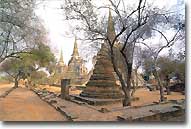 Wat Phra Si Sanphet. This is the most importance temple within the Royal Palace compound and
the original from which the Temple of The Emeral Buddha in Bangkok has
been copied. Three outstanding Ceylonese style pagodas were built during
the 15th century to enshrine the ashes of three Ayutthaya kings.
Wat Phra Si Sanphet. This is the most importance temple within the Royal Palace compound and
the original from which the Temple of The Emeral Buddha in Bangkok has
been copied. Three outstanding Ceylonese style pagodas were built during
the 15th century to enshrine the ashes of three Ayutthaya kings.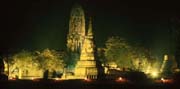 Wat
Phra Ram. This temple is situated outside the grand palace compound
to the east. King Ramesuan commanded that it be built on the ground
where the royal cremation ceremony for his father, King U-Thong, took
place. Only a pagoda and a big lagoon called " Bung Phra Ram "
remain. The area is currently used as a public park.
Wat
Phra Ram. This temple is situated outside the grand palace compound
to the east. King Ramesuan commanded that it be built on the ground
where the royal cremation ceremony for his father, King U-Thong, took
place. Only a pagoda and a big lagoon called " Bung Phra Ram "
remain. The area is currently used as a public park.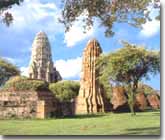
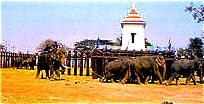 ElephantKraal Pavilion. This pavilion was utilized as the royal seat to
witness the elephant round up. It is located 4 kms. Northeast of the
town along Highway No.309. The outlook is a big cage surrounded with
logs having from the front centre, fencing lines of 42 degrees spread
out to both sides far away into the jungle area.
ElephantKraal Pavilion. This pavilion was utilized as the royal seat to
witness the elephant round up. It is located 4 kms. Northeast of the
town along Highway No.309. The outlook is a big cage surrounded with
logs having from the front centre, fencing lines of 42 degrees spread
out to both sides far away into the jungle area.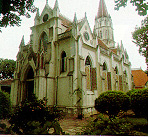 Wat
Phanancheng. This temple , south of the town, has no record about
its construction. It had been built before Ayutthaya was founded as the
capital. The principle image called " Prachao Phannachoeng" in
the vihara was built in 1325. The golden Buddha image is 19 metres tall
, made of stucco in the attitude of subduing evil. It is most revered by
the inhabitants of Ayutthaya.
Wat
Phanancheng. This temple , south of the town, has no record about
its construction. It had been built before Ayutthaya was founded as the
capital. The principle image called " Prachao Phannachoeng" in
the vihara was built in 1325. The golden Buddha image is 19 metres tall
, made of stucco in the attitude of subduing evil. It is most revered by
the inhabitants of Ayutthaya.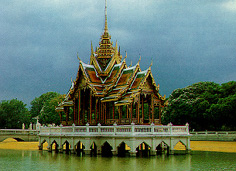 Bang
Pa-In Palace. This famous attractions is located 18 kms. South of
Ayutthaya. At Km. 35 of Highway No. 1 there is an 7 kms. access road to
the palace. A daily train from Bangkok stops at the Bang Pa-In station
and visitors can continue by local transport for another 4 kms.
Originally, the palace and Wat Chumphon Nikayaram was built by King
Prasat Thong on riverine island. The palace was used as a country
residence for the later Ayutthayan kings. After being abandoned for 80
years during the early Bangkok period, King Rama V commanded several
more buildings constructed in the compound as seen today. These include
pavilions and halls constructed in Thai, Chinese, and European
architectural styles, a theater, temples, and monuments. Most buildings
were named in rhymes Aisawanthipphaya-at, Warophatphiman, Utthayan
Phumisathian, Hemmonthian Thewarat, Saphakhan Ratchaprayun,
Withunthatsana, Keng Buppha Praphat, and Wehat Chamrun. The palace is
open to the public everyday from 8.30 a.m. to 4.00 p.m. Admission fee is
50 Baht. call (035) 261044 for more information.
Bang
Pa-In Palace. This famous attractions is located 18 kms. South of
Ayutthaya. At Km. 35 of Highway No. 1 there is an 7 kms. access road to
the palace. A daily train from Bangkok stops at the Bang Pa-In station
and visitors can continue by local transport for another 4 kms.
Originally, the palace and Wat Chumphon Nikayaram was built by King
Prasat Thong on riverine island. The palace was used as a country
residence for the later Ayutthayan kings. After being abandoned for 80
years during the early Bangkok period, King Rama V commanded several
more buildings constructed in the compound as seen today. These include
pavilions and halls constructed in Thai, Chinese, and European
architectural styles, a theater, temples, and monuments. Most buildings
were named in rhymes Aisawanthipphaya-at, Warophatphiman, Utthayan
Phumisathian, Hemmonthian Thewarat, Saphakhan Ratchaprayun,
Withunthatsana, Keng Buppha Praphat, and Wehat Chamrun. The palace is
open to the public everyday from 8.30 a.m. to 4.00 p.m. Admission fee is
50 Baht. call (035) 261044 for more information.