Geography

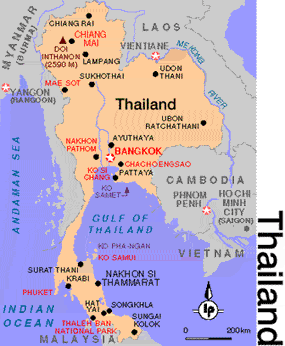
       Thailand is a Southeast Asia, predominanty Buddhist, kingdom almost equidistant between India and Chaina. Know for centuries by outsides as Siam, Thailand has been something of a Southeast Asia migratory, culture and religious crossroads. With an area of some 510,000 square kilomaters and population that exceeds 65 million, Thailand is approximately the same size as France ( and slightly samller than Texas. Thailand shares borders with Burma to the west and north, Laos to the northeast, Cambodia to the east and Malaysia to the south.

The mountainous North
          Where elephants work forests and winter temperatures are sufficiently cool to permit the cultivation of temperate fruits such as strawberries peaches and wine grapes, is home to the country's second larglest city Chiang Mai, and most of the minority hill tribes.

The sprawling Northeast plateau (also known as the Korat plateau), largely bordered by the Mekong River, where the worlds oldest Bronze Age civilization flourished some 5,600 years ago, is the country's second largest region after the north and also its poorest. The region, also known as Isaan, is largely populated by rice farmers.

The Central Plain, also known as Thailand's "rice bowl", is one of the world's most fertile rice and fruit-growing areas and is the economic and cultural heartland of the nation, thanks mostly to the fact that the capital is located here.

The Eastern coastal plain, increasingly a spillover area for Bangkok and an where fine sandy beaches support the growth of summer resorts like the renowned seaside town of Pattaya.  The Western region, whose mountains and valleys are in creasingly being developed for hydroelectric power. Logging companies have also been moving in, clearing large tracts of land and plainting cash crop like sugar cane and cassava.

The peninsular South, where arresting scenic beauty complements economically vital tin mining, rubber cultivation and fishing.

Back

Hosted by www.Geocities.ws

1