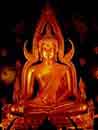
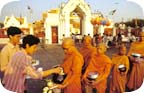
| Theravada Buddhism is the professed religion of more than 90 percent of Thias, and casts a strong influence on daily life. It is also the state religion of Thailand. Buddhism frist appeared in Thailand during the 3rd century B.C. at Kakhon Pathom, site of the world's tallest Buddhist monument, after the Indian buddhist Emperor Asoka (267-227 B.C) dispatched missionaries to Southest Asia to propagate the newly established faith. Besides molding morality providing social cohesion and offering incomparable artistic impetus. In common with medieval European cathedrals, Thailand's innumerable multi-roofed temples inspired major artistic creation. |
|
|
Another reason for Buddhism's strength is that there are few Thai
Buddhist families in which at least one male member has not studied the
Buddhist's teachings in a monastery. It has long been a custom for
Buddhist males over 20, once in their lifetimes, to be ordained for
period ranging from five days to tree month period during the rainy
season when all monks forgo travel and stay inside their monasteries.
Besides sustaining monastic communities, Thai temples have traditional
served other purposes as the village hostelry, villages news, employment
and information agency, school, hospital, dispensary and community
center which means they play a vital role in Thai society. The Thais have always subscribed to the ideal of religious freedom. Thus, sizeable minorities of Muslims (especially in the south), Christians, Hindus and Sikhs freely pursue their respective faiths. |