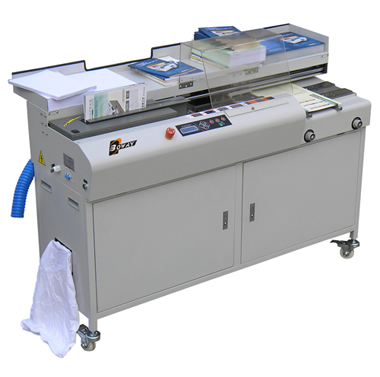
A binding machine is a device used to secure papers together. It is a relatively common piece of piece of equipment used in offices and schools. Businesses offering copying services will also likely have binding machines available. Depending on the company, self-serve binding machines may be available right alongside photocopy machines for public use.
Binding machines are available in both manual and electric styles. If you only have a few projects that require binding, or items to be bound are only a few pages long, then a manual binding machine may be the right choice. However, in a situation where you have a large volume of materials to be bound or your projects are rather lengthy, it makes more sense to go with an electric version.
Modern commercial binding
There are various commercial techniques in use today. Today, most commercially produced books belong to one of four categories:
Hardcover binding
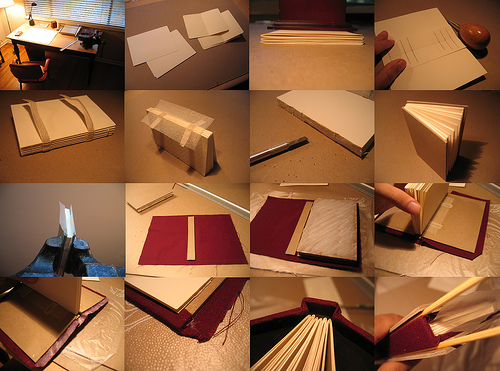
A hardcover, hardbound book has rigid covers and is stitched in the spine. Looking from the top of the spine, the book can be seen to consist of a number of signatures bound together. When the book is opened in the middle of a signature, the binding threads are visible. Signatures of hardcover books are typically octavo (a single sheet folded three times), though they may also be folio, quarto, or 16mo (see Book size). Unusually large and heavy books are sometimes bound with wire.
Until the mid-20th century, covers of mass-produced books were laid with cloth, but from that period onward, most publishers adopted clothette, a kind of textured paper which vaguely resembles cloth but is easily differentiated on close inspection. Most cloth-bound books are now half-and-half covers with cloth covering only the spine. In that case, the cover has a paper overlap. The covers of modern hardback books are made of thick cardboard.
Some books that appeared in the mid-20th century signature-bound appear in reprinted editions in glued-together editions. Copies of such books stitched together in their original format are often difficult to find, and are much sought after for both aesthetic and practical reasons.
A variation of the hardcover which is more durable is the calf-binding, where the cover is either half or fully clad in leather, usually from a calf. This is also called full-bound or, simply, leather bound.
Library binding refers to the hardcover binding of serials and paperback books intended for the rigors of library use. Though many publishers have started to provide "library binding" editions, many libraries elect to purchase paperbacks and have them rebound as hardcover books, resulting in longer life for the material.
Methods of hardcover binding
There are a number of methods used to bind hardcover books, from them:
- Case binding is the most common type of hardcover binding for books. The pages are arranged in signatures and glued together into a "textblock." The textblock is then attached to the cover or "case" which is made of cardboard covered with paper, cloth, vinyl or leather. This is also known as perfect binding, cloth binding, or edition binding.
- Oversewing, where the signatures of the book start off as loose pages which are then clamped together. Small vertical holes are punched through the far left-hand edge of each signature, and then the signatures are sewn together with lock-stitches to form the text block. Oversewing is a very strong method of binding and can be done on books up to five inches thick. However, the margins of oversewn books are reduced and the pages will not lie flat when opened.
- Sewing through the fold (also called Smyth sewing), where the signatures of the book are folded and stitched through the fold. The signatures are then sewn or glued together at the spine to form a text block. In contrast to oversewing, through-the-fold books have wide margins and can open completely flat. However, the text block of a sewn-through-the-fold book is not very secure, which can cause some signatures to come loose over time. Many varieties of sewing stitches exist, from basic links to complex decorative stitches. While Western books are generally sewn through holes punched along the fold, some Asian bindings, such as the Retchoso or Butterfly Stitch of Japan, use small slits instead of punched holes.
- Double-fan adhesive binding starts off with two signatures of loose pages, which are run over a roller—"fanning" the pages—to apply a thin layer of glue to each page edge. Then the two signatures are perfectly aligned to form a text block, and glue edges of the text block are attached to a piece of cloth lining to form the spine. Double-fan adhesive bound books can open completely flat and have a wide margin. However, certain types of paper do not hold adhesive well, and, with wear and tear, the pages can come loose.
Thermally activated binding
Some of the different types of thermally activated binding include:
- Perfect binding is often used, and gives a result similar to paperback books. National Geographic is one example of this type. Paperback or soft cover books are also normally bound using perfect binding. They usually consist of various sections with a cover made from heavier paper, glued together at the spine with a strong glue. The sections are milled in the back and notches are applied into the spine to allow hot glue to penetrate into the spine of the book. The other three sides are then face trimmed. This is what allows the magazine or paperback book to be opened. Mass market paperbacks (pulp paperbacks) are small (16mo size), cheaply made with each sheet fully cut and glued at the spine; these are likely to fall apart or lose sheets after much handling or several years. Trade paperbacks are more sturdily made, with traditional gatherings or sections of bifolios, usually larger, and more expensive. The difference between the two can usually easily be seen by looking for the sections in the top or bottom sides of the book.
- Thermal binding uses a one piece cover with glue down the spine to quickly and easily bind documents without the need for punching. Individuals usually purchase "thermal covers" or "therm-a-bind covers" which are usually made to fit a standard size sheet of paper and come with a glue channel down the spine. The paper is placed in the cover, heated in a machine (basically a griddle), and when the glue cools, it adheres the paper to the spine. Thermal glue strips can also be purchased separately for individuals that wish to use customized/original covers. However, creating documents using thermal binding glue strips can be a tedious process which requires a scoring device and a large format printer.
- A cardboard article looks like a hardbound book at first sight, but it is really a paperback with hard covers. Many books that are sold as hardcover are actually of this type. The Modern Library series is an example. This type of document is usually bound with thermal adhesive glue using a perfect binding machine.
- Tape binding refers to a system that wraps and glues a piece of tape around the base of the document. A tape binding machine such as the Powis Parker Fastback or Standard Accubind system will usually be used to complete the binding process and to activate the thermal adhesive on the glue strip. However, some users also refer to Tape Binding as the process of adding a colored tape to the edge of a mechanically fastened (stapled or stitched) document.
- Unibind is a variety of thermal binding that uses a special steel channel with resin rather than glue inside of it to give it a more sturdy bind to hold the pages in place. Unibind can be used to bind soft covered documents with a look that is similar to perfect binding. It can also be used for binding hardcover books and photo books. Like Thermal Binding, unibind usually requires you to purchase a one piece coverset to bind your documents. However, Unibind also offers SteelBack spines that allow you to use your own covers in the binding process. The majority of Unibinds covers can be printed on as well to give documents a unique finish. (Unibind is also the name of an International binding company)
Stitched or sewn binding
Types of stitched or sewn bindings:
- A sewn book is constructed in the same way as a hardbound book, except that it lacks the hard covers. The binding is as durable as that of a hardbound book.
- Stapling through the centerfold, also called saddle-stitching, joins a set of nested folios into a single magazine issue; most American comic books are well-known examples of this type.
- Magazines are considered more ephemeral than books, and less durable means of binding them are usual. In general, the cover papers of magazines will be the same as the inner pages (self-cover) or only slightly heavier (plus cover). Most magazines are stapled or saddle-stitched; however, some are bound with perfect binding and use thermally activated adhesive.
|