Lithography (from Greek λίθος, lithos, "stone" + γράφειν, graphein, "to write") is a method of printing originally based on the fundamental antipathy of oil and water. Printing is from a stone (lithographic limestone) or a metal plate with a smooth surface. It was invented in 1796 by German author and actor Alois Senefelder as a cheap method of publishing theatrical works. Lithography can be used to print text or artwork onto paper or other suitable material.
Lithography originally used an image drawn with oil/fat/wax on the surface of lithographic limestone plate, which after being treated with a mixture of acid (etching) and gum arabic, and then with water, did attract ink, but only in the drawing's sticky areas and not in the wet etched areas clear of oil/fat/wax, which application prevented etching. The ink was then transferred to a blank paper sheet producing a printed page.
In modern lithography, the image is made of a polymer coating applied to a flexible aluminum plate. To print an image lithographically, the flat surface of the stone plate is roughened slightly—etched—and divided into hydrophilic regions that accept a film of water, and thereby repel the greasy ink; and hydrophobic regions that repel water and accept ink because the surface tension is greater on the greasy image area, which remains dry. The image can be printed directly from the plate (the orientation of the image is reversed), or it can be offset, by transferring the image onto a flexible sheet (rubber) for printing and publication.
As a printing technology, lithography is different from intaglio printing (gravure), wherein a plate is either engraved, etched, or stippled to score cavities to contain the printing ink; and woodblock printing, and letterpress printing, wherein ink is applied to the raised surfaces of letters or images. Most types of books of high-volume text are printed with offset lithography, the most common form of printing technology. The word lithography also denotes photolithography, a microfabrication technique used in the microelectronics industry to make integrated circuits and microelectromechanical systems.
The principle of lithography
Lithography uses simple chemical processes to create an image. For instance, the positive part of an image is a water-repelling ("hydrophobic") substance, while the negative image would be water-retaining ("hydrophilic"). Thus, when the plate is introduced to a compatible printing ink and water mixture, the ink will adhere to the positive image and the water will clean the negative image. This allows a flat print plate to be used, enabling much longer and more detailed print runs than the older physical methods of printing (e.g., intaglio printing, letterpress printing).
Lithography was invented by Alois Senefelder in Bohemia in 1796. In the early days of lithography, a smooth piece of limestone was used (hence the name "lithography": "lithos" (λιθος) is the ancient Greek word for stone). After the oil-based image was put on the surface, a solution of gum arabic in water was applied, the gum sticking only to the non-oily surface. During printing, water adhered to the gum arabic surfaces and avoided the oily parts, while the oily ink used for printing did the opposite.
Lithography works because of the mutual repulsion of oil and water. The image is drawn on the surface of the print plate with a fat or oil-based medium (hydrophobic) such as a wax crayon, which may be pigmented to make the drawing visible. A wide range of oil-based media is available, but the durability of the image on the stone depends on the lipid content of the material being used, and its ability to withstand water and acid. After the drawing of the image, an aqueous solution of gum arabic, weakly acidified with nitric acid HNO3 is applied to the stone. The function of this solution is to create a hydrophilic layer of calcium nitrate salt, Ca(NO3)2, and gum arabic on all non-image surfaces. The gum solution penetrates into the pores of the stone, completely surrounding the original image with a hydrophilic layer that will not accept the printing ink. Using lithographic turpentine, the printer then removes any excess of the greasy drawing material, but a hydrophobic molecular film of it remains tightly bonded to the surface of the stone, rejecting the gum arabic and water, but ready to accept the oily ink.
When printing, the stone is kept wet with water. Naturally the water is attracted to the layer of gum and salt created by the acid wash. Printing ink based on drying oils such as linseed oil and varnish loaded with pigment is then rolled over the surface. The water repels the greasy ink but the hydrophobic areas left by the original drawing material accept it. When the hydrophobic image is loaded with ink, the stone and paper are run through a press which applies even pressure over the surface, transferring the ink to the paper and off the stone
The modern lithographic process
High-volume lithography is used presently to produce posters, maps, books, newspapers, and packaging—just about any smooth, mass-produced item with print and graphics on it. Most books, indeed all types of high-volume text, are now printed using offset lithography.
For offset lithography, which depends on photographic processes, flexible aluminum, polyester, mylar or paper printing plates are used instead of stone tablets. Modern printing plates have a brushed or roughened texture and are covered with a photosensitive emulsion. A photographic negative of the desired image is placed in contact with the emulsion and the plate is exposed to ultraviolet light. After development, the emulsion shows a reverse of the negative image, which is thus a duplicate of the original (positive) image. The image on the plate emulsion can also be created by direct laser imaging in a CTP (Computer-To-Plate) device known as a platesetter. The positive image is the emulsion that remains after imaging. Non-image portions of the emulsion have traditionally been removed by a chemical process, though in recent times plates have come available which do not require such processing.
The plate is affixed to a cylinder on a printing press. Dampening rollers apply water, which covers the blank portions of the plate but is repelled by the emulsion of the image area. Hydrophobic ink, which is repelled by the water and only adheres to the emulsion of the image area, is then applied by the inking rollers.
If this image were transferred directly to paper, it would create a mirror-type image and the paper would become too wet. Instead, the plate rolls against a cylinder covered with a rubber blanket, which squeezes away the water, picks up the ink and transfers it to the paper with uniform pressure. The paper passes between the blanket cylinder and a counter-pressure or impression cylinder and the image is transferred to the paper. Because the image is first transferred, or offset to the rubber blanket cylinder, this reproduction method is known as offset lithography or offset printing.
Many innovations and technical refinements have been made in printing processes and presses over the years, including the development of presses with multiple units (each containing one printing plate) that can print multi-color images in one pass on both sides of the sheet, and presses that accommodate continuous rolls (webs) of paper, known as web presses. Another innovation was the continuous dampening system first introduced by Dahlgren instead of the old method which is still used on older presses (conventional dampening), which are rollers covered with molleton (cloth) which absorbs the water. This increased control of the water flow to the plate and allowed for better ink and water balance. Current dampening systems include a "delta effect or vario " which slows the roller in contact with the plate, thus creating a sweeping movement over the ink image to clean impurities known as "hickies".
The process of lithography printing is seen here. This simplified version of a lithographic printing press gives you an idea of how the printing process works. This press is also called an ink pyramid due to the fact that the ink is transferred through several layers of rollers with different purposes. The lithographic printing presses are commonly used in newspaper production where fast rolling and jumping rolls are a famous part of the pressing scene in every newspaper production movie.
The advent of desktop publishing made it possible for type and images to be modified easily on personal computers for eventual printing by desktop or commercial presses. The development of digital imagesetters enabled print shops to produce negatives for platemaking directly from digital input, skipping the intermediate step of photographing an actual page layout. The development of the digital platesetter during the late 20th century eliminated film negatives altogether by exposing printing plates directly from digital input, a process known as computer to plate printing.
Microlithography and nanolithography
Main article: Photolithography
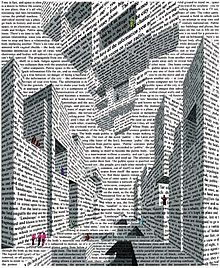
City of Words, lithograph by Vito Acconci, 1999
Microlithography and nanolithography refer specifically to lithographic patterning methods capable of structuring material on a fine scale. Typically, features smaller than 10 micrometers are considered microlithographic, and features smaller than 100 nanometers are considered nanolithographic. Photolithography is one of these methods, often applied to semiconductor manufacturing of microchips. Photolithography is also commonly used for fabricating Microelectromechanical systems (MEMS) devices. Photolithography generally uses a pre-fabricated photomask or reticle as a master from which the final pattern is derived.
Although photolithographic technology is the most commercially advanced form of nanolithography, other techniques are also used. Some, for example electron beam lithography, are capable of much greater patterning resolution (sometimes as small as a few nanometers). Electron beam lithography is also important commercially, primarily for its use in the manufacture of photomasks. Electron beam lithography as it is usually practiced is a form of maskless lithography, in that a mask is not required to generate the final pattern. Instead, the final pattern is created directly from a digital representation on a computer, by controlling an electron beam as it scans across a resist-coated substrate. Electron beam lithography has the disadvantage of being much slower than photolithography.
In addition to these commercially well-established techniques, a large number of promising microlithographic and nanolithographic technologies exist or are being developed, including nanoimprint lithography, interference lithography, X-ray lithography, extreme ultraviolet lithography, magnetolithography and scanning probe lithography. Some of these new techniques have been used successfully for small-scale commercial and important research applications. Surface-charge lithography, in fact Plasma desorption mass spectrometry can be directly patterned on polar dielectric crystals via pyroelectric effect, Diffraction lithography.
|


