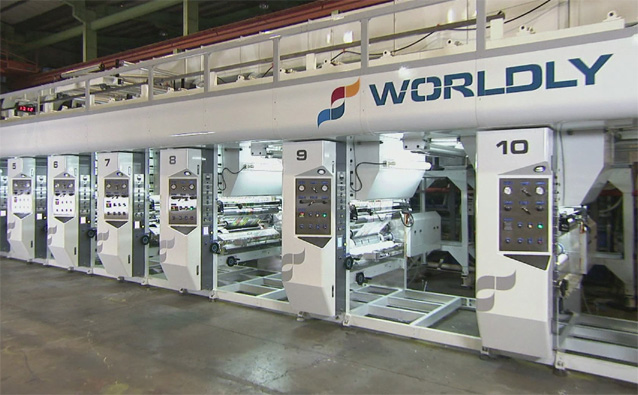
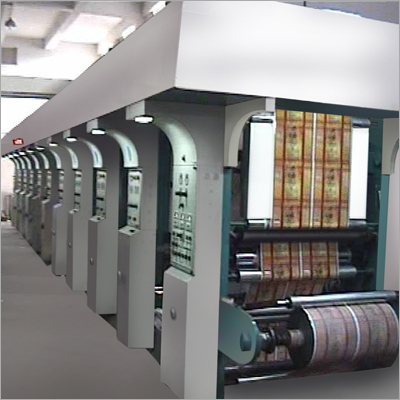
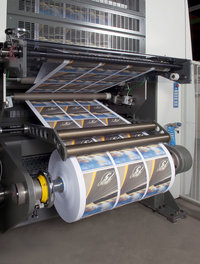
Rotogravure (Roto or Gravure for short) is a type of intaglio printing process, which involves engraving the image onto an image carrier. In gravure printing, the image is engraved onto a cylinder because, like offset printing and flexography, it uses a rotary printing press. Once a staple of newspaper photo features, the rotogravure process is still used for commercial printing of magazines, postcards, and corrugated (cardboard) product packaging.
Components
The first step of Gravure is to create the cylinder with the engraved images that need to be printed: the engraving process will create on the cylinder surface the cells that will contain the ink in order to transfer it to the paper. Since the amount of ink contained in the cells corresponds to different colour intensities on the paper, the dimensions of the cells must be carefully set: deeper cells will produce more intensive colours whereas less deep cells will produce less intensive ones. There are three methods of photoengraving that have been used for engraving of gravure cylinders, where the cell open size or the depth of cells can be uniform or variable:
Method |
cell size |
cell depth |
Conventional |
uniform |
variable |
"Two positive" or "Lateral hard dot" |
variable |
variable |
Direct transfer |
variable |
uniform |
Gravure cylinders are usually made of steel and plated with copper and a light-sensitive coating. Previously machined to remove imperfections in the copper, most cylinders are now laser engraved. In the past, they were either engraved using a diamond stylus or chemically etched using ferric chloride, which creates pollution. If the cylinder was chemically etched, a resist (in the form of a negative image) was transferred to the cylinder before etching. The resist protects the non-image areas of the cylinder from the etchant. After etching, the resist was stripped off. The operation is analogous to the manufacture of printed circuit boards. Following engraving, the cylinder is proofed and tested, reworked if necessary, and then chrome plated.
A rotogravure printing press has one printing unit for each color, typically CMYK or cyan, magenta, yellow and key (printing terminology for black), but the number of units varies depending on what colors are required to produce the final image. There are five basic components in each color unit: an engraved cylinder (AKA "Gravure cylinder") whose circumference can differ according to the layout of the job; an ink fountain; a doctor blade; an impression roller; a dryer.
Process
In direct image carriers such as gravure cylinders, the ink is applied directly to the cylinder and from the cylinder it is transferred to the substrate
While the press is in operation, the engraved cylinder is partially immersed in the ink fountain, filling the recessed cells. As the cylinder rotates, it draws ink out of the fountain with it. Acting as a squeegee, the doctor blade scrapes the cylinder before it makes contact with the paper, removing excess ink from the non-printing (non-recessed) areas and leaving in the cells the right amount of ink required: this tool is located quite close to the paper so that the ink left in the cells does not have enough time to dry. Next, the paper gets sandwiched between the impression roller and the gravure cylinder: this is where the ink gets transferred from the recessed cells to the paper. The purpose of the impression roller is to apply force, pressing the paper onto the gravure cylinder, ensuring even and maximum coverage of the ink. The capillary action of the substrate and the pressure from impression rollers force the ink out of the cell cavity and transfer it to the substrate (Figure 1). Then the paper goes through a dryer because it must be completely dry before going through the next color unit and absorbing another coat of ink.
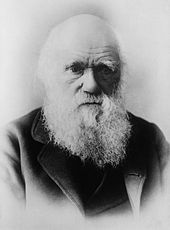
Rotogravure portrait of Charles Darwin, c. 1880
Features
Because gravure is capable of transferring more ink to the paper than other printing processes, it is noted for its remarkable density range (light to shadow) and hence is a process of choice for fine art and photography reproduction, though not typically as clean an image as that of offset lithography. Gravure's major quality shortcoming is that all images, including type and "solids," are actually printed as dots, and the screen pattern of these dots is readily visible to the naked eye.
Gravure is an industrial printing process capable of consistent high quality printing. Since the Gravure printing process requires the creation of one cylinder for each colour of the final image, it is expensive for short runs and best suited for high volume printing. Typical uses include long-run magazines in excess of 1 million copies, mail order catalogs, consumer packaging, Sunday newspaper ad inserts, wallpaper and laminates for furniture where quality and consistency are desired. Another application area of gravure printing is in the flexible-packaging sector. A wide range of substrates such as polyethylene, polypropylene, polyester, BOPP, etc. can be printed in the gravure press. Gravure printing is one of the common processes used in the converting industry.
Rotogravure presses for publication run at 45 feet (14 m) per second and more, with paper reel widths of over 10 feet (3 m), enabling an eight-unit press to print about seven million four-color pages per hour.
The vast majority of gravure presses print on rolls (also known as webs) of paper or other substrates, rather than sheets. (Sheetfed gravure is a small, specialty market.) Rotary gravure presses are the fastest and widest presses in operation, printing everything from narrow labels to 12-foot-wide (3.66-meter-wide) rolls of vinyl flooring. For maximum efficiency, gravure presses operate at high speeds producing large diameter, wide rolls. These are then cut or slit down to the finished roll size on a slitting machine or slitter rewinder. Additional operations may be in line with a gravure press, such as saddle stitching facilities for magazine or brochure work.
Advantages
The rotogravure printing process is the most popular printing process used in flexible-packaging manufacturing, because of its ability to print on thin film such as polyester, OPP, nylon, and PE, which come in a wide range of thicknesses, commonly 10 to 30 micrometers.
Other appreciated features include:
- printing cylinders that can last through large-volume runs without the image degrading
- good quality image reproduction
- low per-unit costs running high volume production
Disadvantages
Shortcomings of the gravure printing process include:
- high start-up costs: hundreds of thousands of copies needed to make it profitable
- rasterized lines and texts
- use of chemicals in the ink.
|