
SILK SCREEN PRINTING | A COMPREHENSIVE GUIDE | By: Rodelio D. Balagot
| ARCHIVE DIRECTORY | OFFSET PRINTING | LETTERPRESS | ROTOGRAVURE | FLEXOGRAPHY | LITHOGRAPHY | SILK SCREEN |
 |
||
Silk ScreenPrinting Process |
 |
||||
|
 |
||||
|
|
||
Silk Screen Printing |
A screen is made of a piece of mesh stretched over a frame. A stencil is formed by blocking off parts of the screen in the negative image of the design to be printed; that is, the open spaces are where the ink will appear on the substrate.
A. Ink. B. Squeegee. C. Image. D. Photo-emulsion. E. Screen. F. Printed image.

Different samples of the printed image

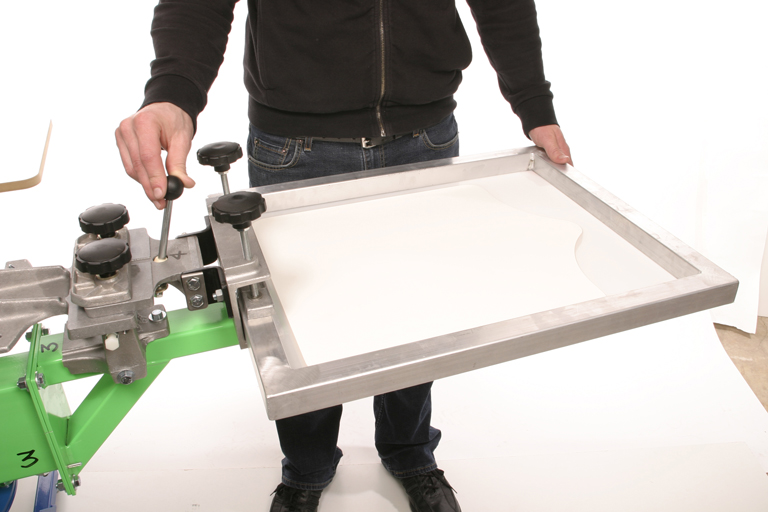
Used to hold screens in place on this screen print hand bench

Trolley used in Squeegee & Ink studio containing a wooden squeegee and acrylic ink

Screen printed fabric on heat press to sure ink in studio

A Wash out for cleaning screens at Squeegee & Ink screen print studio

Screen Printing four layers on a hand bench at Squeegee & Ink studio
Printing technique Before printing occurs, the frame and screen must undergo the pre-press process, in which an emulsion is 'scooped' across the mesh and the 'exposure unit' burns away the unnecessary emulsion leaving behind a clean area in the mesh with the identical shape as the desired image. The surface (commonly referred to as a pallet) that the substrate will be printed against is coated with a wide 'pallet tape'. This serves to protect the 'pallet' from any unwanted ink leaking through the substrate and potentially staining the 'pallet' or transferring unwanted ink onto the next substrate. Next, the screen and frame are lined with a tape. The type of tape used in for this purpose often depends upon the ink that is to be printed onto the substrate. These aggressive tapes are generally used for UV and water-based inks due to the inks' lower viscosities. The last process in the 'pre-press' is blocking out any unwanted 'pin-holes' in the emulsion. If these holes are left in the emulsion, the ink will continue through and leave unwanted marks. To block out these holes, materials such as tapes, specialty emulsions and 'block-out pens' may be used effectively. The screen is placed atop a substrate. Ink is placed on top of the screen, and a floodbar is used to push the ink through the holes in the mesh. The operator begins with the fill bar at the rear of the screen and behind a reservoir of ink. The operator lifts the screen to prevent contact with the substrate and then using a slight amount of downward force pulls the fill bar to the front of the screen. This effectively fills the mesh openings with ink and moves the ink reservoir to the front of the screen. The operator then uses a squeegee (rubber blade) to move the mesh down to the substrate and pushes the squeegee to the rear of the screen. The ink that is in the mesh opening is pumped or squeezed by capillary action to the substrate in a controlled and prescribed amount, i.e. the wet ink deposit is proportional to the thickness of the mesh and or stencil. As the squeegee moves toward the rear of the screen the tension of the mesh pulls the mesh up away from the substrate (called snap-off) leaving the ink upon the substrate surface. There are three common types of screen printing presses. The 'flat-bed', 'cylinder', and the most widely used type, the 'rotary', Textile items printed with multicolored designs often use a wet on wet technique, or colors dried while on the press, while graphic items are allowed to dry between colors that are then printed with another screen and often in a different color after the product is re-aligned on the press. Most screens are ready for re-coating at this stage, but sometimes screens will have to undergo a further step in the reclaiming process called dehazing. This additional step removes haze or "ghost images" left behind in the screen once the emulsion has been removed. Ghost images tend to faintly outline the open areas of previous stencils, hence the name. They are the result of ink residue trapped in the mesh, often in the knuckles of the mesh (the points where threads cross). While the public thinks of garments in conjunction with screen printing, the technique is used on tens of thousands of items, including decals, clock and watch faces, balloons, and many other products. The technique has even been adapted for more advanced uses, such as laying down conductors and resistors in multi-layer circuits using thin ceramic layers as the substrate. Stenciling techniques
 A macro photo of a screen print with a photographically produced stencil. The ink will be printed where the stencil does not cover the substrate.
A method of stenciling that has increased in popularity over the past years is the photo emulsion technique: Hand-painted color separation on transparent overlay by serigraph printer Csaba Markus
Another advantage of screen printing is that large quantities can be produced rapidly with new automatic presses, up to 1800 shirts in 1 hour. The current speed loading record is 1805 shirts printed in one hour, documented on 18 February 2005. Maddie Sikorski of the New Buffalo Shirt Factory in Clarence, New York (USA) set this record at the Image Wear Expo in Orlando, Florida, USA, using a 12-colour M&R Formula Press and an M&R Passport Automatic Textile Unloader. The world speed record represents a speed that is over four times the typical average speed for manual loading of shirts for automated screen printing. Screen printing materials
Versatility
Screen with exposed image ready to be printed.
Screen printing is more versatile than traditional printing techniques. The surface does not have to be printed under pressure, unlike etching or lithography, and it does not have to be planar. Different inks can be used to work with a variety of materials, such as textiles, ceramics, wood, paper, glass, metal, and plastic. As a result, screen printing is used in many different industries, including:
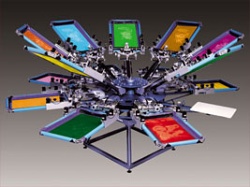
Semiconducting materialIn screen printing on wafer-based solar photovoltaic (PV) cells, the mesh and buses of silver are printed on the front; furthermore, the buses of silver are printed on the back. Subsequently, aluminum paste is dispensed over the whole surface of the back for passivation and surface reflection. One of the parameters that can vary and can be controlled in screen printing is the thickness of the print. This makes it useful for some of the techniques of printing solar cells, electronics etc. One of the most critical processes to maintain high yield. Solar wafers are becoming thinner and larger, so careful printing is required to maintain a lower breakage rate. On the other hand, high throughput at the printing stage improves the throughput of the whole cell production line. Screen printing pressTo print multiple copies of the screen design on garments in an efficient manner, amateur and professional printers usually use a screen printing press. Many companies offer simple to sophisticated printing presses. Most of these presses are manual. A few that are industrial-grade-automatic printers require minimal manual labor and increase production significantly. Rotary screen printingA development of screen printing with flat screens from 1963 was to wrap the screen around to form a tube, with the ink supply and squeegee inside the tube. The resulting roller rotates at the same speed as the web in a roll-to-roll machine. The benefits are high output rates and long rolls of product. This is the only way to make high-build fully patterned printing/coating as a continuous process, and has been widely used for manufacturing textured wallpapers. A large number of such machines have been supplied by Stork B.V..
|