Heritage
Motorcycling
Travels
Alien
Words
Window
Links
Contact
Home
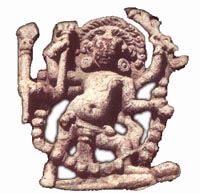
the scariest
Hindu deity
in Assam is not Kali or
Bhairav Shiva ...
Grotesque
Lion Man
The village was
suddenly abandoned
and shifted downstream..
the
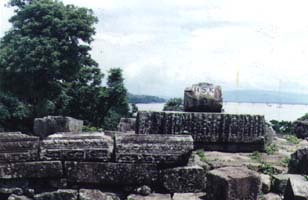
Gorsam
Stupa
.a
section of Bhutanese Buddhists belive that Assam is where Buddha died..
A Search In Hajo
Bull, bull and more
bulls, but
would someine clarify..
Nandis of
Assam
|
|
RIVER
OF FAITH
"Creation, Destruction and
Resurrection", are
patterns of an average river's cycle, as they supply life giving water,
cause devastating floods, and prepare fertile ground for new
habitation
in the end. No wonder, rivers in India have always been interwoven with
religious mythologies, and scarcely a stream exists without a claim to
divinity.
Among the sacred rivers of the country,
none is
held holier then the Ganges. Held as a divine manifestation, it's
waters
are attributed with powers to cleanse ones sins and cure all ailments.
The innumerable pilgrimage sites on it's banks from the very source in
the Himalayas to it's mouth in the Bay of Bengal, attesting it's
revered
position.
While the Ganges has become almost
synonymous
with Hinduism, there flows another river in India which has proved
itself
to be of no less importance to the faith. The only major male
holy
river of India, the mighty Brahmaputra or the son of Brahma, had played
a pivotal role in the religion from the earliest of times.
Unlike the Ganga, which in itself is the
object
of veneration, the Brahmaputra and its tributaries served the
faithful
by offering them a passage to the hundreds of shrines and temples
of ancient Assam, a land known for it's Tantric heritage.
Pragjyotisha or Kamarupa, as ancient
Assam
was known, was a little known mysterious region. Covered by dense
sub-tropical
jungles and swamps, with the only entry into its confines by the way of
high mountain passes in the north and east, and the Brahmaputra
in
the west.
In this semi isolated state there arose
within
it's precincts a distinctive Hindu civilisation, which flourished from
the 4th to the 13th century, during which a number of large
cities
and considerable rock temples were built. The religion practiced here
also
differed from the mainstream Hinduism proliferating elsewhere.
Thus,
the early Vaishnav cult of Vasudeva prospered in ancient Assam
way
up to the eleventh century long after it had died out in the rest of
the
country and Tantrism in both it's Hindu and Buddhist guises, developed
many of it's distinctive forms here. While various historical
treaties
often described the natives of the region as Sun or Surya
worshipers.
Gauging from the carvings on rocks and
stone blocks
of ancient temples, a remarkable attribute of Hinduism in ancient
Assam was the uncommon convergence of Shiva-Shakti worship with
Vaishnavism
into a unified stream. However, it was the Shaktic traditions of the
land,
whose reputation went far beyond it's boundaries that was
responsible
for dubbing the area as "the land of Tantra-Mantra".
A glorious reminder of the ancient Tantric
tradition,
the large shrine of the Mother Goddess Kamakhya in Guwahati, whose
origins
are traced to the 4-6th century CE still stands, albeit in a highly
repaired
and renovated state.
Studying the remnants of the hundred of
ancient
temples which dot the Assamese landscape, there is a possibility that
there
may have been a regular riverine traffic of pilgrims who came on boats
from the other parts of the subcontinent during the early medieval
period.
An assumption also supported by the Tantric opus Kalika Purana ,
the oldest remaining text dealing with India's eastern region,
believed
to be compiled in the 9-10th century CE.
Though revolving around a supposed
conversation
in between Shiva and Parvati, as narated by the mythical Sage
Markayenda,
a major section of it consists of descriptions of the ancient
holy
places of the region. Mentioned are the attributes of various temples,
the adjacent topography and the riverine route for reaching there; for
the only mode of transportation in ancient Assam was via water, and the
rivers served as highways linking one settlement to another. The tract
covered in the Kalika Purana spans the entire Brahmaputra
valley
from the western to the easternmost boundaries of the region, and among
the numerous places cited, it specifically names fifteen places as
sacred
to Shiva, five to the Devi and Vishnu respectively, which include
temples,
shrines, hills and Kundas or ponds.
Many of these places like the
Kamakhya
temple or Bishwanath are easily identified, while others like
eastern
Dikkaravassini area's Vasudeva Temple, the Urvasi
Kunda
or the Agni Pahar have disappeared, the casualties of
the pernicious actions of nature and time.
Attempting to visualise and study the
topography
as per the descriptions of the Kalika Purana to locate the
missing
shrines is a near impossible task, as countless rivers have changed
courses
and numerous hills have been leveled by earthquakes. But, comparing all
the early medieval archeological sites of ancient cities and temples of
Assam, with the recognized places described in the Kalika Purana
, a feature common to all of them, is their near vicinity to the
Brahmaputra
or one of it's tributary rivers.
Ruins of at least three major ancient
cities of
the pre-medieval and early medieval periods, had been located on the
banks
of the Brahmaputra in Assam. The one believed to be the earliest is in
the area of Sri Surja-Pahar, a hilly area near the town of Goalpara on
the south bank in western Assam.
It contains ruins dating from the 1CE (
though
endorsed by authorities, this date is heavily disputed) upto the early
medieval era. Named after Surya or the sun god, it is a large area
featuring
numerous ruins of temples and countless rock carved statues of
different
divinities, many of them of the solar deity. The ruins of Sri Surja are
however not limited to one creed, as there are numerous Buddhist and
Jain,
statues and carvings in that locality. In fact Sri Surja is the
only
place in Assam to feature Jain relics.
Pragjyotishpur, the one time capital
of
ancient Assam is thought to be located within the confines of modern
Guwahati.
Though the claim is unauthenticated, it cannot be denied is that there
once stood an ancient city on the spot because of the large number of
stone
building blocks and statues unearthed in the city. Incidently, the
Kalika
Purana describes the three present-day islands of the Brahmaputra
near Guwahati as being joined to the mainland, it is probable that the
river must have changed course and washed away a major part of the
ancient
capital. An interesting aspect about Guwahati's numerous ancient
shrines,
is that they are located on the banks of the river.
The territory of the modern town of
Tezpur on
the north bank of the Brahmaputra is another enigmatic ancient site.
With
innumerable ancient ruins scattered all over the town, the identity of
the ancient city is still unknown. Thought to be the remains of
Haruppeshwar,
a capital of the Salastambha dynasty, the theory is not backed by any
comprehensive
proof.
The only thing obvious about the ruins is
that
they mostly belong to religious structures built in circa 8 to10th
century
CE. The scattered remains on the Bamuni Pahar near the Brahmaputra are
the largest of them all, while the rock pillars surrounding the modern
Mahabhairav Shiva temple have been dated to the 7th century CE. ( All
the
legends of Krishna being associated with Tezpur appear to be codified
fantasies
of neo-vaishnav pratisioners)
There are traces of several more
early settlements
and cities, as well as a large number of isolated temples scattered all
over the state. From the Buddhist ruins of Mancachar in the west, to
the
Dhansiri valley ruins in the east. Each of these centers were located
at
considerable distances from each other and the lack of any records
about
them, makes it very difficult to establish their ancient names and
assign
them to specific periods or dynasties. However, they are very similar
to
each other by the nature of the designs and structures of the ruins,
the
large number of religious relics found, and their invariable location
on
a riverside.
Again, many of the currently existing
but ancient,
Shaktic shrines of Assam are found in clusters or standing alone in
areas
where no other signs of contemporaneous habitation are found. The large
ruins of Madan Kamdev and the Baman temple near Guwahati, the
Singri
and the Bishwanath temples near Tezpur are excellent examples.
The Madan Kamdev complex consists of
eighteen
temple sites located on a hillock near a dead course of a river, and
the
Kali temple of Baman is situated beside a canal of the river Barnadi.
Belong to the 9-11th century CE period,
both
were built with stone blocks and feature elaborate carvings. The Singri
temple of Shiva is one of the only two all rock temples still standing
in Assam, the other being in Hajo.
Located on the convergence point of the
Buri Ganga
and the Brahmaputra, Biswanath Ghat was once an ancient riverine port
of
considerable importance. Now it is just a laid back fishing village,
and
its claims to sanctity consist of only rocky ruins of the ancient
Bishwanath temple and numerous Ahom period shrines.
Even the relatively inland town of Hajo
which
is a major pilgrimage site for both the Hindus, Buddhists and the
Muslims
was located on the bank of Brahmaputra till 1662 CE, when the
river
changed it's course. ( A passage from the Ahom Buranji describes how
the
"Tilao" or Brahmaputra changed it's course after their "Deuri" - priest
made an offering of a black chiken.)
There is no comprehensive proof of the
existance
of a riverine pilgrimage itinerary for visiting the shrines of Eastern
India, but the locations of the ancient temples of the region and the
descriptions
of the Kalika Purana provide for such a possibility. And
one
can only admire the faith and courage of the people who ventured into
this
strange land and it's wild rivers, solely on the strenght of spiritual
devotion.
© Ravi J. Deka 2000
|