Heritage
Motorcycling
Travels
Alien
Words
Window
Links
Contact
Home
the scariest
Hindu deity
in Assam is not Kali or
Bhairav Shiva ...
Grotesque
Lion Man
The village was
suddenly abandoned
and shifted downstream..
the
Gorsam
Stupa
the scariest
Hindu deity
in Assam is not Kali or
Bhairav Shiva ...
Grotesque
Lion Man
For the dwellers of
Ancient India,
both Assam and the Brahmaputra denoted fear and divinity..
The river of faith
|
|
 NANDIS
OF ASSAM NANDIS
OF ASSAM
If frequenting the Noonmati and
Gitanagar
localities of Guwahati, one is bound to see a remarkable sight.
Perched
atop a steep hill towards the south-east, is a newly built temple of
considerable
dimensions, whose entire roof consists of a giant concrete image
of
Nandi the bull. The motif effectively attracts attention, but
raises
quite a few eyebrows as well. Startled by the enormous figure,
people
seem to deliberate more about the structures load bearing capacity,
and
not its religious implications.
The "Nandi Mandir" as it is popularly
known, is
quite an oddity as it's design adheres neither to the traditional, nor
to contemporary norms of temple construction. Even the
usage
of the Nandi statue is not common for a temple of this region. At times
found engraved on ancient temple panels and alongside Shiva idols,
individual
sculptural portrayal of bulls are rare, which is quite
surprising,
considering the large number of Shaivait temples here. A few examples
of
ancient Nandi or bull sculptures in the state, are located among other
places in Gorukhuti near Sipajar, Hatimuria near Jakhalabandha in the
Nogaon
district, while a few were unearthed in the Ambari excavations of
Guwahati.
Nandi or Nandin, whose form is noticeable
in
most Shaivait temples of the country, has a very complicated identity.
Regarded as Shiva's mount, the bull is also deemed a theriomorphic
representation
of the god himself. A number of passages of the Ramayana and the Matsya
Purana describe Shiva's faithful attendant Nandin as none other
but
a form of Shiva.
Idolisation of bulls, is evident even in
the dawn
of human history. A popular symbol of strength and virility, their
oldest
portrayals are seen in the form of cave paintings in Europe, and
then in almost all the consecutive civilisations of the world. In both
Create and Egypt, the two earliest Mediterranean civilizations, bulls
played
a vital role in their respective religions. For the Minoians of Create,
their entire creed evolved around the worship of bulls, hence their
sworn
enemies, the Greeks created legends of a bull headed demon
Minotaur.
In ancient Egypt the symbol and the mount of their tutelary deity
Osiris
was Apis the bull.
Subsequently the figure of the bull
resurfaced
again in Mitraism or the cult of "Mitras the Bull Slayer", an esoteric
astrological religion which covered parts of Europe, North Africa and
West
Asia, and was a direct competitor to early Christianity. Incidentally,
the concept of bull slaying in Mitraism was a metaphor of supreme
power, and it was the zodiacal sign of Taurus the bull, which
became
the emblem of the faith.
Closer home, bulls were equally revered
in the
Indus valley civilisation. As attested by the findings of
numerous
clay seals depicting bulls and that of the horned medicant figure
surrounded
by wild animals and a bull, which is thought to be a portrayal of a
Proto-Rudra,
the precursor of the Aryanised Shiva.
Reverting to the topic of
ancient
sculptures of Nandi in Assam. Stylistically most of the images found
here
differ little from those of other places, but there are atleast two
instances
where the portrayal of bull figures are distinctly atypical
and worthy of special attention.
One such debatable representation of
Nandi is
located in Hajo, a town 14 odd miles north-west of Guwahati. There,
from
the road to the Kedar temple, diverge a series of steps leading to the
Netai Dhubuni Pat Sil, a rocky area revered by Tibetan Buddhists
and Hindus alike. One has to follow those steps to the top, and turn to
the left, where in the middle of a slight clearing is a solitary form
of
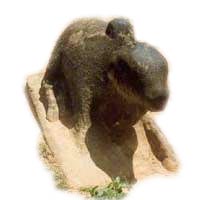
a reposing black bull. It will take a moment to realise, it is
not
alive but a statue. Life size and very realistic, blackened by
countless
layers of oil, milk and vermilion smeared by the devout pilgrims, the
Sar
Garu as it is locally known, is sculptured from rock.
It is difficult to ascertain it's age, and
nor
are there any connected local legends or lores explaining its
incidence.
Moreover, as it is situated in an isolated place far from any
temple,
shrine or Shaivait image, it can only be cogitated if the statue is
that
of Nandi. Besides, the sculpture is also devoid of ornamental carvings
like a shoulder mat or a garland around the neck, so
characteristic
to average Nandi images.
The second place in Assam featuring
unusual bull
figurines, is the Kamakhya temple on the Nilachal hill in Guwahati. On
the southern facet of the temple, embedded in the wall are two large
bull
headed human images, while a third stands in the north-eastern corner
of
the Sobhagya Kunda, the pond adjacent to the shrine. These statues have
been dated to circa 9th century CE, and are enigmatic because
Hindu
iconography does not allude any bull headed human bodied divinity,
though
such figures appear in other sacred traditions. As mentioned earlier,
the
ancient Greeks recounted a bull-headed monster, while revering a bull
horned
demi god Dionysus.
In neighbouring Tibet, Yama the god of
death
is represented as a ferocious entity with a bull's head, and so
is
the more complex Tantric deity Yamantaka , who according to the
SrimahavajraBhairava
Tantra is a fierce emanation of Manjushri and a destroyer of Yama.
It would be absurd to speculate if the
statues
of the Kamakhya temple, bear any association to the outwardly similar
Minotaur.
And as the Audhas or symbols held in the hands of these images do not
tally
with those attributed to the Yama or Yamantaka, we can rule out a
Tibetan
influence. The priests of the temple also offer no clues as to their
identities,
and when questioned offer something incomprehensive like "Goru
Pokhi"??(
Cow bird !!)
Exploring all the options, the eventuality
of
these statues representing Nandi seem most likely. A view upheld by the
eminent Art Historian Dr.T.K.Biswas, who believes them to be an unusual
personified form of Nandi, also known as Nandi Bhairava.
Classifying the bull headed statues as
those of
a personified Nandi solves a major riddle, but in turn generates
a new one. Strictly a member of the Shaivc family, it is anomalous for
a Nandi statue to be placed in a Shaktic complex. However, as the
statues
are set in the latter medieval Ahom reconstructed part of the
temple,
and not in the original stone Garba-Gribha, it is quite probable that
they
were cannibalised or sourced from another structure, in all possibility
a now nonexisting Shiva temple, once located somewhere on the
hill.
The solitary statue standing beside the pond, further corroborates such
a possibility.
"Quality supersedes quantity", at least
that is
what people like to say. So, if an occasion arises when someone derides
Assam's deficiency in Nandi bulls, we can proudly mention the rare
sculptures
at Hajo and the Kamakhya temple. But, if size is all that matters, the
location of the Gitanagar's "Nandi Mandir" had already been described.
© Ravi J. Deka 2000
|