Archaeology
Motorcycling
Travels
Alien
Words
Window
Links
Contact
Home
|
|
SONG-KRAN
IN ASSAM
We stopped right in front of the Vihar
which in itself was surprisingly almost empty in spite of it being a
day
of a major festival. A number of women sat in the prayer hall of the
monastery
wearing their traditional black Meklas(long skirts) and white
Chadars(stoles).
All the activity was concentrated in one
corner
of the compound where a group of men of different years crowded around
a
small pavilion housing a weird bamboo mechanism. All decked out in
checked
blue sarongs i.e. lungi in deshi
speak, the few elders authoritatively
yelled out directions, while the indifferent youngsters continued their
efforts
in calibrating the apparatus with constant cries of "Pour, no,no Stop,
stop !! Ok Pour !!" ringing in the air.
"This is where the Buddha idols will be
bathed",
explained Bipul Shyam Gohain my host in Solapathar, a village
surrounded
by oil derricks near Sibsagar. A senior geologist with the ONGC,
belonging
to the tiny Theravada or Hinayana Buddhist community of Tai Khamjangs, in Assam,
better known as the "Shyams Gohains." It was his invitation to
celebrate "Pani Bihu" in his ancestral village that brought me to
this eastern corner of the state.
The festival, which is actually called "Poi
Sanken"
in their native tongue is again derived from the Hindu "Sankranti" and
held on the same day in mid April, a day before the commencement of the
Assamese Rongali Bihu. Also marking the new year, it is equally
celebrated
by all the indigenous Theravada Buddhist communities of the north-east
like the Singphos, Fakials and Khamtis, as well as in Burma and
Thailand where it is called Song-Kran.
Being one time émigrés from these far-eastern countries,
it is apparent
that the festival too was imported by these tribes. The nomenclature
"Pani
Bihu" is derived from its association with water Pani, and because most
traditional festivals in Assam are invariably branded as one Bihu or
another.
The ceremony of the occasion involves
bringing
out all the statues of a Buddha Vihar to a specially prepared enclosure
where they are all given a "shower" to purify them for the coming year.
Here the Bamboo contraption comes into the picture. A complex layout
resembling
a fan with a skeletal frame in place of blades, it comprises of a
vertical
rotor with thin hollow bamboo segments branching out. Water fed from an
elevated point via another hollowed out bamboo pole sets it spinning
and
finally comes out of tiny holes in the the projecting members.
The
result of is a spinning shower.
The ritual of removing the statues for
long had
all the villagers waiting in anticipation glancing alternatively at the
large
wall clock and at their own wrist watches for the auspicious time to
begin the ceremony,
set in accordance to the Sakret a Buddhist calendar sent from Thailand.
At last the auspicious moment arrived and after a short prayer the head
Bhikhu of the Vihar picked up a small statue of Buddha and
started
the procession to the bathing enclosure under the shade of a
distinctively
oriental bamboo umbrella which I later found out to be of Burmese
origins.
Considered a ceremonial requisite, these are appropriately known as
Mann
Sati or Burmese umbrellas. With all the movable statues positioned
within
the ceremonial bathroom and its walls which were also made of bamboo
thatch
were draped with sheets of cloth; to give privacy to the idols as they
were bathed. Water is then poured into the troughs and the rotating
shower
set into a spin.
The huge brass statue of inside the Vihar
was
however left in its place due to its bulk and its purification was
achieved
by tying it to a length of rope, the other end of which was tied to the
bathing enclosure. The same technique was applied for the scripture
cupboard.
The images remained in the enclosure,
to
be reinstated after a day in a ritual called Fra Khan.
Later, when invited for tea by the
Bhante (a honorific
for the head monk), a young Khamti monk with a marked missionary zeal
for
preserving the Buddhist heritage and the "Tai" sub culture, I got the
opportunity
to discussed the origins and the significance of the occasion. Joining
us were a few older citizens of the village, who I realised wanted to
make
sure that the young friar got nothing wrong. A retired village
schoolmaster
occasionally put in his word, while an aged master woodworking
craftsman,
a recipient of the Presidential medal, was the most vocal of them all,
at times forcing the polite Bhante to withdraw from the conversation
into
a very Buddhist-like state of tolerant speechlessness. The others
present
preferred to be spectators.
"The roots of this festival lie in the
Shan area
and our Tai people have spread it all across from Thailand to here"
began
the monk. Here the craftsman went into an elaborate tirade about the
migration
of the Tai communities from the better known Ahoms to the Shyams,
drawing
parallels in languages and traditions and even singing out prayers. To
his credit he seemed to know what he was talking about.
Asking about the folklore behind the Poi
Sanken
festival, it was again he who promptly replied " It all started between
a fight between Lord Indra and Brahma !!"
Knowing that the Theravadins shouldn't'
have any
Gods, at least in theory, I turned to the monk for his endorsement, who
strangely nodded in affirmative. "Yes, we Tai people believe that we
are
the descendants of Landon, who is known as Indra by the Hindus" he
stated,
analogising with the Ahom myth of origins and completely ignoring the
atheistic
dogma of Hinayana Buddhism.
"We have many things common with Hindu
dharma,
we even have our own "Shan Tai Ramayan". It is the same one which is
used
in Thailand and it is called Tso Ramang."
"Only here Ram, Lakshman and Sita are
brothers
and sisters. And Ram is known as the "Along Mankong" put in the
craftsman
and turning to the monk he demanded "Why don't you show our guest our
own
copy".
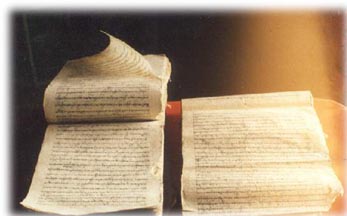
Thus mannaged to see the Vihar's 300 year
old
manuscript of the Thai Ramayan, hand-written written in the old Tai
script
on a handmade paper known as Tula Patta. The book which is kept wrapped
in a piece of cloth sans any other preservation measures was
surprisingly
in a very good condition.
Coming back to the story of Poi Sanken,
apparently
Indra and Brahma once had an argument about an astrological formula for
calculating the advent of rain. The former arguing that the calculation
has to be made with the variable of seven, the latter insisting that
the
number was six.
Neither side yielding they agreed to come
down
to earth in search of a knowledgeable astrologer with the agreement
that
the whoever is proven wrong would lose his head. Hence, a seer who was
tilling his fields suddenly discovers himself in the company of Gods
who
then test his astrological competence. Having passed their trials he
affirms
Indra's stand.
As per the agreement Brahma had to
die,
however all of Indra's efforts in this regard failed as only a secret
technique
could kill the creator god, i.e., with a strand of his own hair.
Indra therefore seduces one of Brahma's
daughters
with the promise of marriage and gets her to tell the secret way
to kill her father and even supplies a strand of his hair. (Amazing
what
promises of marriage could achieve in India even in those days).
Well, Indra manages to kill Brahma but
faces
a problem of storing his severed head which begins to radiate so much
heat
that neither the heavens, nor the earth or the sea can stand the
temperature.
At last Buddha had to be summoned for help, who in turn agrees to keep
the head in his Vihar. As a day in heaven equals one earth year, Buddha
is brought out annually and given a shower to cool him off.
A remarkable synthesis of mythologies
from diverse
sources. The element of Buddha coming to the rescue in the last resort
has a remarkable likeness to the Chinese myth of Sun Wukong, where the
mischievous monkey king is brought under control by the Buddha of
the western universe (Amitabha Buddha) after he spawned havoc in the
court
of the Zade Emperor. Similarly, the instance of Brahma's head being
severed
is present in both Hindu and the Mahayana Buddhist tradition. The
Bhairav
form of Shiva also cuts of Brahma's head, while the twelve armed form
of
the Tibetan Vajrayana deity Sambhara clutches it in one of his hands.
Incidentally,
this iconography is not meant to deride Hinduism, because Brahma is
also
a part of the Mahayana pantheon.
That evening while talking to Sasen
Bansa Bkihu
Mahathera in a neighbouring Buddha Vihar and Pali school, the aged
Buddhist
scholar confessed with a giggle that he himself could never understand
the presence of Hindu and Mahayan elements in the Theravada
system.
"The sectaran differences seem to be only
in
theory. When in practise, I have seen that people just need rituals and
gods" he conceded with a casual shrug that would shock the younger
monks
and had been doing so for years.
Outside children horsed around playing
with little
pails of water, their mother's preparing various delicacies at home.
Meanwhile
I couldn't help agreeing to a phrase which I read somewhere, "the only
Buddhists who are true to Buddha's words are found in the west"
© Ravi J.Deka 2000
|