Archaeology
Motorcycling
Heritage
Alien
Words
Window
Links
Contact
Home
a floating Kailash,
lost civilizations
and shimmering peaks...
meeting the stream
a secret mission, snow fields and an
Iradium
that didn't work...
View from the top
|
|
 A Gupt Kashi.
In a land of scarce records and a volatile
history,
Bishwanath or Bishwanath Ghat is among the oldest landmarks of Assam.
Mentioned
in the 9th century Kalika Purana as the place where the Jagathpati
(ruler
of the world - Vishnu) destroyed the demon Haya-Griva, it is one of the
very
few places described in the book that can be identified till this
day.
Approximately 100 km east of the modern
town of
Tezpur on the north bank of the Brahmaputra, Bishwanath is situated on
confluence point of the Buri Ganga. An ancient settlement and river
port from
the pre-Ahom era, it subsequently became a stronghold of the Ahom army
before being taken over by the British forces who maintained a huge
garrison
there in the early years of Assam's annexation.
With the building of roads, the role of
riverine
transportation diminished and so did Bishwanath's importance as a port
and military bastion. Known today only as an obscure pilgrimage site,
it
has lingered on as a forlorn remnant of ancient grandeur.
Being an agnostic of sorts, Bishwanath
Ghat would
have remained off my wandering circuit had I not been gathering data
about
curious labyrinth, maze and spiral drawings often found on riverside
rocks of Assam.
And as Bishwanath is one such place, the visit was inevitable.
We left Tezpur early in the morning and
headed
east along the highway towards the turn-of-point, Bishwanath Chariali.
A faceless commercial town revolving around a crossroad "Chariali",
best
known as a place where long distance buses halt to oblige their
passenger's
need of release and refreshments.
The going was slow as the highway was full
of
bumps, cracks and craters. Forced off the road at least five times by
bulldozing
army convoys manned by scowling soldiers, it took three hours to
covered
the 80-km stretch.
We turned right from the "Chariali" and
headed
south, and soon were on an empty road passing through harvested paddy
fields,
lined by giant coral-flower trees in full bloom, their leafless
flowering
branches appearing ablaze with crimson flames.
In its present-day incarnation Bishwanth
Ghat is a
large fishing village with the main road twisting through it middle
before terminating
by the riverside.
Still in early spring, the water level of
the
Buri-Ganga was low, its width reduced to 250 meters. The water
appeared
motionless with a slight greenish tinge as during winter the mouth of
the
river becomes just an inlet of the Brahmaputra.
A cluster of country boats tied to a few
posts
swayed on the lapping waters, nearby children splashed around, while a
flock of geese dutifully swam to and fro. Behind, a number of temple
domes
rose above the roofline. The tallest of them belonging to the
Bishwanath
Doul, a two hundred year old Ahom legacy.
A few Sanyasis walked about spreading
the unmistakable
wisps of cannabis smoke in the air. With two bathing Ghats, the eastern
one descending to the Buri Gang and the southern to the Brahmaputra,
wet pilgrims could be seen jaunting from one side to another. Despite
the
Kalika Purana's Vaishnav legend, Bishwanath seemed to be a Shaivait
site.
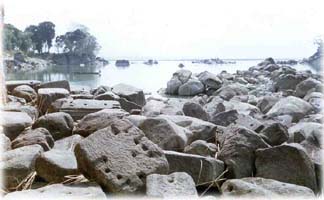
The river bank was strewn with boulders
of greyish-purple
quartzite, rounded smooth by water. More were seen on the other side
and forming
small islands. To the left rose a high wall of rock, cutting
perpendicularly
into the river reaching almost to the middle forming a natural
wharf.
The entire terrain looked like it had
been formed by a savage force, while the bizzare rock formations struck
as a setting from a si-fi movie or a realm of goblins and spirits, with
unseen serpents gliding beneath the river's tranquil surface.
Surroundings
befitting Shiva, especially as his Bhutnath title makes him the lord
of
Buths and Prets(Ghosts and Demons).
A hundred odd meters to our right, the
river converged
with the vast glassy expanse of the Brahmaputra. Across the river on
the
south bank were the tall hills of the Kaziranga National Park.
As we got out of the car, a number of
people offered
their boats. Not sure why one was needed, we were told that the
Bishwanath
Baba's temple was on the other side as were the rock carvings for which
I was there. Recruiting the services of the one standing closest and
agreeing
to pay exactly half of what he asked, we set forth to a large heap of
the
rocks projecting like a finger from the opposite bank. On top of the
mass
stood two thatched huts.
"This is the actual Bishwanath Baba's
temple"
our boatman guide illuminated us, pointing at the thatched huts, " he
can
only be worshipped for half a year, as once the rains start the river
covers up the place, thus the temporary hut".
Interestingly, the mound featured piles of
chiselled
stone blocks; telltale remnants of an ancient structure. Some were
quite
eroded, others well preserved, mainly comprising rectangular units with
the charactaristic inverted pyramid
dowel orfices and other structural bits and pieces characteristic to
early
medieval Hindu temple design.
Carved from the same greyish-purple
quartzite,
few had Kirti Mukhas (demon faces) carved on them. A humanoid figurine
resembling Vishnu could be seen on a heavily eroded block.
Entering the thatched temples we beheld a
very
peculiar sight. Instead of the customary Shiva linga or idols of the
god,
the objects of worship in both the shrines, were cylindrical
pits.
Carved by the rotating action of water for hundreds of years, these
were deep
potholes bored in rock.
What was stranger still, was that the
larger thatched
shrine was built upon the floor and the lower vestige of an ancient
rock
temple. Moreover, as the pothole is situated right in the middle of the
floor, it raises a number of questions about the design of the ancient
temple. Obviously, it was not designed to remain submerged for half a
year
!! But, to have a pothole develop right at the centre is equally
unusual.
Our Boatman guide further informed us
that all
the round rocks lying around are considered to be Shiva lingas in their
own right, and there are Unakouti, (one less then a crore) of them. By
believing him, we took the easier way out.
Bishwanath has two parallel legends of
it's association
with Shiva. Almost identical, one involves King Bana, a contemporary of
Narakasura, the mythical first Aryanised king of Assam, the other is
about
Sage Vyas. The Kalika Purana's account somehow doesn't figure in the
local
lore.
The first legend has it that Bana, who
ruled in
Tezpur was a devotee of Shiva and wanted to establish another Kashi in
the east, and so installed one crore Shiva lingas in Bishwanath.
However,
as no Kashi can exist outside Benaras, Ganesha stole one of them and
rendered
the place ineffective!!
Discovering one of the lingas missing, a
despaired
Bana appealed to Lord Shiva, who in turn told him to consult the two
sages
Kumud and Koustav who lived nearby.
Approaching the two sages who were
then
meditating, Bana bellowed, "Where is Kashi ?" Disturbed by the king's
unruly
behaviour they answered disdainfully, "Where will you find Kashi here?
Go west."
Disgusted, Bana contemplated suicide by
immolation,
but Shiva materialised in front of him and forbade his bid, cursing the
two hermits to turn to stone.
When the two astonished sages inquired
about
the reason, Shiva accused them of not knowing what is going on in their
own neighbourhood. The sages then answered in unison, "well if you
willed
a creation of a secret Kasha, then let it remain so". Hence Bishwanath
became known as Gupta Kashi or hidden Kashi.
Interestingly, there are two enormous
rocks standing
in the Brahmaputra near Kaliabor in the Nowgaon district of Assam
known as the Dui Muni Sil, or the two sage rocks. Believed by the
people
to be none other than the ill-fated Kumud and Koustav.
The second myth describes how Sage Vyas
came east
to establish a second Kashi after his earlier plan to create Vyas Kashi
north of Benaras failed. Apparently after he ran into foul weather with
the Goddess Annapurna or Durga, who cursed anyone dying there to be
reborn
as a donkey.
Hence, Vyas arrives at Bishwanath and
installs
one crore Shiva lingas. This time it was Naradh who mischievously
steals
one of them, and proceeds to inform Lord Shiva about the creation of a
new Purba Kashi. A curious Shiva then comes to region and starts
searching
for the site. He then comes across Kumud and Koustav, who were
busy
teaching their students. Shiva repeatedly questions them about the
location
of the new Kashi, but so involved were the hermits with their task,
that
they didn't even notice him. An enraged Shiva turns them to stone.
As history is silent about the origins
of the
enigmatic temple ruins, religious lore must suffice. My only
condolences
are for hapless Kumud and Koustav. Who says ignorance is bliss!!
Finishing with the unique Bishwanath
Mandir, we
next moved on to the site of the rock drawings. Located in the midst of
low scrubs not far from the eastern bank, was a large flat shoulder of
rock, with a slight crest on one edge. The unique diagrams were
engraved
on the flat face along with a few other crude animal and geometrical
patterns.
On the side of the crest was engraved a Ganesha and an indecipherable
inscription.
Noticing our activity, a cowherd and a
boatman
who brought a couple of pilgrims to a nearby temple volunteered their
knowledge.
Pointing at the Ganesha, the cowherd said," this is Vyas Muni". "These
are Pakha Khells''' or dice boards, he continued, referring to the
square
maze-like diagrams and described the spirals as something to do with
Abhimanu
or Arjun. Apprehending another confusing parable of stolen lingas and
reincarnated
donkeys, clarifications were not asked.
The last stop of the boat ride was a
small isle,
positioned right at the mouth of the Buri Gang. Consisting of a few
huge
rocks, it was home to a tall water level indicating pillar and a
magnificent
giant engraving of a Trishula.
By the time we finished our little
exploration,
it was well in the afternoon. Making use of the little time left, we
checked
out the numerous shrines located all around. However, the various
Vasudev,
Durga and Shiva mandirs failed to impress.
The natural Shiva linga's of the Buri
Ganga
and Bishwanath must have intimidated our attention. Besides we were
just
tired from too much sun and jumping around rocks!
© Ravi J.Deka 2000
|