Archaeology
Motorcycling
Heritage
Alien
Words
Window
Links
Contact
Home
a secret mission, snow fields and an
Iridium
that didn't work...
View from the top
Pot smoking Sanyasis, millions of
Shiva lingas
and a stranded barge ...
A Gupt Kashi
Royal
Enfields, Pilgrims, Yoga & the Techno Baba
High
& Dry
|
|
Meeting
the stream
A
brain crazed by monotony and boredom can have very abstract
revelations -
like what could be common in-between dramatist Samuael Becket and the
Hindu God Shiva?
And had I not been sitting for two days
at
a warf
in the west Assam town of Dhubri, right at the border with Bangladesh,
listlessly awaiting the arrival of a boat named "Kailash", that was
suppoed to ferry me up to Guwahati, the capital of the east Indian
state. My answer
would have also been "nothing".
But, buy the time, the floating abode of Shiva, the
"Kailash"
finally docked, three days behind schedule. I was feeling no
different from the tramps of "Waiting for Godot".
However unwelcome, the delay proved to
be
a necessary
prelude to the sedate nature of riverine
travel.
Besides, watching the constant traffic of boats
pulling in and out of the Ghats introduced me to the considerable role
of the Brahmaputra in that region. Moreover, with my aim of re-enacting
at least a part of the medieval riverine pilgrimage
route
of the Brahmaputra as elucidated in the 9th century Tantric Hindu text
the Kalika Purana, the anticipation was a small price to
pay.
The "Kailash" proved to be a small
wooden river
trawler manned by a crew of four, which normally hauled cargo
from
Dibrugarh to Pasighat, in the eastern sections of the river.
Refuelling and loading food supplies, and
the
cargo (in this case myself), the crew wasted no time and the boat was
soon
back in the greyish-brown midstream of the Brahmaputra. Before
long,
the golden dome of the historic Guru Tek Bahadur Gurudwara,
Dhubri's
tallest riverside landmark became just a mere glint in the mid-day
sun.
The progress was reasonably fast
as instead being powered by the
ubiquitous
irrigation
pump's diesel thumper, the boat was
powered by a unit from a TATA truck, the mover of the omnipresent
"OK, BLOW HORN's" of Indian roads . However the din of the motor
and the jarring feeling of sitting
inside a moving truck's bonnet took away much of the initial
elation
of boarding the vessel.
Distancing myself from the racket, I
roosted
atop the pilot's cabin and dedicated
myself
to the task of watching the transient banks, while the boat gently but
powerfully made its way upstream.
A few nautical kilometres onwards, the
riverine
channels narrowed down and the boat
started
meandering in and out of the alluvial maze of "Chars" the omnipresent
sandbanks
.
The Brahmaputra at Guwahati effects a
very
wrong
perception of being a singular broad
stream
of water. As through most of its passage through the plains of Assam
and
Bangladesh, it splits into numerous channels amidst these plateau-like
alluvial islands and sandbars. With their seasonal existence and
the inconstant shapes these riverine deposition comprise of sediments
of
no less then three countries India, Burma and China.
Depicted as faceless islands on maps,
only when
seeing them up close, is their diversity realised. Some are over
20kms long with huge trees and cultivated fields, with a dense
population
of "minorities" bearing remarkable likeness to the people of
Bangladesh;
others are barren sand dunes with constant dusty winds. Again some are
part mud and part silt or sand, but almost all are populated by various
species of water birds, which I discovered don't always look like ducks
or
geese.
The true scenic splendour of the
Brahmaputra
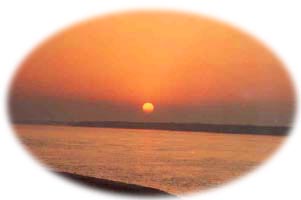
surfaced only towards the end of the day. When the setting Sun become a
bright ball of fire rapidly transforming from fiery orange to a dull
red
as it sped towards the horizon, chased by a flaming tower reflected on
the water. The river too appeared
to
mellow down and the water now glided in a silvery
sheen, swaying in gentle rhythms, each swell mirroring the azure and
scarlet
hues of the afternoon sky.
After the sunset, the river acquired a
placid
glasslike property and in every direction
the distant horizons seemed
to
be separating two mirrors. Each
reflecting
a strip of hazy purple followed by a band of pink dissolving
into a shade of bluish-grey.
The first night was spent near the
"Naranarayan
Setu" at Jogighopa. The bright glare of
the
bridge's Sodium vapour lamps and the passing trucks eliminated all
novelty
of sleeping on the boat and sparing the lapping waves, it felt more
like
a Mumabi footpath.
We set sail early the next morning and
within
an hour were crossing the Surya Pahar range of the south-bank. A
series of low hills which nestle in its folds, some of the oldest
traces
of civilisation in Assam. Extensive ruins and rock sculptures of
the Hindu, Buddhist and Jain traditions. Shimmering
above the northern horizon were the outlines of snowy Himalayan
peaks.
As we continued east, the human
presence
on the river radically decreased. There
were
fewer fishing boats and hardly any habitation on its sides. The
only
objects not lacking in men were the occasional motorised countryboats
functioning
like buses on that stretch. Overloaded to such an extent that one
can't help wonder which law of Physics kept them afloat.
Yellow-white sand dunes covered both the
banks
and the "chars" and the rivers appeared to be passing through a
desert, with the dancing heat waves supplementing the mid-day glare.
With no
landmarks
or villages on the river edge, one could only guess the boat's
whereabouts. Besides distances on the river, I found out were
measured
by the number of days it took from one major Ghat (warf) to
another.
The second nightly stopover, somewhere
in the
Barpeta district, compensated for the first. The absense of any sound
caused
a loud ringing in the ears, especially after being subjected to the
TATA's
tumult for two continuos days. The sky lit up with a million specs of
light,
while sporadic meteors criss-crossed the heavens.
Fog on the river is invariably
accompanied by
an eerie stillness, both descending without any notice. Suddenly
visibility
lowers, everything turns grey and the temperature plummets. The Sun
becomes
a ubiquitous luminescence, while the water turns dark, stagnant and
lifeless,
the boats engine a muffed thud. It was on the third morning
before
reaching Guwahati that we hit a fog bank. The worst part of the
trip,
it took three hours to break free from its clammy cold grasp.
Guwahati's diesel and vehicular fumes
could be
smelled when we were still 20 km
away.
Before long the Saraighat Bridge loomed in the horizon and soon the
boat
was passing below the Nilachal hill, the abode of the mother
goddess
Kamakhya, heading towards the islands of Karmanxa, Urvasi and
Umananda. The latter two containing remnants of ancient temples, the
one
at Ummananda, a living shrine while Urvasi with its plethora of rock
carvings
and sculptures goes under water for half a year.
At the end of the 400-km journey, I had
to admit
that my primary objective of undertaking the trip had not been met. As
sparing the outlines of the Goalpara hills and the Guwahati shrines, I
had failed to discover any ancient landmark mentioned in the 9th
century
Tantric opus. Nothing prepared me for the vastness of the riverine
system
and seeing the futility of the task, I simply forgot all about it.
Enthralled by its natural splendour, I
could
only perceive that even in the days of the Kalika Purana, the
Brahmaputra
was more than a mere waterway or a mythical entity. It was the
timelessness,
which it evokes that must have constituted the essence of the Kalika
Purana's
pilgrimage.
© Ravi J.Deka 2000
|