Heritage
Motorcycling
Travels
Alien
Words
Window
Links
Contact
Home
The village was
suddenly abandoned
and shifted downstream..
the
Gorsam
Stupa
.a
section of Bhutanese Buddhists belive that Assam is where Buddha died..
A Search In Hajo
For the dwellers of
Ancient India,
both Assam and the Brahmaputra denoted fear and divinity..
The river of faith
Bull, bull and more
bulls, but
would someone clarify..
Nandis of
Assam
|
|
The Grotesque
Lion Man
The widely contrasting philosophical
tenets in
Hinduism had always been a subject of perplexity, to both its own
practitioners
as well as the followers of other creeds. A situation further
intensified
by an iconography delineating a host of strange, fierce and often gory
divine forms, rivalling only only of Tibet.
From simple multi-handed forms, to those
with
animal bodies and faces, the Tantric stream of Hinduism takes the cake
with deities that sit on corpses, wear skull garlands, drink blood and
armed with choppers, axes and spears.
Oblivious to the metaphors involved, all so
often
people especially of the Judeo Christian fold find the Hindu gods and
goddesses
demonesque, the religion wild and pagan.
Today, as Hinduism has transcended the
borders
of the subcontinent and reached the west, people there are more
accustomed
to the strange attributes of the religion. However, most still can't
help
expressing a shudder upon seeing a frightening image of Chinamasta Kali
(headless Kali), more so when they hear the associated myths and
philosophy.
Traditionally a pocket of Hinduism, the
length
and breath of Assam in north-eastern India, is covered with ancient
shrines,
rock sculptures and carvings of different Hindu deities. And a section
of these are from the scary realm of Tantric imagery. The male
figurines
being mostly deviations of the Bhairava Shiva theme, the female icons,
usually representations of forms of Kali like Chamunda, Tara and
Maheshamardini
Durga.
As fearful as they may appear, this
multitude
of skull donning and machete totting pantheon of Tantric gods are still
a far cry from fiercest divinity of Assam. Not even a member of their
fold,
this unlikely deity pertains to Vaishnavism.
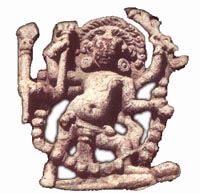
A gargoyle's face with bulging eyes and
fangs,
two hands ripping a child's belly, the other two lifting out the
entrails;
it is the icon of NaraSimha the man-lion avatar of Vishnu which is by
far
the most grotesque image of the land.
The fourth avatar of Vishnu, half man
and half
lion, the god had supposedly taken this form to kill the demon
Hiranyakashipu,
for the insolence of not worshipping him, whereas his son Prahlad
did.
Ancient rock sculptures and carvings of the
lion-man
deity are relatively common here, and next to the stanka (standing) and
asana (sitting) murtis (statues) of Vishnu, comprises the most widely
found
sculptured image of the Vaishnav tradition. Found both as individual
statues
and rock carvings, as well as in temple panels, the figure of NaraSimha
is portrayed in widely disparate forms. At times their only common
feature
is the cradled childlike figure, which is to be assumed to be that of
Hiranyakashipu.
Most Hindus are familiar with the
"Vishnu" and
the "Vayu Purana's" story of how the demon king Hiranyakashipu,
received
a boon from Brahma gaining immunity from any man or beast, day and
night,
both indoors and outdoors. So Vishnu turns into half-man and half-lion,
breaks out of a pillar one evening and rips apart the heretical
demon.
According to the legend, Hiranyakashipu's
supreme
faults were his vanity, and Shaivism his sublime imperfection.
Moreover,
he used met out all sorts of unspeakable punishments on his son
Prahlad,
a staunch devotee of Vishnu, who every time walk away unscathed.
The texts offer a very conflicting view of
the
father-son relationship, as they alternately mention that
Hiranyakashipu
both loved and hated Prahlad.
Though both the Puranas provide vivid
descriptions
of all the ordeals Prahlad was forced to undergo, they paradoxically
extend
only a very sketchy report about the actual NaraSimha episode. It is in
fact the Bhagavat, which narrates this episode in all of its
glory.
Needless to say, the tale contains strong
undercurrents
of sectarian rivalry, and was probably the Vaishnav way of telling the
Shaivaite "our god is superior".
A fair deal of imagination is required
on the
part of the beholder to identify the NaraSimha statues of Assam.
Firstly,
their faces hardly resemble anything even close to that of a lion's,
which
is quite explicable as the nearest live over three thousand kilometres
away in Gujarat. Secondly, the form of Hiranyakashipu which was
supposed
to be ugly and huge as any self-respecting Asura ought to be, had been
reduced to the size of a small child. Not merely in dimensions but in
figure
as well.
Initially the object of this reduction was
probably
adopted to project NaraSimha as the larger and mightier entity, and
later
became a stylistic norm.
Again NaraSimha was supposed to have caught
hold
of the demon, sat down, placed him on his lap and then continued with
the
stomach ripping business. But only a few statues depicted the Lion-man
deity in the original sitting pose, most are delineated standing,
others
in out of the world yogic stances (possible only by divinities).
Images of NaraSimha cut in rock can be
seen with
the other nine avatars on the walls of shrines like Haya-Griva Madhav
in
Hajo, Ashwakranta in N.Guwahati, the Urvasi Island in the Brahmaputra
at
Guwahati and in the various Tezpur sites. The first two are late
medieval
carvings, while the latter ones belong to much earlier traditions.
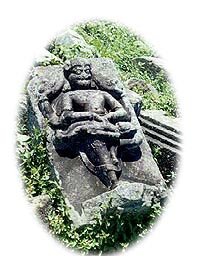
The sizeable NaraSimha statue of the Bamuni
hills
near Tezpur, is one of the best examples of sculptures of such
kind
in this region. Bearing influences of the Orissa School of sculpturing,
the image is carved out of granite and is about 4 ft. tall and 2 ft.
wide.
A much smaller image of the deity can also be seen carved on the
remains
of a giant door sill lying nearby.
Similar statues of the man-lion deity
dating
to early medieval periods have been found in many places of the state
and
a number of them are now displayed in the State Museum of Assam.
In Guwahati, a number of singular rock
carvings
of NaraSimha are scattered all over the Nilachal hill, the abode of the
mother goddess Kamakhya, which is in fact quite strange given the
Shaktic
nature of the area.
Two such images are also located right next
to
the old pump house in the Uzanbazar area of the city. Cut out of a huge
bolder on the bank of the Brahmaputra, the larger one is carved
independently,
while the smaller figure has the images of Durga and Ganesha
alongside.
This is a very interesting aspect of the
NaraSimha
statues in Assam, as sparing the inset images of the Dasa Avatars in
temple
bodies, many of these are found in the company of deities of rival
sects.
This leads to the most perplexing
point
about the incidence of these statues. Firstly the documented history of
Assam does not mention any specific cult of NaraSimha and nor do any of
the ancient religious texts offering an overview of region, speak of
the
deity with any special regard.
In short, there are simply no reasons
why
only NaraSimha and not any of the other nine avatars were portrayed
individually.
One possibility could be rooted in the
fact,
that NaraSimha is a violent deity, possibly the fiercest in the
Vaishnav
pantheon. With the identity of Parsurama having strong casteist
overtones
(Brahmins stronger then Kshatriyas) and Sri.Krishna being a relatively
new import (4-6th CE) into the stream, more so in Assam (16th CE) it
was
probably only NaraSimha which could appease the people attuned to the
militant
spirituality of Shaktism.
It might be also be for this reason, the
deity
is often found alongside other violent or Ugra (angry) deities
like
Durga. Could it have been competition, or was it potential
comradeship?
Whatever was the motive of the people
who commissioned
and carved these statues, one thing is for sure; faithfully to the
parable
about Hiranyakashipu, the NaraSimha images of Assam have proved
superior
to the Shaivaite ones at least in one respect. "They are a whole lot
scarier!!"
© Ravi J.Deka 2000
|