Heritage
Motorcycling
Travels
Alien
Words
Window
Links
Contact
Home
The village was
suddenly abandoned
and shifted downstream..
the
Gorsam
Stupa
the scariest
Hindu deity
in Assam is not Kali or
Bhairav Shiva ...
Grotesque
Lion Man
For the dwellers of
Ancient India,
both Assam and the Brahmaputra denoted fear and divinity..
The river of faith
Bull, bull and more
bulls, but
would someone clarify..
Nandis of
Assam
|
|
A
SEARCH
FOR
BUDDHA
The town of Hajo lies on the north bank of
the river
Brahmaputra, 24 Km away from Guwahati, the capital of the North-eastern
state of Assam in India. A sleepy place doted with a number of ancient
temples, brass and bell metal works, and Nam-ghars the traditional
Assamese
community prayer houses, it distinguishes itself, by being a rare
pilgrimage
center for three religions, Hindus, Buddhists, and the
Muslims.
While the latter visit the shrine of Pua Macca, which was
established
by the Sufi Saint Pir Gyasudin Aulia , and is supposed have 1/4
sanctity
of Mecca, the Hindus and the Buddhists share their most sacred shrine
in
that area, the Haya-Griva Madhav temple.
Equally revered by both the religions,
the temple
is located on a slight hillock called Manikuta and can be reached only
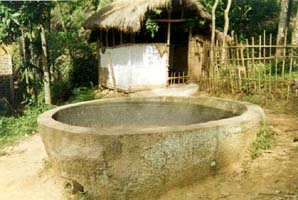
by climbing a lengthy flight of stone steps. Below is a large pond
called
Apurnabha, which has a number of huge tortoises, and anyone bathing
there
is supposed to be freed from the cycle of re-birth. The Haya-Griva
Madhav
temple, has a very curious legacy, and the legends attributed to it are
as controversial as those of the identity of it's deity, as in both the
religions, they are absolutely different entities.
The Hindu tradition as per
the Kalika
Purana (9-11th century CE), asserts that the God Haya-Griva
which means "Horse-necked" in Sanskrit, is a lesser known form of God
Vishnu,
who took this form to kill the Fever demon Jvarasura on the
Manikuta
hill. After the fight, a feverish Vishnu took a bath and hence
the
Apurnabha tank was formed.
The Haya-Griva form, however suffers
from
an identity crises, as the Kalika Purana on two other
instances
calls the deity a demon. On one page it says that the
Jagatpathi
( lord of the world- it's not clear whether it denotes Shiva or Vishnu
) destroyed the demon Haya-Griva in Viswanatha, while on
another,
that Haya-Griva was the demon guard of the eastern gate of the mythical
King Narakasur's kingdom.
Yogini Tantra (another
mediavel Tantric
text pertaining mostly to Eastern India ), on the other hand, offers no
accounts about this form of Vishnu, but claims that the statue in
the temple, is made from the same piece of wood as the statue of
Jaganath
of Puri in the state of Orrisa. The tale is evidently of recent
synthesis,
dating not earlier then the post medieval period, and was probably
aimed
at legitimising the Vaishnav presence in the shrine. Besides, the
statues
inside are made of stone.
While it is difficult to ascertain the
identity
of Haya-Griva in Hinduism, a deity of the same name and similiar
description,
occupies a high tutelary rank in the Tibetan Buddhist Tantric pantheon.
Known in Tibetan as rTa-mgrin Tam-Din , the deity was
originally,
one of the demon deities of the Bon-po religion which proliferated in
greater
Tibet ( including the territory of modern Ladakh, Sikkim and Bhutan ),
before the advent of Buddhism.
PadmaSambhava , the Indian Tantric adept
who
brought Buddhism to Tibet was supposed to have subdued him and
converted
him into a Dharmapala, or the protector of the Dharma. Considered to be
the protector of horses and horsemen, he is supposed to equal Buddha
himself
, when he takes the form of Yi-dam
The thousand of Tibetans and Bhutanese
pilgrims
who come on a pilgrimage to this temple every winter, however don't
come
here to worship Haya-Griva Tam-din. For them Hajo is the sacred
ground,
where Buddha attained Maha Parinirvana was cremated. They believe
that the Haya-Griva Madhava temple which they call
rTsa-mchg-gron
( Tsam-cho-dun ) is a Samadhi (Chortem) of Buddha, while the Neta
Dhubunir Pat Sil, a rocky area a few kilometers away, is
considered
to be the " Sil-wa tsal-gi tur do " or " the pyre of the cool grove",
the
place where he died and was cremated. The incidence of a very old
Tibetan
inscription carved out on a rock, saying "Om Mani Padme Hum", near the
place, along with a strange shaped rock called the Maha Muni's butter
ball,
which supposedly had slipped out of his hand when he died, together
illucidate
a once strong Tibetan Buddhist presence in the area.
So high is the veneration for Hajo among
the Tibetan
Lamas, that they have even collected soil and rocks from
here
and placed them in four places in Tibet, for the benefit of the
pilgrims
who are unable to visit the real place. Two of them exist near
Lhasa,
the third lies near Tashi-linpo, while the fourth in Sel-brag.
The
other Hindu shrines of Hajo, are also included in their
pilgrimage,
and considered to be holy Buddhist sites. The ancient
Kedarnath
temple, a Shaivaite shrine which is located on the shoulder of a steep
hill nearby, and is the only all stone temple to be still
standing
in Assam, also figures prominently in the Buddhist pilgrim's itinerary.
And the lake beside the temple had been dubbed the "Tso-mani bhadra" or
"the lake of the notable jem".
The basis of the strange legend, which
lies behind
this phenomenon has perplexed a number of scholars, as Gautama Buddha
is
recorded to have died in Kushinagar. A place which some believe to
be
in the Gorakhpur district in eastern part of the North Indian
state
of Uttar Pradesh, while others deem it to be situated on the bank of
river
in the neighbouring state of Bihar, near the border of Nepal. There are
also no indications that Buddha ever visited the territory of ancient
Assam,
let alone die here. However the insistence of the Tibetan, Bhutanese,
Ladakhi
and earlier, even the South Chinese Buddhists, that Buddha died in
Hajo,
is being instrumental in giving birth to a number of theories to this
effect,
some of which seem plausible, while others way-out and improbable.
Pioneer Tibetologist Dr. Waddell, the
only academician
to carry out an extensive study of this legend, suggested that an
area near Hajo might be erroneously considered by the Tibetan Lamas as
the actual Kushinagar, and he identified the nearby town of
Sualkuchi
as the cause of this lapse. He tried to correlate the word
with as Buddha is believed to have died in between two Sal trees,
and to Kushinagar. However, the learned scholar was
apparently
unaware, that Sualkuchi was, known a Sial-Kuchi till
the eighteenth century, meaning Jackals and
coming
from the Sanskrit word Konchi , meaning group or gathering.
Moreover the large number of villages in Assam, having the name ,
for example, Patasarkuchi, Sangkuchi, Kahikuchi, etc. make Dr.
Waddell's
theory, somewhat ludicrous.
Another theory, which has gained
prominence,
and has a number of adherent supporters, is that Hajo might be the last
resting place of PadmaSambhava, the Indian Tantric mystic who is
reputed
to have converted the area of Greater Tibet into Buddhism.
PadmaSambhava or Guru Rinpoche Pemajung,
also
known as Guru Ugyan Guru Grgyan , went to Tibet from the province of
Uddiana
in Swat now located in Pakistan, in 747 CE. He was invited by the
Tibetan
King Khri-Srong-Lder-btan (Trishona Dretsen) upon the
suggestion
of Santarakshita , an Indian Buddhist monk, who went there
earlier,
to spread the Buddhist doctrine. The prevalent religion at that time in
Tibet was Bon-po, which was an animistic, demon worshipping Shamanic
faith.
Santarakshita, who was a learned scholar
from
the Nalanda University, was definitely not equipped for the task of
converting
demon worshipers and their clergy, and so summoned PadmaSambhava. Not
much
is known about the activities of PandmaSambhava in Tibet, except that
he
was a miracle maker and a demon fighter and a led a very unconventional
life for a Buddhist adept. He traversed the entire territory of
Tibet,
Sikkim and Bhutan and is credited to have subdued all the demons of the
older religion and established the Law of Buddha in the land.
Most of the records of his deeds are
found in
the "Padma thang-yig" or the Padma scrolls and the
"bKa-thang
sde-inga" or the Fivefold scrolls. But as both the chronicles
were
compiled only in around 1400 CE, one can expect a large amount of
fabrication
and fantasy to have crept into these records, during the six hundred
years
in between his visit, and them being written. Even though
he
is reputed to have stayed in Tibet for fifty years and left only
in 802 CE, PadmaSambhava's stay there was brief, and he had to flee as
he ran into foul weather with the Bon-po priests and their powerful
followers
in the court. The claim of the fifty years stay is also nulified by the
legends of his departure, according to which King Trishona Dretsen
personally escorted him upon his
departure,
but the King himself expired in 786 CE. Nothing definite is known
about PadmaSambhavas subsequent whereabouts.
The popularity of Buddhism grew in
Tibet, and
PadmaSambhava became a legend, as well as one of the supreme
deities
of the land, specially among the Ngnima-pa or the ancient
unreformed
Red hat sect.
He is also considered to be both
an
incarnation of the Sakyamuni (Gutama Buddha) and the Amitabhva Buddha
(Buddha
of the eternal light) himself, as according to the Mahayana and the
Vajrayana
doctrine, different forms of which, are widespread in Tibet, anyone
reaching
complete realisation is considered to have attained Buddhahood, and is
hence known as one.
Coming back to Hajo, a number of factors
seem
to provide for a distinct possibility that PadmaSambhava breathed his
last
here. The theory that he arrived in Assam via Bhutan, is based on
the fact, that at the time of departure from Tibet, he is supposed to
have
said that he was returning to Jambudvip ; one of the
mythological
names denoting India. Records say that he was last seen in
Gungthang-la
, near Mangyul
Northern Tibet, where he was supposed
to
have ascended a rainbow and disappear. The assonance of
Mangyul to Mongol, seems to indicate
that
he was near the border with Mongolia or more likely that of the modern
province of Inner Mongolia in the north eastern part of the country.
Though
a considerable distance, the shortest route from there to the
Indian
plains, is via the age old trade route leading from Assam to Tibet via
eastern Bhutan.
The large number of holy places there,
attributed
to his visit, also confirm his passing through the Himalayan kingdom.
Devanagiri
or Deothang, the easternmost gate of ancient Bhutan and the start of a
mountain pass into Tibet, lies due north of Hajo which stands right on
the way from there to the river Brahmaputra. As the only mode of
travel from this region to the other parts of India, was via the
Brahmaputra,
it is only logical to assume that travelers coming from Bhutan or Tibet
and proceeding via ancient Assam, would have to pass through the
town, on their way to the river.
Secondly, in a mythical statement
attributed to
PadmaSambhava before his departure, he said that he was returning
to
Jambudvip , to the east of which lies Lankapuri . The name
Lankapuri
, means the city of
, is not to be confused with the more
familiar
Lankadvip , which denotes modern Sri Lanka. This prompts the question
if
he was referring to an area in the Nowgaon district of modern Assam,
near
the Jamuna and the Kapili valleys, which was an ancient seat of
civilization,
with the same name, references to which, are found in numerous ancient
texts. The theory however is not without a few pitfalls, and should not
be considered as very credible, for there is a strong possibility that
it might prove itself as baseless as Dr. Waddell's Kushinagar.
Lastly, among the many names, which the
Tibetans
and the Bhutanese call the main idols in the temple, the more prominent
are, Munir Muni Maha Muni, Namo Guru etc. and one of the subsidary
statues
is called Guru Urgyan. The first two names, emphasize the fact, that
the
deity was a teacher and one who had attained Buddhahood, while the
third
name is one of the names of PadmaSambhava.
Searching for physical traces of
Buddhist
or Tibetan influences in the temple and it's near vicinity is a
challenging
task. Nothing is known about the builders of the ancient rock temple
which
stood here earlier, and had broken down. The present temple had
been
rebuilt by the Koch King Ragunarayan Deva in 1583 CE, who as per
the inscription placed in the temple, discovered it lying in
ruins
and covered with a jungle.
Apart from the plinth and certain
sections
of the lower level of the structure, no part of the ancient temple is
now
existing, as a result, it is very difficult to ascertain it's
original
design. An interesting thing about the surviving sections, is that they
bear absolutely no structural resemblance to any other temple of this
region,
and are almost identical to those of the Kailash temple in
Ellora in the state of Maharashtra in western India, thus helping
in dating the construction to approximately 800 CE, a time which
correlates
well to that of PadmaSambhava's eventual death, and in erecting a
Samadhi.
Although the Kalilash temple is a Hindu
shrine,
it's design carries a distinct Buddhist influence, as it was built at a
time and in a place where Buddhism was flourishing. It is quite
possible
that the artisans and masons who were entrusted with the building
of the Haya Griva temple were imported from such Buddhist
pockets.
Hien-Tsang the Chinese Buddhist
pilgrim
who visited India in the middle of the 7th century CE, and came
upto
ancient Assam, left no account of any temple in Hajo, thus in a way
endorsing
the shrine as a post 7th century effort.
It is also impossible to identify the main
idol
inside the temple, as the Hindu priests zealously keep it covered with
a cloth, and the only visible portion, the face, looks like a
mask
resembling the face of the Jaganath idol in Puri. Those who have
seen the idol claim that it is heavily mutiliated and nothing positive
could be identified, apart that it is made from stone.
What also speaks in favour of the idea that
the
temple might have originally belonged to the Buddhists, is that
almost
all the statues of Hindu Gods and the Dasa Avatars ( ten avatars of
Vishnu
), on the walls of the rebuilt temple are very crude and stylistically
discordant with those of the surviving older structure. Besides most of
them are not carved from granite and metamorphic quartzite, the stone
used
in the older section, but from sandstone, and at times brick and
mortar, thus indicating that they are post renovation additions, dating
to the later medieval Koch and the Ahom period. Moreover the
tradition
of carving statues from Sandstone was never very popular in Assam, and
as those found on the temple walls and in the compound are portable in
nature, they must have been brought in from elsewhere.
A number of other unexplained traces of
Buddhism
in the neigbouring areas, which were always a predominantly Hindu belt
are also noticable. Apart from the temples of Hajo, and the
various
remains of the Tibetan Buddhist tradition there, the present Siddheswar
temple in Sualkuchi, which lies nine miles south of Hajo on the bank of
Brahmaputra, contains a diverse collection of statues, a number
of
which are mysteriously of Buddhist origin, and reflecting a strong
Sino-Tibetan
influence.
The total lack of any records about the
advent
of PadmaSambhava's death, as we ll as the construction of the
original
Haya griva temple, leave us to a lot of guesswork and theories.
It
is difficult to ascertain if it was originally a Buddhist shrine, and
if
so how come it was taken over by the Hindus. Was it because Buddha was
embraced into the Hindu pantheon, and designated an incarnation of
Vishnu,
or was it because of a lack of a strong Buddhist power in the
vicinity.
But, what we can believe as the near
truth, is
that an enlightened teacher of the Tibetan Buddhist tradition, left his
mortal body in Hajo, and it is quite likely that his original
followers,
had a hand in building the original Haya-Griva Madhava
temple,
and their descendants, till today are still venerating him.
And as their religious doctrine says, that
anyone
attaining self-realisation, becomes a Buddha, it won't be erroneous of
us, to embrace their belief, that it is the place where Buddha attained
Maha Parinirvana.
© Ravi J. Deka 2000
|