|
Contracture
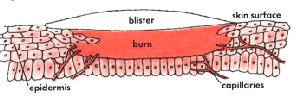
When the wound is deeper, healing elements of the epidermis may have been destroyed and therefore are not available for
epithelialization. In this case, the body closes
the skin defect by drawing on the surrounding skin. This process of pulling the edges of the wound in toward the center of the wound is called contraction. This means that
as the wound heals, it actually shrinks, or becomes smaller. Contraction is a natural process, the body's attempt to close the wound. The contraction process can result in
what is called contractures.
A contracture is loss of normal movement as a result of healing. The skin pulls together in an attempt to heal. 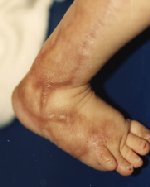 The pulling together causes shrinking or shortening of tissue during wound healing. This shortening of tissue can pull eyes, nose and mouth out of normal position. Contracted tissue can pull surrounding healthy tissue into distorted appearance. The pulling together causes shrinking or shortening of tissue during wound healing. This shortening of tissue can pull eyes, nose and mouth out of normal position. Contracted tissue can pull surrounding healthy tissue into distorted appearance.
Contraction can also cause the formation of tight scar bands across joints which limit their function.
Scar Bands or Cords
When a scar occurs across a joint, such as a knee, elbow or shoulder, the scar can often limit the movement of that joint. This happens because the body responds to the
loss of skin by contracting the wound (making it smaller). 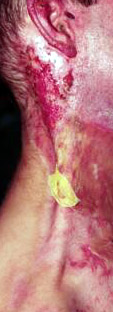 The contraction causes the skin on
both sides of the joint to come together, and the distance across the joint is shortened; a stretch position then results in the appearance of a scar band or cord. As a
result, it may not be possible for the person to completely move the joint as fully as they could before the injury. The contraction causes the skin on
both sides of the joint to come together, and the distance across the joint is shortened; a stretch position then results in the appearance of a scar band or cord. As a
result, it may not be possible for the person to completely move the joint as fully as they could before the injury.
Skin cords or bands are treated with splints that provide a prolonged stretch and total contact to the area of shortened skin (for example transparent neck splint or
axillary airplane splint). The treatment also involves exercises to stretch or elongate the skin and sometimes a surgical procedure such as
Z-plasty or release
(adding more skin). Both a Z-plasty and a release break up the band/cord area.
Formation of Granulation Tissue
As any deep burn wound heals, the smallest blood vessels, called capillaries, grow into the wound and make a network of new blood vessels called granulation tissue.
For many years, people believed that you had to wait for granulation tissue to start to grow before you could perform skin grafts. However, these days doctors know that
they don't have to wait. They can start these procedures earlier, so that people don't have to stay in the hospital as long. It also means there is less chance for
infection and less stress on the patient.
Sensations After A Burn
A sensation is the power or ability to see, hear, smell, taste or touch. The sensation of touch is felt through our skin. Hot, cold, wet, dry, sharp, dull, smooth, rough,
soft, hard and pain are all sensations a person can feel from the skin. If a burn injury damages the nerve ending layer of the skin (the epidermis), the nerves will have to
re-grow. Nerve re-growth is often slow and sensations may be permanently changed.
Sweating (Perspiration) After A Burn
Heat is created in the body by muscle action and by burning food for energy. If the body is getting cold, the muscles automatically contract (shrink) rapidly to create more
heat. When the body does this we shiver. When it is hot, the body must cool itself or it will overheat. To do this, the blood vessels at the skin surface dilate (enlarge)
and we sweat, or perspire.
In skin that has healed after a burn, both the sweat glands and the surface blood vessels have been damaged. The blood vessels are surrounded by scar tissue and cannot
expand or contract properly. Sweat glands cannot make moisture on the skin surface as they did before the injury. Because of the changes in sweat glands, itching and
abnormal sweating are often a problem as burns finish healing and after they become mature. Dressing in clothing that breathes (cotton) and shields from the sun can help
the body stay cool in hot temperatures. When the weather is very cold, warm clothing is necessary to help protect damaged skin.
|