THE KHYBER PASS more
information
The prime attraction in this region is the
Khyber Pass, situated in the Sulaimans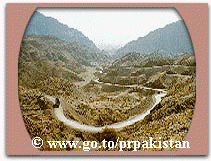 Hills which form the western
barrier of Pakistan. Tourists need a permit and an armed escort from the
Political Agent in Stadium Road to visit the Khyber Pass. Residents in Pakistan
get their Khyber permits from the Home Secretary at the Civil Secretariat. The
permits are free and delivered immediately. The hills dip down here, leaving a
passage sometimes as broad as 1½ km. (1 mile) and sometimes as narrow as 16
metres (52 feet). The pass begins near Jamrud Fort 18 km. (11
miles) from Peshawar and extends beyond the Afghan border of Pakistan at Torkham
58 km. (36 miIes) away. The road runs west
Hills which form the western
barrier of Pakistan. Tourists need a permit and an armed escort from the
Political Agent in Stadium Road to visit the Khyber Pass. Residents in Pakistan
get their Khyber permits from the Home Secretary at the Civil Secretariat. The
permits are free and delivered immediately. The hills dip down here, leaving a
passage sometimes as broad as 1½ km. (1 mile) and sometimes as narrow as 16
metres (52 feet). The pass begins near Jamrud Fort 18 km. (11
miles) from Peshawar and extends beyond the Afghan border of Pakistan at Torkham
58 km. (36 miIes) away. The road runs west
from the cantonment and through University
Town, Hyattabad and Karkhanai Bazaar, before and after which the fields on
either side of the road are covered with refugee camps. After the camps are the
compounds of Pathan tribesmen, their high mud walls furnished with turrets and
gunslits, their entrances guarded by huge corrugated-iron gates.
Jamrud Fort,
18 kilometres (11, miles) from Peshawar and at the mouth of the Khyber Pass, is
as far as you can go without a permit. The fort, coarsely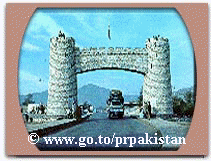 constructed of stone daubed with
mud plaster, was built by the Sikhs in 1823 on the site of an earlier fort. The
famous Sikh general Hari Singh died and is buried here. The modern stone arch
spanning the road dates from 1964. There is also an arch, the Bab-i-Khyber
(gateway to the Khyber) which dates from 1964. There is a viewing platform for
visiting dignitaries and information about the pass on a nearby wall.
constructed of stone daubed with
mud plaster, was built by the Sikhs in 1823 on the site of an earlier fort. The
famous Sikh general Hari Singh died and is buried here. The modern stone arch
spanning the road dates from 1964. There is also an arch, the Bab-i-Khyber
(gateway to the Khyber) which dates from 1964. There is a viewing platform for
visiting dignitaries and information about the pass on a nearby wall.
Sphola 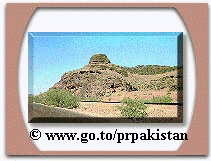 Stupa, a Buddhist
ruin dating from the second to the fifth
centuries AD, stands to the right of the road and above the railway at the
village of Zarai, 25 kilometres (I6 miles) from Jamrud. The stupa has a high
hemispherical dome resting on a three-tiered square base. Some beautiful
Gandharan sculptures were found here when the site was excavated at the
beginning of this century. Some of the finds are now in the Peshawar Museum.
Stupa, a Buddhist
ruin dating from the second to the fifth
centuries AD, stands to the right of the road and above the railway at the
village of Zarai, 25 kilometres (I6 miles) from Jamrud. The stupa has a high
hemispherical dome resting on a three-tiered square base. Some beautiful
Gandharan sculptures were found here when the site was excavated at the
beginning of this century. Some of the finds are now in the Peshawar Museum.
The side of the stupa facing the road has been
restored. Landi Kotal, at the end of the railway and eight
kilometres (five miles) from the border, is still a smugglers' town. There is a
Central Asian caravanserai and a fort garrisoned by the Khyber Rifles. But the
most exciting aspect of the town is the bazaars. All kinds of imported goods are
available. One shop sells only clothing with the St. Michael (Marks and
Spencer's) brandname. There are all kinds of electrical goods, china and
glassware, secondhand cars and parts of cars. The best known of all are the
drugs and gun shops. Imports have continued unimpeded by the war in Afghanistan,
for the tribesmen are businessmen and "business is business'.
Darra Adam Khel
is 42 km. (26 miles) south of Peshawar and leads on to Kohat.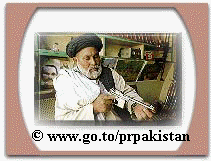 Darra is the biggest centre of
indigenous arms manufacture of the Tribal Areas. It has been supplying arms to
the whole tribal belt for the last 100 years. In Darra village, its real name is
Zarghun Khel, almost every house is a gun factory, fabricating
astonishing copies of all imported guns and pistols with the crudest of tools.
Buses and taxis ply to Darra. The visit to Darra is subject to permission by the
Secretary, Home Govt. of N.W.F.P. The permit is free and issued while you wait,
but you should get it the day before you plan your factory visit.
Darra is the biggest centre of
indigenous arms manufacture of the Tribal Areas. It has been supplying arms to
the whole tribal belt for the last 100 years. In Darra village, its real name is
Zarghun Khel, almost every house is a gun factory, fabricating
astonishing copies of all imported guns and pistols with the crudest of tools.
Buses and taxis ply to Darra. The visit to Darra is subject to permission by the
Secretary, Home Govt. of N.W.F.P. The permit is free and issued while you wait,
but you should get it the day before you plan your factory visit.
The Darra arms 'factory' fired up in 1897. In
return for turning a blind eye to this illegal Pathan enterprise, the British
were guaranteed safe passage along the main roads. In any case, the British
believed it better that the Pathans have inferior weapons of their own making
than stolen British-made guns.
Darra's main street is lined on either side
with small forges at which guns are made by hand. The tools are astonishingly
primitive, yet the forges turn out accurate reproductions of every conceivable
sort of weapon, from pen pistols and hand-grenades to automatic rifles and
anti-aircraft guns. The copies are so painstakingly reproduced that even the
serial number of' the original is carried over. Much of the craftsmanship is
very fine, but the materials are sometimes wanting: gun barrels are often made
from steel reinforcing rods diverted from the building trade. The main street
constantly erupts with the roar of gunfire, as tribesmen step out to test
prospective purchases.

Islam,
Pakistan
Trips
from Peshawar: The Khyber Pass, Gandhara,
Swat
Profile,
History, Hotels, Education,
Old Peshawar, New
Peshawar, Map
Pashto
Dictionary: A, B,
D, E, F, G,
H, I, K, L,
M, N, O,
P, Q, R, S, T,
U, W, Y, Z
Web
master
Copyright
© prpakistan. All rights reserved.