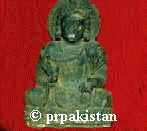
GANDHARA
Gandhara Art
Charsadda, the site of Pushkalavati, is 28 kilometers northeast of Peshawar. Pushkalavati was the capital of the ancient kingdom of Gandhara from about the 6th century B.C to the 2nd century of A.D.
Today, there is nothing to see except a huge mound about 800 meters to the left of the Charssadda called Bala Hisar. This mound has been excavated thrice, and according to Sir Mortimer Wheeler, here lay the great fort which was invaded by Alexander's generals in the 4th century B.C.
The one at Pushkalavati, a great archaeological site, Shaikhan Dheri, a kilometer northeast of the Bala Hisar. From the top of Bala Hisar mound it is visible across the river; only dedicated archaelogists gain much by going to take a closer look. It is a place to which the habitation had shifted in the lst century B.C. Remains of a Greek town have been excavated here.Charsadda is surrounded by hundreds of hectares of graves, all decorated with black and white stones in geometric pattern.
Takht-i-Bahi
 Some 801/2 km. (50 miles) from
Peshawar, and 16 km (10 miles) north-east of Mardan town, is Takht-e-Bahi , the
ruins of an ancient Buddhist monastery situated on the top of a 52 metres (500
feet) high hill. The last 3 1/4 km (2 miles) have to be walked uphill unless a
jeep is at hand. The difficult approach has helped the preservation of the
monument. The site consists of a large rectangular court, on the north of which
is the main monastery and to the south is a well-planned monastic shrine on a
high terrace. The main structure dates back to the 2nd-5th
centuries A.D.
Some 801/2 km. (50 miles) from
Peshawar, and 16 km (10 miles) north-east of Mardan town, is Takht-e-Bahi , the
ruins of an ancient Buddhist monastery situated on the top of a 52 metres (500
feet) high hill. The last 3 1/4 km (2 miles) have to be walked uphill unless a
jeep is at hand. The difficult approach has helped the preservation of the
monument. The site consists of a large rectangular court, on the north of which
is the main monastery and to the south is a well-planned monastic shrine on a
high terrace. The main structure dates back to the 2nd-5th
centuries A.D.
The monastery, on the north, was probably a double storey structure consisting of an open court ringed with cells, with kitchens and a refectory attached. On the west there is a double row of subterranean meditation cells.
Shahbaz Garhi
Shahbaz Garhi76 km (47 miles) from Peshawar, on the ancient route, which runs north to the Kabul River, lie the ruins of another Buddhist monastery at Chanaka Dheri near Shahbaz Garhi. These consist of a rectangular tank, the foundations of a circular stupa, and the main complex consisting of two rows of three stupas each, plus a row of monastic cells on the side of the tank and royal stone-carved edicts of the great Mauryan King Asoka (2nd century B.C). It was one of the most important cities of Gandhara.

Trips from Peshawar: The Khyber Pass, Gandhara, Swat
Profile, History, Hotels, Education, Old Peshawar, New Peshawar, Map
Pashto Dictionary: A, B, D, E, F, G, H, I, K, L, M, N, O, P, Q, R, S, T, U, W, Y, Z
Copyright © prpakistan. All rights reserved.