 rooms for travellers. The site has
been considered holy for nearly 2,000 years. In the second century AD, it was a
Buddhist shrine and monastery known as the Tower of Buddha's Bowl. With the
decline of Buddhism, it became a Hindu shrine,
rooms for travellers. The site has
been considered holy for nearly 2,000 years. In the second century AD, it was a
Buddhist shrine and monastery known as the Tower of Buddha's Bowl. With the
decline of Buddhism, it became a Hindu shrine,Gor Khatri
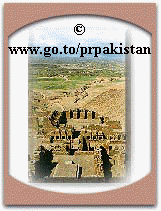
The Mughal gateway of a caravanserai known as Gor Khatri" (Worriors grave) at the top end of Sethi Street.
A huge Mughal gateway leads into a
courtyard over 200 metres (650 feet) square, which was once surrounded on all
four sides by rooms for travellers. The site has
been considered holy for nearly 2,000 years. In the second century AD, it was a
Buddhist shrine and monastery known as the Tower of Buddha's Bowl. With the
decline of Buddhism, it became a Hindu shrine,
This was built by Shah Jahans Daughter. During the Mughal era, it was common practice throughout the empire for local notables to construct safe places where wealthy merchants could stay. The merchant and their retinues lodged in the lock-up rooms surroundings the central courtyard of the caravanserai, normally paying a charge for the privilege. The gates were locked from sunset to sunrise and the walls manned day and night by armed guard, so that merchant could rest secure in the knowledge that their goods were safe from robbers.
The Sikhs knocked down the mosque during their 19th-century rule, built by ShahJahans daughter and replaced it with a temple to Gorakhnath, a sikh deity. This still stands in the south eastern comer of the courtyard, with a shrine to Nandi beside it. The Sikhs closed the caravanserai and installed their governor in the compound.
Gor Khatri has been an important place for travellers for thousands of years. But now, Gor Khatri is used as government offices and also houses police and fire stations.

Trips from Peshawar: The Khyber Pass, Gandhara, Swat
Profile, History, Hotels, Education, Old Peshawar, New Peshawar, Map
Pashto Dictionary: A, B, D, E, F, G, H, I, K, L, M, N, O, P, Q, R, S, T, U, W, Y, Z
Copyright © prpakistan. All rights reserved.