
|
|
| Biographies |
|
|
|
|
|
|
|
|
|
|
|
|
|
|
|
|
|
|
|
|
|
|
|
|
|
|
|
|
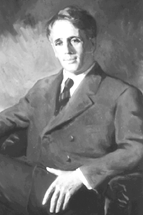
Robert Frost was born in San Francisco, California, on March 26th, 1874.
In 1885, after the death of his father, his family moved to New England.
Although he briefly attended Dartmouth and Harvard colleges, he did not
earn a degree. During the 1860s, he was a farmer, editor, and schoolteacher.
In 1912, he briefly moved to England, where his poetry was well accepted.
Here, he published his first book of poetry titled A Boy's Will in 1913.
Frost's final collection of poetry was named In the Clearing, and was
published in 1962. He died in 1963, at the age of 89.
|
Frost's poems can be identified with New England, in particular with Vermont and New Hampshire. His poetry is often noted for it's plain language, conventional poetic forms, and graceful style. He was greatly influenced by the classical poets. Many of Frost's early poems are as richly developed as his later poems. Frost often places people and nature side by side, and to some it appears as if he was writing romantic poetry. There is, however, a large difference between the old romantic poetry and Frost's poetry. The Romanic poets believed that people could live in harmony with nature. Frost, on the other hand, felt that nature's meaning could never be known because the purpose of nature and people are never the same. He felt that looking for nature's secrets was foolish, and that the only way serenity could be met was by working usefully and productively. |
 |
Throughout his lifetime, Frost was recognized often for his outstanding poetry. He won the Pulitzer Prize for poetry in 1924, 1931, 1937, and 1943. In 1960, the Congress of the United States voted Frost a gold metal in recognition of his poetry. In January 1961, Frost's public career reached a climax when he recited his poem "The Gift Outright" at the inauguration of President John F. Kennedy.
The following poem, "The Gift Outright" was the poem that Frost recited at the inauguration ceremony of President John F. Kennedy, at Kennedy's request.
The Gift Outright
The land was ours before we were the land's.
She was our land more than a hundred years
Before we were her people. She was ours
In Massachusetts, in Virginia,
But we were England's, still colonials,
Possessing what we now no more possessed.
Something we were withholding made us weak
Until we found it was ourselves
We were withholding from our land of living,
And forthwith found salvation in surrender.
Such as we were we gave ourselves outright
(The deed of gift was many deeds of war)
To the land vaguely realizing westward,
But still unstoried, artless, unenhanced,
Such as she was, such as she would become.
Home | Biographies | Links | Poety Aspects | Student Work | Poem Ideas