
|
|
| Biographies |
|
|
|
|
|
|
|
|
|
|
|
|
|
|
|
|
|
|
|
|
|
|
|
|
|
|
|
|
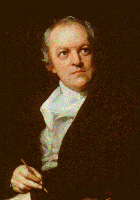
William Blake was a poet born in 1757 in London, England. While spending
most of his life there, Blake took to the profession of illustrating books
and engraving, then later taking on poetry and painting.
|
Throughout his life, Blake claimed to be seeing visions often, ever since his childhood. Many of his poems he called visions or prophecies. Blake believed that we suffer from war, injustice, and unhappiness because our way of life is based on mistaken and misguided beliefs. He felt that we cannot rely on our five senses, yet we concern ourselves with scientific truths and materialistic values that are created from those very senses. Blake also felt that we cannot understand reality beyond the material or gain full control of ourselves until we trust our instincts, energies, and imaginations. To him, this was the basis of all religious, social, and personal truths. Blake died in 1827. |
 |
One of Blake's most famous poems is the following poem known as 'The Tiger'. This poem came from one of his works known as 'Songs of Experience' (1794). According to an observation made by William Harmon, editor of 'The top 500 Poems', "[The poem's] powerful rhythm seems pounded out of an instrument of percussion, something that beats like a heart or a hammer, both of which are named in the poem. The mighty beast is the whole world of experience outside ourselves, a world of igneous creation and destruction. Faced with such terrifying beauty, the poet can only ask; the poem is nothing but one wondering question after another."
The Tiger
Tiger, Tiger, burning bright
In the forests of the night;
What immortal hand or eye,
Could frame thy fearful symmetry?
In what distant deeps or skies
Burnt the fire of thine eyes!
On what wings dare he aspire?
What the hand, dare seize the fire?
And what shoulder, & what art,
Could twist the sinews of thy heart?
And when they heart began to beat,
What dreaded hand? & what dreaded feet?
What the hammer? What the chain?
In what furnace was thy brain?
What the anvil? What dread grasp
Dare its deadly terrors clasp?
When the starts threw down their spears
And water'd heaven with their tears:
Did he smile his work to see?
Did he who made the Lamb make thee?
Tiger, Tiger, burning bright,
In the forests of the night:
What immortal hand or eye,
Dare frame thy fearful symmetry?
Home | Biographies | Links | Poety Aspects | Student Work | Poem Ideas