14 Dis 07
Opisyal na lingguhang
pahayagan ng mga
mag-aaral ng Unibersidad
ng Pilipinas - Diliman
Search
 
Philippine Collegian

Issue 19 in PDF

   
Adobe Reader is required to access the file. If you don’t have this application, you may download it here.
 
On its 85th year, the Philippine Collegian looks back at eight decades of headlines that saw print on its pages & sent ripples within and outside the university.
 
10 Dec 1982
Sudden action sparks
speculation over trigger
WE Forum
printshop
raided by
military
Military authorities
raided the offices and printshop of We Forum and Malaya last Tuesday and arrested the publisher, Jose Burgos Jr., and 14 staffers and columnists for alleged subversive activities and conspiracy against the government.


Last week
 
Editoryal
Revolutions on a whim
Balita
Suspek sa pagpaslang kay Mendez, kakasuhan na

PL groups seek probe of C5 extension

CAL council, pub decry relocation

Solons file bills vs oil price hikes

Militant groups seek junking of JPEPA

Anti-TFI student pubs face repression

Theft tops UPD crime stats

Kultura
Sining Gerilya:sining ng pakikibaka ni Parts Bagani
The Doghouse Crumbles
Lathalain
Batas ng Armas: pagsipat sa tunguhin ng ugnayang US-Pakistan

Wasteland

Grapiks
Komiks : Tsupeyups

Sipat : Another Year Coming

Opinyon
A(d)VERTisements

Kina Sir Nic at Rene

s
Return to Sender

We don’t despair

 
Home
 
About
 
Downloads
 
Contact
 
Links


Gimik sa Aurora:
Kalbaryo ng Bagong Magdalena

Ma. Rosa Cer M. dela Cruz
Philippine Collegian
Last updated December 11th, 2007

Madilim ang kahabaan ng Aurora Boulevard. Sa likod ng nagliliwanag na Araneta Center matatagpuan ang mga gusali ng lumang mga sinehan at ilang motel. Tanging malamlam na ilaw lamang mula sa mga poste ng Meralco ang nagsisilbing tanglaw ng lugar.

Marami pa ring mga babaeng nakatambay sa tapat ng mga gusali. May mga lalaking lumalapit panaka-naka at pasimpleng bubulong ng, “Miss, gumigimik ka ba?” Hindi magtatagal at aalis itong kasama ang isa sa mga babae. Hindi bago ang eksenang ito rito. Kilala ang Aurora bilang tambayan ng mga “gumigimik,” o mga babaeng bayaran.

Sa kasalukuyan, may humigit-kumulang 50 babaeng regular na nakapwesto sa Aurora. Matatagpuan sila sa tapat ng mga bangko, tindahan at sinehan. Kabilang sa kanila si Angie*, isang dalagang ina.

Kapit sa patalim
Dating saleslady si Angie sa Rustan’s Mall sa Araneta Center. Unang taon sa kolehiyo lamang ang kanyang inabot at napilitan siyang huminto dahil sa kakapusan ng salapi.

Nagsimulang gumimik si Angie sa edad na 23 upang ipagamot ang hika ng anak na mag-isa niyang itinataguyod. Katwiran niya, hindi sapat ang kinikita niya sa Rustan’s upang maipagamot ang anak. “Anim na buwan ang gamutan. Isang linggo pa lang, P1,500 na ang gastusin. Saan ko pupulutin iyon?” aniya.

Ayon kay Joan Salvador, National Secretary-General ng GABRIELA, kahirapan ang pangunahing dahilan ng mga kababaihang pumapasok sa pagpuputa. May ilang naloloko ng mga recruiter at bugaw dahil sa kawalan ng sapat na edukasyon, habang mayroon ding walang ibang trabahong mapasukan kaya nauuwi sa nasabing trabaho.

Noong 1998, tinatayang may 100,000 hanggang 600,000 babaeng prostituted sa Pilipinas. Bagaman walang opisyal na datos, dumami pang lalo ang bilang na ito sa kasalukuyan. “Dahil palala nang palala ang kahirapan ng mamamayan, hindi mahirap buuin ang konklusyon na dumarami rin ang bilang ng prostituted women. Dumarami ang bars at clubs na kilala o hinihinuhang fronts ng prostitution,” dagdag pa ni Salvador.

Hubad na kasaysayan
Subalit hindi lamang sa kasalukuyan nagsimula ang suliranin ng prostitusyon. Ayon sa Center for Women’s Resources (CWR), noon pa mang panahon ng Kastila, laganap na sa Pilipinas ang prostitusyon, bagaman itinuring itong maselang isyu sa lipunan. Ang mga Kastila ang nagbansag na “puta” sa mga babaeng prostituted.

Noon namang panahon ng mga Amerikano, ang mga lugar sa palibot ng mga itinayong base militar ang nagsilbing mga unang kilalang pugad ng prostitusyon, lalo na ang Olongapo na nagsilbing “rest and recreation area” ng mga sundalong Amerikano.

Samantala, dumami ang kaso ng prostitusyon sa Maynila noong dekada ‘80. Kasabay ng paglago ng turismo, lumaganap din ang mga pugad ng prostitusyon tulad ng mga bar na nakahahakot ng turista.

Ngayon, lalo pang umusbong ang prostitusyon sa tulong ng makabagong teknolohiya tulad ng internet at cellphone. Maaari nang maisagawa sa internet ang mga transaksiyon sa pagitan ng bugaw at kostumer. Mayroon na ring sex tours na lantarang ipinapatalastas sa mga website, tulad ng cebuanas.com na nag-aalok ng “romance tour” sa mga dayuhan.

Ayon sa CWR, maraming pagkukulang ang mga batas ng bansa laban sa prostitusyon, kung kaya nananatiling laganap ang nasabing gawain. Bukod pa rito ang lumalalang lagay ng kahirapan sa bansa na siyang nagtutulak sa mga kababaihang pumasok sa larangan ng pagbebenta ng aliw.

Alipin ng kalakalan
Dalawang taon na ang lumipas mula nang unang gumimik si Angie, subalit patuloy pa rin siya sa pagbebenta ng aliw. “Mabilis kasi ang pera dito,” aniya. “Kapag malakas kasi [ang kita], mga P1,500 hanggang P2,000; pero kapag mahina, P500 lang.”  Ayon pa kay Angie, maraming kita tuwing Biyernes, Sabado at kinsenas, maging sa Disyembre.

Madalas, P400 kada dalawa hanggang tatlong oras ang napagkakasunduang presyo ng bugaw at ng bumibili ng aliw. Subalit sa karanasan ni Angie, karaniwang natatapos sa loob lamang ng 10 hanggang 15 minuto ang isang sex session. Kinakarinyo ni Angie ang kanyang mga kostumer gamit ang matatamis na salita at paghaplos-haplos. “Kadalasan mga P500, P400 [yung tip]. Naranasan ko nang mabigyan ng P2,000. Siyempre, kailangang lambing-lambingin mo siya para mataas ang tip niya,” dagdag niya. Mga estudyante at young urban professionals o yuppies diumano ang kalimitang kumukuha sa serbisyo niya.
 
Bagaman may ibang pinagkakakitaan ang ilang prostituted, hindi naman sapat ang kinikita nila bilang saleslady o factory worker. Kadalasan, may pamilyang itinataguyod ang mga nagpuputa, katulad ni Angie na may anak na binubuhay. “Kaya nagsa-sideline [sila] ng prostitution para kumita ng nakabubuhay na kita, ‘yung kayang sumuporta sa pamilya,” ani Salvador.

Suong sa panganib
Subalit mabilis man ang pasok ng pera sa paggimik, maraming suliraning kinakaharap ang mga prostituted, kabilang na ang panaka-nakang raid ng mga pulis. “Kapag nagkabagansiyahan, wala kang takas. Lahat ng pwede mong takbuhan, may nakabantay. Kahit nakatayo ka lang diyan sa labas, huhulihin ka,” ani Angie.

Bukod pa rito, malaki rin ang panganib na magkaroon sila ng mga sakit na nakukuha sa pagtatalik. “Kapag may kostumer ako na ayaw magcondom, ako ang nagpipilit. Kasi, sa ganitong uri ng trabaho, kailangan talagang gumamit ng proteksiyon, kung hindi, baka mahawa ka ng kung anong sakit,” ani Angie.

Nakaranas na rin si Angie na saktan ng lalaking sineserbisyo niya, partikular ng isang dayuhan. Matapos na sikapin niyang pigilan ang lalaki sa “pambababoy” sa kanya at kanyang kasama, nagsimula siyang dahasin ng dayuhan. “Tatawag na ako sa [room service] nang binunot niya yung wire ng telepono. Hinawakan niya ako at inihiga sa kama at [pinaso] ng sigarilyo. Sinipa niya ako at inilagay sa ilalim ng kama.” Sa kabutihang-palad, inawat ng Pilipinong umarkila sa kanila ang kasama nito. Nakatakbo si Angie palabas ng kwarto upang manghingi ng tulong.

Kadalasan, wala naman daw pagpipilian ang mga prostituted kundi manatili sa pagpuputa gaano man ito kapanganib, ayon kay Salvador. “May social stigma sa mga dating prostituted women, which also limits the options open to them. Kaya ‘yung iba, bumabalik pa rin sa prostitusyon.”

Sa kabila ng mga suliranin, wala pa ring balak na magretiro si Angie, bagaman nagnanais siyang makaalis ng bansa. “Lahat naman tayo, may pangarap. Lalo’t may anak ako,” aniya.

Subalit nakatali na rin sa pagpuputa ang mga pangarap ni Angie. Nais niyang magtungong Japan upang doon magbenta ng aliw. “Mahirap ang buhay ngayon. Kung dito rin lang ako magpapakapokpok, bakit hindi na lang sa ibang bansa?”

Mayroon ding panawagan si Angie sa pamahalaan. “Kung sana, may maayos lang na trabahong naibibigay ang gobyerno, walang mga kabataang pumapasok sa ganitong trabaho.”

Sa kasalukuyan, ilang libong kababaihan sa bansa ang nauuwi sa prostitusyon. Hangga’t walang malinaw na hakbangin ang pamahalaan upang masugpo ang dantaong-sistema ng kalakalan ng aliw, magpapatuloy ang prostitusyon sa susunod pang mga henerasyon. Patuloy ding darami ang mga tulad ni Angie na hindi inaalintana ang kinasadlakang buhay sa pagnanais na makaalpas sa kahirapan. #Philippine Collegian

*Hindi tunay na pangalan

<< back to home


After School: The political aspirations of world worldwide student protests

Alaysa Tagumpay E. Escandor and Pauline Gidget R. Estella
Philippine Collegian
Last updated December 12th, 2007

Escalating hostilities threaten to destabilize the established world order.

Previously strong markets are experiencing the beginnings of an economic recession. Following the logic of capital, countries sought to curb the impending decline by intensifying privatization, deregulation and liberalization schemes. Just recently, the French and Greek administrations approved reforms that will cut social welfare and encourage state universities to become “market-friendly.” The weakening of the dollar has prompted American corporations to cut down costs, either by trading with overseas sweatshops or creating their own garment factories. In developing countries such as Iran and Mexico, demands for higher wages and employment were promptly met with outright repression.

In response, students from the said countries held a string of massive protest actions, spraying revolutionary slogans on buildings and walls. In France, widespread riots erupted as students directly confronted policemen with rocks and pillboxes. Meanwhile, Greek students and teachers marched steadily into the Parliament even as tear gas filled the air. In both countries, students secured universities and barricaded classrooms, disrupting classes for weeks. The United States’ (US) highways were filled with marching students who clamored for higher wages for garment workers. Iranian and Mexican students, undaunted by repression,called for social democratization.

At the heart of the student protests is a condemnation of the governments’ obeisance to capital at the expense of people’s basic rights. Students point that the economic crisis is a manifestation of the prevailing system’s imminent collapse. For at the core of the global recession is the failure of the established political and economic order.

Permanent Opposition
Italian philosopher Antonio Gramsci explains that social forces, such as the state, church, schools and mass media generate a “social consensus” imperative for maintaining the established order no matter how perverse. Through hegemony, the logic of capitalism is seen by many as the only viable social order.

Thus, from the point of view of governments, the global recession can be resolved by intensifying the domination of capitalism, and not by opposing the prevailing system. Following the dictates of capital, what was originally a public service is now a commercial venture. Education, water, electricity and other basic needs have become commodities, earning high profits at a perpetual demand. Events in Greece, France, Mexico and Chile illustrate how the necessities for human subsistence are converted into private property.

Meanwhile, globalization imposes new modes of accumulation – from individual capitalists to powerful cartels. Subsequently, new ways of accretion have been developed for this globalized era.  According to Pablo Alejandro Leal, professor of political economy in Benito Juárez University, the prevailing capitalist system allows the “possession and dispossesion of not only the material but also of less tangible aspects of human social life: cultures, collective imaginaries, forms of political organization, ways of relating to nature and ways of relating to each other.”

The possession and dispossession of economic, political and cultural products are examples of social control, which determines the organization of power, and subsequently, domination. And just as corporeal and non-corporeal objects are commodified, so are basic rights hampered by the market.

“The fittest shall survive” is also one directive of the capitalist system. To “survive,” transnational corporations (TNC) strive for efficiency, not equity; impediments to production are removed in sweatshops and assembly lines. Globalization has made possible global nodes of manufacturing that ensure the continuation of the cycle of production. In the event of a worker strike, TNCs can easily shut down one factory and move to another location at low costs. Such is the oppressive arrangement that characterizes the world order, and it is this condition that students sought to dismantle.

Disrupting the System
For as long as forms of social control are not under threat, the depraved conditions remain. It is the nature of revolutions, however, to turn consensus into contestation.

Student protests start out as conjectural phenomena, defined by Gramsci as a movement that criticizes minor, day-to-day issues. Conjectural movements, however, can evolve into organic phenomena, which have far-reaching political and historical impact. To illustrate, protests that begin in one nation can potentially resonate across the globe.

Although youth protests may function as catalysts of change, University of the Philippines (UP) Prof. Michael Andrada argues that “any action by the youth without the support of masses is futile. It is the necessary discipline for the alignment of all forces in the society.” In Philippine society, these forces include the peasants and workers.

Further, today’s universities are tasked to yield the ascendant working class who will support the global economy. Universities formerly designed to train the elite have become the hub of global production. For instance, UP, the leading state university in the country, is a product of the American colonial period. Presently, many of its graduates either work abroad, in fulfillment of the government’s labor export policy, or replenish the country’s laborer reserve. Even before Filipinos graduate, many already reinforce the economy by working in foreign corporations, usually call centers.

Advances in technology have also made labor specialization possible, separating productive labor from intellectual labor. However, Katsiaficas declares that “what the student revolt represents on a much broader and historic scale is the colossal transformation of the productive forces…the reintegration of intellectual labor into productive labor.” The demands of students, then, must be adjacent to the demands of workers; when students call for change, they actually demand the transformation of a system they will soon inherit.

Domestic Front
The Philippines is under the same global system that governs France, Greece, Chile, Mexico and the US. The incursion of capital into people’s basic needs is as rampant here as in other parts of the world. Government policies such as the Higher Education Modernization Act of 1997 have sanctioned the privatization and commercialization of state universities. State abandonment of education is manifest in the yearly increases in tuition rates.

The people’s rights are placed beneath the dictates of the market. Thus, sweatshops proliferate in the country’s super regions. In compliance with the capitalist agenda, military officers are tasked to create investment-friendly regions by suppressing protests and unions. Subsequently, wages remain depressed amidst the escalation of prices, like oil, as deregulation and free trade are imposed upon the nation’s market system.

At a time when global crises have intensified, the student movement must respond with greater opposition. While capitalism banners the illusion of progress, real emancipation comes only when the voices of the oppressed are articulated. #Philippine Collegian

<< back to home


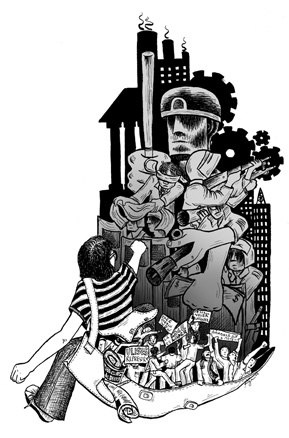
    Artwork : Piya Constantino
   
 
Home | About Us | Downloads | Contact | Links
All Rights Reserved. 2007 © Christianne Sintones Ursua
Hosted by www.Geocities.ws

1