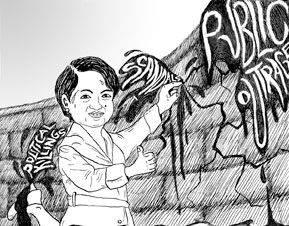
| Tyrannies have
advanced, not in a sudden torrent of atrocity, but in
gradual, measured steps of malevolence.
For seven years now, tyranny has steadily claimed this
nation, robbing fundamental liberties and freedoms while
the people are deep in induced stupor. Once acclaimed
as one of the relative freer states, the “sick
man of Asia” is not merely sick but enslaved and
deprived. The pseudo president who now sits in power
has gained notoriety for her insatiable rapacity whetted
by fantasies of perpetual dominion. Save for Martial
Law, no other rule has shown such utter disregard for
the people’s civil liberties, or such obsession
for the propulsion of one’s political dynasty.
For in tyrannies characterized by wanton greed, continued
dominion necessitates the suppression of resistance.
Thus, the last four years may possibly be one of the
most repressive – the spate of political killings
has been complemented by the expeditious approval of
legislation seeking the curtailment of democratic liberties.
Thus, the phenomenon of state-sponsored terrorism, as
instigated by the Calibrated Pre-emptive Response, Presidential
Proclamation 1017, the Human Security Act, and the dogged
compliance with the US’ War on Terror .
Seven years into the steady erosion of democratic space,
this diminutive thief has committed colossal sins of
commission and omission, that no rug can possibly conceal
the enormity of her transgressions. Instead, bankrupt
illusions of democracy were created albeit in a controlled
arena.
Yet, while illusions are distortions of actuality,
they are nonetheless influenced by objective reality.
The events last Thursday illustrate how the illusive
shroud of stability was once again ruptured with one
jolt from reality. The appearance and breaking testimony
of Rodolfo ‘Jun’ Lozada Jr., former consultant
of the shelved National Broadband Network project, is
one such jolt. And just when the administration thought
it has eluded public scrutiny, the anomalous contract
is again in the headlines, arousing the national imagination
from its stupor.
During the Senate hearing, Lozada narrates a story
of breathtaking rapacity, prompting former Socioeconomic
Secretary Romulo Neri’s much quoted instruction,
“moderate their greed.” Lozada’s articulations,
however, should come as no surprise. A perusal of this
administration’s track record would reveal unprecedented
levels of larceny and corruption: the $932 M South Rail
project, the P728 M fertilizer scam, the P1.1 B Diosdado
Macapagal Boulevard project, and the P1.3 billion automated
vote-counting machines.
Where top leadership is morally bankrupt, so are its
appendages.
Thus the avarice of former Comelec Chair Benjamin Abalos,
the spineless silence of Neri, and the blatant fabrications
of the police. As the public interrogated each official,
their cautious statements regarding the president and
the first gentleman are symptomatic of the Malacañang’s
orchestrations. In a press conference, PNP Chief Avelino
Razon, hard pressed over the police’s suspicious
silence on Lozada’s two-day disappearance, explained
in an evasive tone “Sa trabaho namin, hindi puwede
ang madaldal.”
As the public witnessed asinine attempts at cover-up,
the administration unleashed a torrent of malevolence
to contain the potential rupture. Close allies were
laid at the sacrificial altar, the length of partnership
subsumed beneath the enticements of power.
Tyrants, after all, know no other ally than power.
Months after Joey de Venecia disclosed the first gentleman’s
alleged P70 M commission from the NBN deal, presidential
sons Mikey and Iggy Arroyo moved to oust former House
Speaker Jose de Venecia from position in a brutal wrestle
for leadership. Notwithstanding a long history of alliance,
the longest-serving speaker was easily disposed for
a more politically expedient ally.
The slaughter takes on a more sinister form in clandestine
operations. Concurrent with de Venecia’s fall,
Lozada, key witness to the NBN deal, was forcibly taken
by officials suspected to be from the military. Although
Lozada tried to send text messages to his family, they
were easily intercepted by the abductors. This type
of wiretapping technology is available only to the AFP,
rousing suspicions that the event was a Malacañang
orchestration.
In light of the prevalence of extra-judicial killings,
Lozada is fortunate to still be alive. It is clear from
his testimony how potential public outrage dissuaded
the abductors from pulling an enforced disappearance
act.
From the convoluted amalgamation of cover-up, abduction,
and corruption, rises the need for explanations.
In an attempt to explicate the seemingly institutionalized
corruption, Lozada points that the country suffers from
a “dysfunctional government procurement system,”
where projects are driven neither by service nor need.
To illustrate, government creates projects not to deliver
necessary services but to employ suppliers, particularly
those it has close ties with. Moreover, mechanisms for
check-and-balance are nonexistent.
One manifestation of democracy is government transparency,
in which projects warrant the people’s mandate.
As recent events would show, however, government structures
are neither transparent nor open to public scrutiny.
If anything, the national conditions demonstrate the
undercurrents of tyranny.
The first step to democracy, therefore, is to counter
containment with engagement. And engage we must, if
we are to excise the guilty culprits, chief of which
is the president.# Philippine
Collegian
<< back to home |