| Celebrations necessitate
interrogation. More than simply rejoicing at having
reached a certain era, or else being a declaration of
a conceited yet hollow excellence, an assessment of
the motives and reasons behind such revelry must be
deemed imperative.
For being celebratory is a double-edged disposition.
It can either be a worthy occasion for examination,
or a mere opportunity for extravagance. The University
of the Philippines, being a university of and for the
people, one whose history is inextricably linked with
the nation’s development, should know better than
to settle for the latter.
Such is what UP President Emerlinda Roman’s administration,
in its conduct of the centennial celebrations, fails
to realize. Indeed, the administration never fell short
in terms of the grandiosity of its lined-up activities.
Everywhere in the campus we are assaulted by spectacles
of lavishness, even arrogance.
It therefore seems appalling that UP’s centennial
has now become an opportunity for massive income generation.
Administration propaganda never fails to trumpet that
UP alumni all the world over have donated and continue
to donate funds amounting to millions. All this supposedly
for the upgrading of the university’s facilities
and the improvement of service to its constituents,
foremost of whom are the students.
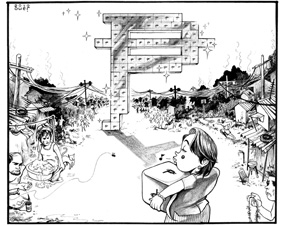
And yet beneath the layers of these spectacles lie
conditions we are so relentlessly prevented from seeing.
At the onset, we were confronted by the onslaught of
full-page newspaper advertisements announcing the university’s
centennial and its prepared activities. We will never
forget the ostentatious kick-off festivities, a widely
attended affair complete with presentations and a fireworks
display. About P20 million was spent on the restoration
of the Carillon, UP’s emblematic tower, and the
procurement of custom-made bells. For the rest of the
year, similar celebrations are certain to be undertaken.
Many of us, however, are perhaps unaware that in the
same kick-off activity, a number of students from Diliman
and Pampanga were prevented by their school administrations
from reminding the UP community of the university’s
history as a stronghold of activism, and that it is
our reassertion of our basic right to education, and
not relenting to a government policy of self-reliance
through income-generation, that warrants our concerted
effort.
The UP administration, in addition, has stubbornly
invoked the occasion of the university’s centennial
to railroad the passage of a new UP Charter, in what
is boastfully declared as the government’s gift
to UP’s 100th year. Yet the barrage of celebratory
pronouncements conceals the fact that the democratization
of access to and governance of UP we have long been
clamoring for continues to be sidelined.
Indeed, we find junctures in UP’s history that
merit commemoration. The seeds of nationalism that flourished
within its halls, the university’s dauntless refusal
to bow to the dictates of martial rule, the various
personalities it molded towards serving the oppressed
sectors, all these point to the lofty ideals that UP
has stood for in the past century.
One hundred years after, however, we bear witness to
actions contrary to the university’s supposed
orientation as the country’s premier state university.
Just last year, a tuition hike of 300 percent on average,
as well as a host of exorbitant laboratory and miscellaneous
fees, was implemented. Privatization of basic services
reared its ugly head in the form of massive lay-offs
of janitors. Corporate tie-ups in the guise of science
and technology parks, a submission to the national government’s
neo-liberal policies on education, proliferated in the
form of a commercial hub and a call center facility.
The brand of celebration that the UP administration
wants everyone to subscribe to, therefore, is one that
is replete with the attendant excessiveness and yet
sorely lacking in vital introspection. The gravest pitfall
of any celebration, after all, is its propensity to
emphasize on its supposed victories, leaving behind
the many battles that have yet to be waged.
But celebrations can only do so much, and can only
last for so long. It is through genuine resistance,
however, in our dauntless exposition of and struggle
against the harsh truths that have come to define our
existence, that we never cease to find the most veritable
reasons to persist.#Philippine
Collegian
<< back to home |