| Forepeak | Foc'sle | Head | Saloon | Galley | Rigging | Hull & Deck | New Projects | Pegasus LOG |
FOC'SLE
(OK,
Vberth)

As Pegasus will be used primarily for Delta, Bay and coastal cruising for 1 or 2 adults we prefer to utilize the v-berth as the primary sleeping area while using the main cabin strictly as a saloon and galley. The saloon settee berths will be used as sea berth during rare over night sails and guest berths if necessary.
The Triton's foc'sle has the potential for comfortable sleeping accommodations (at least for those of us under six feet) but does require some alterations. Also, stowage access can be improved significantly.
The most common modification to small boat v-berths is to transform the entire area into a queen size bed. Its a simple alteration but makes it kind of difficult to exit the bed (at least for us old people ;-) We elected to enlarge the existing berths.

By giving up the nifty little
seat between the two berths we comfortably increased v-berth width by 5
inches (I think you could go up to 7 or 8 inches if desired) and still
be able to swing into and out of the berths. And, we (or anyone else for
that matter) 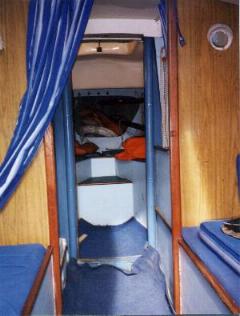 would have little reason to sit in the foc'sle of a 28 foot boat.
I elected not to remove
the original berth bulkheads in their entirety. My reasoning was they were
connected to a critical bulkhead which provides primary support to the
mast and rigging. I clamped the new bulkheads in place and made some final
adjustments. Once satisfied with size and style, stowage was made
more accessible by the adding cutouts for drawers and doors. This
eliminated the need to hold up berth foam and hatch cover while retrieving
a sock. Our experience has indicated that if stowage is difficult to access,
it won't be used and the boat becomes cluttered resulting in less than
desirable cruising and safety conditions (a place for everything and everything
in it place when sailing.)
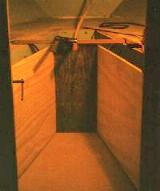 The
entire mockup was then covered with a satin white formica (no more painting)
and secured with glass tape and resin. Cut outs were made to the original
bulkheads to allow the drawers to extend all the way to the hull.
Jo had requested a specific area be set aside for footwear (shower shoes,
extra shoes, etc). An area that kept them off the sole and out of the way
but easy to reach. I used doors for this and elected not to provide access
beyond the original bulkheads to ensure a separation between seldom used
bulk stowage (accessed from the top) and daily stowage accessed through
drawers and doors.
The
entire mockup was then covered with a satin white formica (no more painting)
and secured with glass tape and resin. Cut outs were made to the original
bulkheads to allow the drawers to extend all the way to the hull.
Jo had requested a specific area be set aside for footwear (shower shoes,
extra shoes, etc). An area that kept them off the sole and out of the way
but easy to reach. I used doors for this and elected not to provide access
beyond the original bulkheads to ensure a separation between seldom used
bulk stowage (accessed from the top) and daily stowage accessed through
drawers and doors.
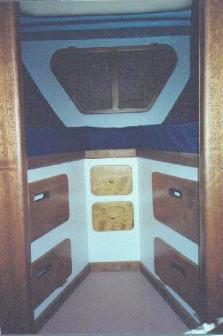 Two "his and her" drawers were installed at the forward end of the bulkhead
for toiletry items and personal odds and ends.
Two "his and her" drawers were installed at the forward end of the bulkhead
for toiletry items and personal odds and ends.
Early in the planning phase,
I had decided to do all interior wood work in birch using original teak
trim that was saved only where appropriate. Teak has become outrageously
expensive and mahogany is following closely behind while most neighborhood
lumber yards carry bulk birch for a reasonable price.
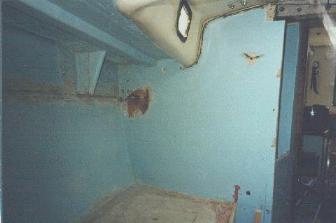 Triton's have another neat idea that I refer to as reservoirs as they are
shelves store water. There is one located over each berth (v-berth and
saloon). Closer inspection of these "reservoirs" showed signs of
dry rot so they definitely had to go. I removed the starboard shelf from
the hull and bulkhead by hand - no pry bar required. The glass to wood
bond was very weak due to what appeared to be insufficient resin
saturation into the wood (A common problem I've been told during the learning
years of GRP). I built a small shelf with a low fiddle (and a drain
hole) to hold glasses, books, etc and placed it between the chain
plate structure and the primary bulkhead.
Triton's have another neat idea that I refer to as reservoirs as they are
shelves store water. There is one located over each berth (v-berth and
saloon). Closer inspection of these "reservoirs" showed signs of
dry rot so they definitely had to go. I removed the starboard shelf from
the hull and bulkhead by hand - no pry bar required. The glass to wood
bond was very weak due to what appeared to be insufficient resin
saturation into the wood (A common problem I've been told during the learning
years of GRP). I built a small shelf with a low fiddle (and a drain
hole) to hold glasses, books, etc and placed it between the chain
plate structure and the primary bulkhead.
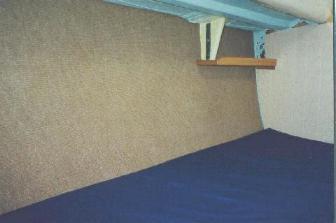 For the ceiling, I departed from tradition and covered it with a polypropylene
material. My reasoning was simple. Installing a wood ceiling
would look nice but take too much time (as much as I enjoy projects, I
enjoy sailing more). The poly would provide insulation sufficient
to reduce condensation in our local climate. Another big plus
for poly is when you roll over in the night, its warm and fuzzy against
your butt, not cold and clammy like wood. The material used is 100%
polypropylene, 1/8 inch thick, will not rot, mildew, fade or sag like vinyl
liners. Having had to remove carpet and its glue from other boats
we've owned, I recommend being very stingy with adhesive - you won't be
walking on this material, just snuggling up to it.
For the ceiling, I departed from tradition and covered it with a polypropylene
material. My reasoning was simple. Installing a wood ceiling
would look nice but take too much time (as much as I enjoy projects, I
enjoy sailing more). The poly would provide insulation sufficient
to reduce condensation in our local climate. Another big plus
for poly is when you roll over in the night, its warm and fuzzy against
your butt, not cold and clammy like wood. The material used is 100%
polypropylene, 1/8 inch thick, will not rot, mildew, fade or sag like vinyl
liners. Having had to remove carpet and its glue from other boats
we've owned, I recommend being very stingy with adhesive - you won't be
walking on this material, just snuggling up to it.
Probably the messiest task in the forward cabin was removing 3 layers of flaking paint applied by a PO in addition to the original Zolotone which also flakes but looks more like a fine sand. I prefer to limit painting interior surfaces as much as possible and I am not a big fan of formica that tries to look like wood. If you want the warmth of wood, then use wood. If not, install a satin finished formica and your maintenance is reduced to near zero.
The bulkhead separating the head was covered with beaded maple stained translucent white so the wood grain would show - I'm not pleased with the results so it is on the "do-over" list.