| Forepeak | Foc'sle | Head | Saloon | Galley | Rigging | Hull & Deck | New Projects | Pegasus LOG |
Saloon
There
are place's in life where one goes to relax and escape the days rush.
A place
to set a glass or mug and enjoy the warmth of quite conversation.
One
such place is the saloon of an old boat.
Escaped
Lately?

As she looked when purchased
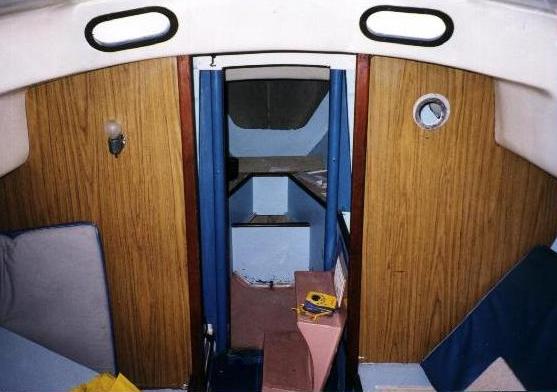

We enjoy a simple but functional saloon where we can relax and escape the wind at days end; discuss the day's journey and plan tomorrow's; share the quietude while sipping a glass of wine, cocktail or a cup of hot tea and; being part of the warmth of an evening on the water. Our saloon must look and feel warm, comfortable and old.
I started the restoration by
scaring both bulkheads even more with a rotary sander to provide a good
tooth. Then I covered the bulkheads with beaded red birch (real wood.)
All entire interior surface's were sanded and the hull painted with same
mildew proof Navajo White paint used throughout the boat. 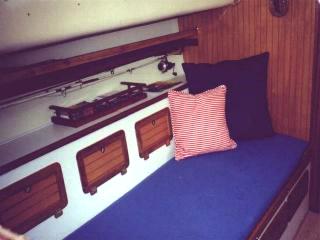 The settee backs and kick plate area was covered with satin white formica
(no painting and easy to clean - love it.) A semi permanent shelf
was added to the back of both settee's to help hide the odds and ends (junk)
that seems to gather during a sail. Access to this stowage area is
through cutouts (4 on port side, 3 on starboard). The shelves are
secured with 4 SS screws and finishing washers for easy removal if needed.
Hatch covers for the cutout's were made from scraps of the red beaded birch
accumulated during the project. When weather changes and condensation
becomes a problem, all hatches are opened before departing the boat.
The settee backs and kick plate area was covered with satin white formica
(no painting and easy to clean - love it.) A semi permanent shelf
was added to the back of both settee's to help hide the odds and ends (junk)
that seems to gather during a sail. Access to this stowage area is
through cutouts (4 on port side, 3 on starboard). The shelves are
secured with 4 SS screws and finishing washers for easy removal if needed.
Hatch covers for the cutout's were made from scraps of the red beaded birch
accumulated during the project. When weather changes and condensation
becomes a problem, all hatches are opened before departing the boat.
 The original cushion fiddles were removed (they were too high and cut the
back of your leg) and replaced with smaller, more comfortable fiddles made
of birch. Access to everyday stowage items under the settee is by
drawers (3 on port side, 2 on starboard.) Items rarely used but necessary
to carry (spare parts, etc.) are also stored under the settee's but accessed
from the top hatches (under the cushions.) Extra can goods needed
for longer cruises are also stored under the drawers as well.
The original cushion fiddles were removed (they were too high and cut the
back of your leg) and replaced with smaller, more comfortable fiddles made
of birch. Access to everyday stowage items under the settee is by
drawers (3 on port side, 2 on starboard.) Items rarely used but necessary
to carry (spare parts, etc.) are also stored under the settee's but accessed
from the top hatches (under the cushions.) Extra can goods needed
for longer cruises are also stored under the drawers as well.
As I indicated in the "Head"
section, I built a 12 VDC lamp from the damaged toilet discharge sea cock
and mounted it on a small shelf on the forward port bulkhead. Below
the the lamp is a small plaque which reads "Mierda No Mas". The door frames
were made of 2x3 inch mahogany to match the frames used between the head
and the v-berth.
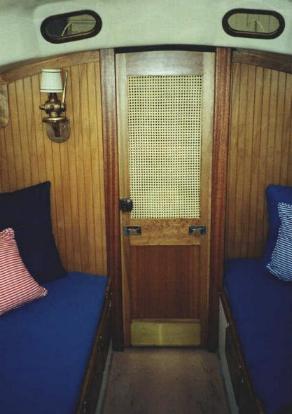
When we purchased Pegasus,
the
table and door (between the saloon and head) had been removed. At
first this seemed like a good idea for a 2 people boat. Why screw
with a door when a curtain would be more than adequate? We asked
ourselves this question and Jo came up with the following answer:
A door would be the logical place to attach a table; IF, when closed,
it would allow maximum air flow critical to survival during the hot Delta
summers and when open, allowed easy access to the toilet while under way
(we prefer not to fool with a door when on a 15+ degree heel.)
This was one of Admirals best
ideas. I was to build a table, hang it on a door that we didn't have
and, provide some form of air conditioning. With my mission well implanted
in my head, I decided to build a door with a large opening starting at
table height. I would attach a table with hinges to cover the opening
so when not in use, it would provide the privacy of a solid door.
When lowered for use, the opening would provide the necessary ventilation.
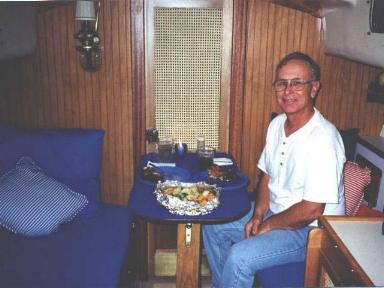 The door I built however, to date the table is still not permanently attached.
Instead, I used table hangers purchased at West Marine so it can be taken
down when not in use. The reason for this is I sail alone a lot and
rarely use the table. Instead, I use the fold up counter on the port
side for eating when by myself. For now the table is stored in the
Head when not in use. For privacy, I hung a blue designer role up
shade on the head side of the door. When rolled up it provides maximum
ventilation and if privacy is desired, just pull it down. It will
remain this way until I have procrastinated long enough to be satisfied
or I build another table (actually I want to build one of those neat looking
old sea tables with folding leaves, fiddles and bronze hinges ;-)
The door I built however, to date the table is still not permanently attached.
Instead, I used table hangers purchased at West Marine so it can be taken
down when not in use. The reason for this is I sail alone a lot and
rarely use the table. Instead, I use the fold up counter on the port
side for eating when by myself. For now the table is stored in the
Head when not in use. For privacy, I hung a blue designer role up
shade on the head side of the door. When rolled up it provides maximum
ventilation and if privacy is desired, just pull it down. It will
remain this way until I have procrastinated long enough to be satisfied
or I build another table (actually I want to build one of those neat looking
old sea tables with folding leaves, fiddles and bronze hinges ;-)
When it came time for new cushions I already knew what I wanted. I had seen pictures of old, classic boats that had simple cushions made of rugged material of the day (canvas) that were navy blue with white piping. To me, they projected everything I envisioned a classic interior should look like; traditional, simple, functional, rugged and nautical. I told an upholsterer of my desire and was informed that the material would not be comfortable nor would it be taught over the sponge because canvas has no elasticity and recommended I use a traditional upholstery fabric of the same colors. I had the cushions made of Royal Navy Blue Sunbrella with Natural White piping. They are everything the upholster said they would be and, they are everything that I was looking for. Time will tell if they stay or get thrown out for a more modern material.
For the back rest cushions we opted for throw pillows so we could get the right fit for the moment. They also add a little color and separation to the saloon section of the cabin.
That pretty much covers the alterations made to Pegasus's saloon. I'm still undecided on the sole. New windows and interior frames are covered on the Hull & Deck page. A few ideas I did not care for after seeing the results will be changed as time permits and there are always little a trim or nice to have type additions like clocks, radios and widgets to be added.