
Spoiler ahead. If you prefer the suspense, click here.
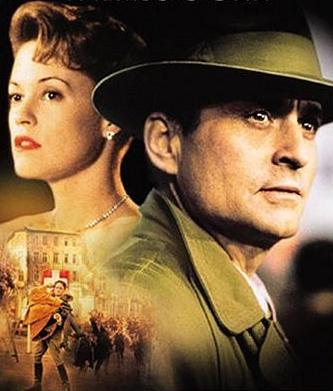
Melanie Griffith as Linda Voss, at first glance, would seem inappropriate for the role; Voss is tough, while Griffith looked soft. Then again, it is only her voice that's soft (she'd be shouting angrily and you still wouldn't believe that she's mad). Maybe that's why she got the part. She's able to fool Liam Neeson's character (Dietrich) into believing that she had a complete Gestapo check and is "clean" enough to be employed in Berlin. It also doesn't hurt that she can effortlessly charm Michael Douglas' character, Ed Leland, who initially is superficial enough to have let Linda go.
It is when Linda finally gets her way and goes to Berlin that the thrill of the movie begins. Even watching it for the third or fourth time, I still feel a shiver of suspense when Linda would have several close calls with the Nazi soldiers. Case in point: When Linda's handbag's secret compartment flies open in front of a Nazi soldier and the folded secret note she's supposed to transmit to the fishmonger drops out, together with a pack of cigarettes (a luxury in wartime Germany). And this is where I think the movie got bad reviews. Linda got too many close calls that she's just so plain lucky. The fact that she's able to hide herself, wounded, in the laundry chute of Margrete's apartment while soldiers search for her make it seem as if the Nazi officers either have myopic eyesight or else careless. Not to mention that she's still alive when Ed and Sunflower finds her several hours later. In real life, a gunshot wound on the abdomen wouldn't have lasted that long, unless some sort of miracle happens.
Notably, Linda's story is narrated by none other than Linda herself. This is many years after and to BBC as a special television segment. This is no secret as in the beginning of the movie, it is tacitly revealed that she's being interviewed and asked to tell her spy story. What is surprising is Linda's narration of her friendship with Margrete Von Eberstein. I absolutely had no idea that she would turn out to be the traitor in this film, the double agent, as Linda so knowingly calls it. There is a time during Linda's narration of Margrete that she cries, and maybe that's what prevented me initially from suspecting that Margrete's the villain. After all, you don't cry for villains, do you? Well, most of the time anyway.
The music is touching. I especially like the piano intro and the ending. The costume design though makes me wonder if shoulder padding on women's clothes was in fashion even back to the second world war (I firmly believe that shoulder pads should be restricted either in a suit or on a football player). I do like Linda's gown that Dietrich makes her wear for the opera though.
So I like this movie. I did say it's my favorite World War II movie, did I? So my verdict?
My rating: Admittedly, I am influenced by my childhood opinion of the film, though I do have to note that Linda and Ed are far too lucky in this movie for my taste. For starters, why aren't there any Nazi soldiers running after them when Ed, carrying the unconscious Linda, crosses the border to Swiss soil? I'm also surprised that the Nazi official for whom she made the disastrous dinner didn't strangle her on the spot.
Memorable scenes:
> Just as Linda is about to be denied employment in Ed Leland's firm, a German-speaking cleaning lady accidentally topples a water dispenser, which crashes to the ground. Linda talks to the cleaning lady soothingly in German, to which the woman, who initially rejected her application, says, "Ms. Voss, you didn't tell me you speak a second language."
> Ed asks her to turn around as a form of a test. Linda firmly says she prefers to do it sitting down.
> Linda tells Ed that the firm's tranlator is lying. She says, 'What is he, a double agent? What are you going to do to him?"
> In a festivity for soldiers, Ed, while dancing with another woman, sees Linda.
> Linda volunteers to replace the murdered Berlin spy, to which Ed refuses, short of firing her.
> Dietrich gives Linda a ride in his car during which he laments about his need for a governess for his two children.
> In a film, Ed sees Linda with Dietrich in a parade for Hitler.
> Linda finds Ed following her in Berlin.
> Linda discovers the secret room where Dietrich hides important documents and which she later microfilms.
> Dietrich takes Linda to the opera.
> Margrete reveals herself to be a double agent.