August/September 2000
August 2000 - historic daffodils listing
July 2000
June 2000
JUNE 2000
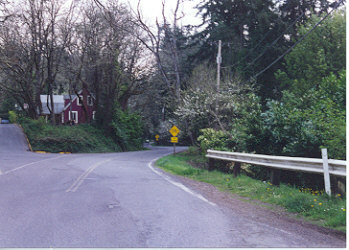
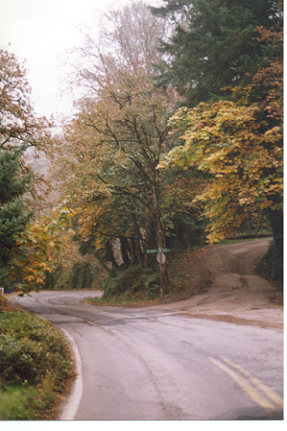
We started researching the history of Lorane Highway in 1994. We first collected all of the pieces of information that had been gathered by various residents since the early 1970s, then went from there to further research.
As we dug deeper and deeper, we found this road represents even more living history than we had initially thought, so we contacted the National Register Coordinator at the State Historic Preservation Office in Salem to look into the possibility of preserving the road�s unique assets. We had little real hope for a place on the National Register of Historic Places for Lorane Highway, however. After all, no Oregon city street has ever been accepted, and only three road segments from this state are even listed: the Barlow Road segment of the Oregon Trail, the Jacksonville to Fort Klamath military wagon road, and the Oregon Central military wagon road.
The coordinator visited Eugene and evaluated the road before she spoke with us in 1999. Lo and behold, she suggested we may well have an excellent, worthwhile subject. And we were further encouraged to hear of the recent trend to consider roads worthy of preservation for themselves, rather than as an element of a historic district only. The trend continues to grow, as was clearly evident from the enormous interest in the second national �Preserving the Historic Road in America� conference that was held in New Jersey last April. (For more information about the conference, please contact Karen Van Gilder at www.ruralheritage.org).
We have almost finished the research and will soon start writing the application for a listing on the National Register of Historic Places. Fortunately, we recently found a consultant to assist us with the writing who will help us sort through four stuffed file drawers and focus on the most relevant details. After we finish writing the application, it, along with the supporting petition, will be submitted to the State Historic Preservation Office. From there, it will be sent to the Eugene Historic Review Board for comment.
The seven-member Historic Review Board is a subcommittee of the Eugene Planning Commission, and, along with the City�s Preservation Planner, it oversees the main components of Eugene�s Historic Preservation Program. The Board usually meets on the fourth Thursday of each month. All meetings are open to the public. The City Planning staff provides Board members with a written report addressing each agenda item one week in advance of the meeting. The report is available to the public. For more information about the City of Eugene Historic Preservation Program, see www.ci.eugene.or.us/pdd/Planning/eugenehistoric/default.htm.
If the Historic Review Board supports the application, it is submitted to the State Advisory Committee on Historic Preservation for review. This nine-member committee meets in Salem in February, May, and October. These meetings also are open to the public. For more information about the State Historic Preservation Office, see www.prd.state.or.us/about_shpo.html. The Committee may support the nomination, or it may send the application back with directions for further refinement, or it may reject the application. If the Committee recommends a nomination, the application will then be forwarded to the Keeper of the National Register in Washington, D.C. who will make the final decision whether to register the road on the National Register of Historic Places. For more information about the National Register, see www.cr.nps.gov/nr/.
The stories, photographs, and other input we have received from residents thus far have been incredible and invaluable. If you have additional information about the road or its history that you would like to share, we would love to hear from you via the guestbook or by email.
JULY 2000
The web site is shaping up, but because of scanner problems, adding all of the photographs has been delayed somewhat. As you may have noticed, however, the main page now sports a beautiful photograph by Robert (Bob) Nyquist. Also, several neighbors have been added to the links page, but because most Lorane Highway residents were not yet aware of the site, the going there is still somewhat slow as well.
Two more people have signed the petition that will accompany the application to place Lorane Highway on the National Register of Historic Places, making for a total of 224 signatures.
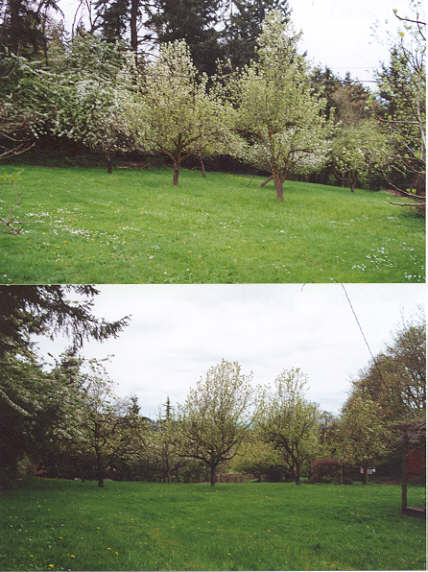
With the help of a surveyor, we now have a 1918 field survey that was done by a surveyor named P.M. Morse superimposed on a 1995 survey. It is absolutely fascinating to see how little has changed along this road. We will walk the road with the maps and descriptions in an effort to identify and photograph the exact trees that were used for the 1918 survey. So far, the first two oaks we attempted to find appear to still be there. While we walk the road, we will also be looking for remnants of the old orchards that used to be here. Some of them had apples, pears, and peaches that were experimental types for this area, but research into the O.S.U. Extension office archives has not yet resulted in identification of exact types or locations.
Research into an Oregon State wild bird and game refuge that was established here in 1913 so far has produced three additional agreements, making a total of 120.88 acres of protected lands. We have tried to find out more about the subsequent history of these refuges, but so far, we have not had much luck. We have not transferred all of the information to maps yet, but the agreements we did find indicate protected lands from Lorane Highway around Madison to possibly as far as Lorane Highway at Whitbeck/Van Buren.
Next, we will be delving into the backgrounds of the thirty-eight petitioners and others who lived along the road around 1918. We hope to unearth more information about the history of the road itself by poking around that way. We will post the information about the early residents under the Lorane Highway history page as soon as possible.
All of this research has had one additional major effect: both of our file cabinets collapsed under the weight of the latest materials we added. The drawers went down like an accordion - but fortunately held on to their contents -, so now everything is stored in individual file boxes that are much more portable and easier to deal with.
For those of you interested in continuing the annual daffodil plantings along the road, we will add a list of historic types of daffodils soon. Most of the information came from Scott Kunst, a landscape historian for almost twenty years and the owner of Old House Gardens in Ann Arbor, Michigan. For an absolute wealth of information about all sorts of heirloom bulbs, please see his web site at www.oldhousegardens.com. It is a fantastic site, and if you need more information, Scott Kunst is extremely helpful and may be reached at [email protected] or at 734-995-1486, fax: 734-995-1687.
There is an interesting document at http://transact.org/Reports/Papers/MOE.HTM. It is the text of an address, �Transportation and the Livable City�, given by Richard Moe, President of the National Trust for Historic Preservation, to the Boston 400. Part of his address concerns historic roads. We also received the documentation of last April�s �Preserving the Historic Road in America� conference, but it contains around 700 pages, so it will be a while before we get through all of that.
Thanks so much to all of you who sent emails and notes, signed the guestbook or petition, or called, letting us know you support this effort. As always, it is very much appreciated. And if you have additional information about the road or its history that you would like to share, we would love to hear from you via the guestbook or by email.
AUGUST 2000 - HISTORIC DAFFODILS LISTING
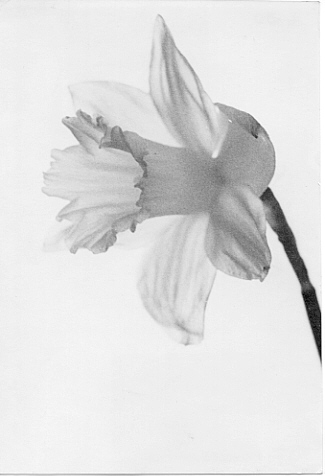
For those of you interested in continuing the annual daffodil plantings along the road, below is a listing of daffodils that were available and may have been planted by the people who lived here at the time Lorane Highway was built. In fact, one of the daffodils, N. �Van Sion�, also known as N. telamonius plenus, appears to be a type that is still occasionally seen along the road. The fact that deer absolutely refuse to eat daffodils likely helped it survive this long in unprotected areas.
Most of the following information came from the Old House Gardens catalog. Scott Kunst, the owner of Old House Gardens, has been a landscape historian for almost twenty years and his catalog contains a wealth of information about historic bulbs including crocuses, hyacinths, tulips, lilies, cannas, dahlias, gladiolus, and many others, including some interesting American natives. For more information, see his web site at www.oldhousegardens.com, email [email protected], or call 734-995-1486/fax 734-995-1687.
Native mainly to the Mediterranean, narcissus were grown by the Egyptians and Greeks and brought into English gardens by the 1500s. Thousands of new tulips and hyacinths were being developed in the 1600s and 1700s, but the number of daffodils grew slowly. Of the 24,000 cultivars listed today in the Royal Horticultural Society International Daffodil Checklist, fifty or so date to the 1600s, and another three hundred fifty were introduced before 1860. Many of these were tender tazettas, and only a handful were ever widely grown in American gardens. In the mid 1800s, a couple of British enthusiasts set to work, and between 1860 and 1900, a thousand new varieties were introduced. Another six thousand were introduced by 1930, making the early 20th century a golden age for daffodils. Unfortunately, only a tiny fraction of these are still available today.
Scott Kunst took time to look into our local climate and he recommends the following daffodils as most suitable for our area. He also generously granted permission to use his copyrighted photographs from the Old House Gardens web site. We trust you will honor his copyrights and refrain from copying the photographs for further use without his permission.
The earliest bloomers are the wild and the Campernelle jonquils.
The WILD JONQUIL, N. jonquilla, also known as N. �Early Louisiana�, N. simplex, and N. �Sweeties�, was documented as far back as 1612. It has the sweetest smelling flower, and for many southerners, its fragrance is the essence of spring. It grows 8-10� tall and has clusters of nickel-size, yellow flowers with small, pointed petals and tiny cups. There are many strains of this wildflower from Spain.
The CAMPERNELLE JONQUIL, N. x odorus, also known as N. �Campernelle� and N. campernelli, was documented by 1601. A hybrid between N. jonquilla and N. pseudonarcissus, true N. �Campernelle� grows abundantly in old gardens throughout the south, and has for centuries. Easy to grow, it blooms on 10-14� stems with one or two strongly scented golden yellow flowers with a large cup and narrow petals that have the informal charm of wildflowers. In addition, the Campernelle jonquil is a great forcer for indoor bloom.
Early midseason brings the cluster-flowered 1906 N. �LAURENCE KOSTER�. Growing 16-18� tall, this vigorous beauty can produce a huge number of flowers on multiple stems. It has creamy petals, little yellow-orange cups, and a superb fragrance. It is one of the oldest poetazes, a group launched in 1890 by crossing N. poeticus and N. tazetta.
Midseason brings another cluster-flowered type, N. �AVALANCHE�, also known as N. �Seventeen Sisters�. One 16-18� tall stem of this sturdy tazetta may have twenty sweetly scented blossoms with white petals and lemon yellow cups. Discovered in 1906 on a sea-cliff in England's Scilly Isles, it probably tumbled there from fields above in the 1800s when the Scillys led the world in tazetta production. It forces beautifully for indoor bloom and it is a long-lasting cut flower as well.
Late midseason brings a well-known favorite of many twentieth-century gardeners, 1916�s N. �THALIA�. It is the oldest available N. triandrus hybrid, a strong grower north and south. Each 13-15� tall stalk bears two nodding, fragrant, pure white flowers that sweep back dramatically from the cup.
Another late midseason bloomer, N. �MRS. R.O. BACKHOUSE�, is from 1921. Known for decades as THE pink daffodil, this is one of the landmark bulbs of the 20th century. Blooming on 16-18� stems, it is a large-cupped type that is more truly ivory and apricot, a veritable sunrise for those who watch closely. Unfortunately, this daffodil is becoming scarce and increasingly counterfeited.
The very late season brings N. �TWIN SISTERS�, also known as N. biflorus or N. x medioluteus. Gerard in 1597 said this wild hybrid was "generally knowne every where,� and he called it �Common White� or �Primrose Peerless�. An enduring classic throughout the south, its names there include �April Beauty�, �Cemetery Ladies�, and �Loving Couples�. It has two fragrant blooms to a 12-14� stem, white petals, and a tiny yellow cup.
And often the last daffodil to bloom, the OLD PHEASANT EYE or POET�S NARCISSUS, N. poeticus var. recurvus, grows wild in endless variety in mountain meadows from France to Greece. Although it is pictured in the English herbals of around 1600, the oldest form now available seems to date only to the early 1800s. Richly fragrant, it lingers in many old gardens and memories. Its 10-13� stems bear solitary flowers with sparkling white petals that recurve from a tiny, yellow, red-rimmed cup.
In addition to the above, the following daffodils are suitable for growing in our area as well.
For the very early season, the TENBY DAFFODIL, N. obvallaris or N. pseudonarcissus obvallaris has grown wild for centuries - it has been documented since 1613 - near Tenby, Wales, and it is native to other parts of western Europe as well. Its blooms were once sold in Covent Garden. Its short petals and wide trumpet are the most perfect in proportion and texture of any deep yellow trumpet. It blooms on sturdy, stiff, 8-10� stalks. It is excellent for naturalizing.
Another very early bloomer is the 1830 N. PRINCEPS, also known as N. gayi and N. �Irish Princeps�. This wildflowery trumpet daffodil is a bicolor N. pseudonarcissus. Millions were once harvested as cut flowers, but it is now very rare. It is great for naturalizing � a drift of N. princeps is a thing of beauty, the clear yellow trumpet and almost white petals on 14-16� stems giving it lightness and grace.
The 1885 N. �GOLDEN SPUR� is an excellent, vigorous naturalizer. This deep yellow Victorian trumpet is often the first daffodil to bloom in spring. It grows 11-13� tall and looks a bit like �King Alfred� before he turned to steroids. It once was the country's leading forcing daffodil.
And the 1921 N. �THE FIRST� is a pale yellow trumpet on 14-16� stems that has a graceful wildflower look that sets it far apart from today's big, beefy trumpets. It is a hearty performer across the country and a great favorite in the South.
Early season brings the COMMON YELLOW DAFFODIL or LENT LILY, N. pseudonarcissus, also known as N. �Early Virginia� or N. lobularis. This wildflower from Europe is very variable. It could be called the original yellow trumpet daffodil - it appears on English garden lists from 1200 AD and has been in gardens from Maine to Texas for centuries. Its long trumpet and lighter petals that are slightly twisted and swept forward give it an informal, decidedly antique look. Blooming on 12-14� stems, it is tough as nails and good for naturalizing.
The DOUBLE CAMPERNELLE, N. odorus �Plenus�, is a very old, widely planted double, a bulbocodium hybrid that has been known and loved since at least 1601 and was offered in most Victorian bulb catalogs. Its small, neat, fragrant, deep yellow blossoms - roses to some, star-bursts to others - bloom on 10-12� stalks.
N. �SIR WATKIN� was crowned �Best Historic� at the 1998 American Daffodil Society national show. It is a vigorous, 16-18� tall old favorite from 1868, with a large yellow cup and wavy, palest yellow petals.
N. �SEAGULL�, from 1893, with its 14-18� stalks topped by snowy white, wing-like petals and small lemon cup fleetingly edged apricot looks something like a white N. conspicuus. It is just as vigorous and free-flowering, too.
And then there is N. �KING ALFRED� from 1899. Although millions of big yellow trumpets on 16-18� stems labeled �King Alfred� are still sold every year, experts agree that virtually all of them are counterfeits substituted since at least WW II. In the 1920s, it replaced �Emperor� as America's favorite daffodil.
N. �ORANGE QUEEN� is from 1913. Although not really orange, this is the most richly colored of the old N. jonquilla hybrids - a deep, glowing saffron yellow, amber, or goldenrod. Cluster-flowered, fragrant, and a glorious forcer, it blooms on 12-15� stems.
Last, there is N. �LITTLE WITCH� from 1921, a petite cyclamineus that is bright golden yellow with a straight, fluted trumpet and petals that sweep back. Vigorous, sturdy, and long-lasting, it blooms on 8-12� stems.
The oldest early midseason daffodil suitable for this area is N. �VAN SION�, also known as N. telamonius plenus. It has been documented since 1620. "The most important of all doubles," wrote A.M. Kirby in 1907, and this had been true since the 1600s. But it is the most confusing, too. During its first year - or in the perfect spot - its doubling is neatly contained within the trumpet. Most years and most places, though, the whole flower explodes into a froth of gold and green. Outstandingly vigorous and enduring, it blooms on 12-14� stems.
N. �EMPEROR� dates from 1865. An elegant, pale and deep yellow trumpet on 13-15� stems, it was one of the first great breakthroughs in daffodil breeding and helped popularize daffodils as a major garden plant. Throughout the late Victorian age and into the early 1900s, it was THE best-known and best-loved daffodil.
N. �W.P. MILNER� is an elfin miniature from 1869. It was one of the first great achievements in Victorian daffodil breeding, and it is the only one still common in commerce, a mark of its sturdiness and enduring quality. With gracefully nodding trumpets and spiraling petals on 8-10" stems, it is a pale, silvery yellow in the north, but in the south it can be truly white.
N. �RIP VAN WINKLE�, also known as N. minor pumilus 'Plenus', N. pumilus or N. pumilus �Plenus�, is a 6-8� tall dwarf double from 1884. It has narrow, pointed petals massed into spiky greenish yellow balls like tiny suns. Fun, and easy to force for indoor bloom, too.
Though registered in 1984, N. �EARLY PEARL� is a much older tazetta that was known by 1899 and found world-wide in bulb fields and old gardens. It is still common throughout southern Georgia. Blooming early in the new year and wonderfully vigorous, it is a lot like the legendary N. �Grand Primo� but with front-facing clusters, lighter citron cups, and a lighter fragrance. It has white petals and blooms on 14-16� stems.
N. �BERYL� from 1907 is a vigorous cyclamineus type. Blooming on 10-12� stalks, this graceful little shooting star has swept-back petals that open pale yellow and quickly mature to creamy white. Its short golden cup is rimmed with orange.
N. �IRENE COPELAND� is a lovely, elegant, and soft 1915 double, its creamy white petals neatly trimmed with narrow ribbons of primrose. It blooms on 16-18� stalks.
Midseason brings the HOOP PETTICOAT, N. bulbocodium bulbocodium, that was documented by 1629. With funnel-like cups and thin, ribbony petals, these wildflowers from Portugal, Spain, north Africa, and southwest and west France are odd and intriguing. Short at 8-10� and deep yellow, they can be challenging. They do best when neglected in gritty acid soil amid grass and left to bake in summer.
The TEXAS STAR or COWSLIP CUPPED DAFFODIL, N. x intermedius, was formerly also known as N. �Bifrons�, N. �Etoile d'Or�, or N. primulinus. With dainty clusters of fragrant, soft yellow stars on 16-18� stems, this wild hybrid of N. jonquilla and N. tazetta was painted by Pierre-Joseph Redout� (1759-1840) before 1816 as N. radiatus. Several slightly different forms have thrived in Southern gardens for ages.
N. �STELLA� was introduced in England in 1869. Its name no doubt refers to its classic, star-like N. incomparabilis form: long white petals centered on a ribbed, loosely-frilled large cup of yellow. In 1897, it was listed in Vaughan's extensive fall catalog. It blooms on 12-14� stalks.
Late midseason bloomers include the lovely N. CONSPICUUS or N. barrii conspicuus from 1869. Blooming on 14-16� stalks, a clump in bloom, with fluttering, creamy yellow petals and short yellow cups barely edged in orange, is like a host of butterflies. It is subtle, graceful, elegant, and unmistakably old-fashioned. It is a strong grower that multiplies rapidly.
N. �QUEEN OF THE NORTH� from 1908 is certainly one of the most beautiful of all daffodils and one deserving of great popularity. Its broad, snow-white petals give the flower an elegant ruff, and it has a small lemon cup. It blooms on 16-18� stems.
N. �SCARLET GEM� is one of the oldest (1910) and hardiest poetazes, and an enduring 20th-century favorite. Clusters of many fragrant flowers with soft, buff-yellow petals and flat, orange-peel orange cups bloom on 14-16� stalks. It is also a wonderful cut flower.
The late season for daffodils brings a Pheasant Eye type, N. ORNATUS, from 1870. It was discovered at London�s Covent Garden as a cut flower from France. It is the earliest blooming of this season-ending clan, two weeks ahead of N. poeticus recurvus. And though it is hardy to �15� F, it thrives in southern heat that is often death to its kin. This is not the usual Pheasant Eye: it has big, round, sparkling white petals, a tiny yellow eye edged with red, and a memorable fragrance.
The latest bloomer and another Poet�s Narcissus, the DOUBLE PHEASANT EYES, N. albus plenus odoratus or N. poeticus plenus, is a true classic, one of the few that show up on almost every daffodil list from Clusius in 1601 through catalogs of the early 1900s. It is snowy white, although occasionally the remnants of the red cup are visible, and it is sweetly fragrant. It grows 16-18� tall and is excellent for cutting. Unfortunately, the buds fail if the weather gets too hot too soon, but in the right spot or good years, these are heavenly daffodils.
Aside from taking time to make recommendations for our local conditions, Scott Kunst also generously allowed the �lifting� of entire descriptions from his catalog, the details of which must have taken years to put together. How nice it is to find a successful businessman and widely respected gardener and historian who still makes time to support a small, local effort.
For additional information about daffodils, please see the web site of the American Daffodil Society. For more information about other historic plants, see the Old House Gardens site.
AUGUST/SEPTEMBER 2000
The Lorane Highway history page has a new section called �The petitioners� that lists the thirty-eight original petitioners who requested the construction of Lorane Highway. Most of the information found so far has been included, but an enormous amount of research is left to be done. Other people significant to the history of Lorane Highway will be added as soon as possible. If you have information that may help piece together the history of the road or photographs of the petitioners, please let us know.
The above August historic daffodils listing now has photographs linked to most of the historic daffodils that do well in our area, courtesy of Scott Kunst of Old House Gardens. The photographs are from the Old House Gardens web site and they are copyrighted. Scott has generously granted permission to use them for this site and we trust you will honor his copyrights and refrain from copying the photographs for further use without his permission.
The guestbook received ten more entries in August.
The petition page has been updated to reflect four more signatures, making for a total of 228 signatures. We have yet to contact a number of the Lorane Highway residents, but as we near completion of the application, we will contact those we have not talked with to see if they would like to be included in the petition.
Thanks to a new scanner, the Lorane Highway photo pages are now up. The pages are a great way to show relatives and friends in distant places the sights of our neighborhood. Two photographs by the late Bob Nyquist and a poem he wrote about the road are included on the summer pages.
The links page includes several more neighbors. If you would like to be added, please let us know.
In addition, there are a number of new links in the text of several pages that lead to relevant photographs or web sites, other pages of the Lorane Highway web site, and/or email addresses.
If Lorane Highway is accepted as a historic site, we hope to see a marker or sign to explain the significance of the road. The good news is that our neighbors Chuck and Lois have generously donated a sign; the not-so-good news is the text of the sign: �on this site in 1897 nothing happened�. Still, it IS a start. And since the road was built in 1919-1920, the sign actually could be used...
The Citizens Nature Project recently collected citizen suggestions for documenting and mapping important natural resources in the Eugene/Springfield metropolitan area to be submitted to the Metro Natural Resources Study. Lorane Highway was submitted as a Eugene resource under the bird habitat, mammal habitat, steep slopes, cultural/historic site, and special geology categories.
On August 22nd, the Lorane Highway web site was accessed for the 1000th time, indicating lots of people are very interested in the road and its history. Unfortunately, for several days early in August, the site crashed and although some rather interesting images came up, we hope that problem will not recur. In the meantime, the site address (URL) has been submitted to a number of search engines and sometime this month or in early October, it should be possible to find the site just by submitting �Lorane Highway� to a search instead of having to remember the actual web site address.
If you know of anyone without computer access who would like to see the site, we will have a binder with a complete print-out of the web site available for loan-outs.
Last, but certainly not least, our area welcomes a new resident: on August 16th, Lorane Highway became home to Dawn and Chris's beautiful baby boy named Cedar. Sibling Rowan is absolutely tickled to be a big brother.
We have had a lot of encouraging responses to the web site that we appreciate very much. As always, if you have additional information about the road or its history that you would like to share, we would love to hear from you via the guestbook or by email.