
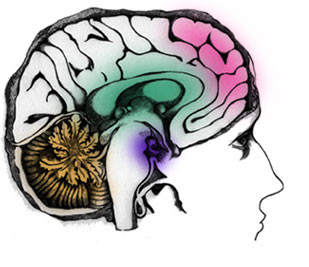
Dyscalculia is a brain based disorder (Shalev, 2004). Dysfunction can be in either hemisphere, but because the left parietotemporal area is of such significance to mathematical thinking in the normally functioning brain, dysfunction in the left hemisphere can be more catastropic for calculation. In one dyscalculic adolescent a large wedge shaped defect was discovered in the left parietotemporal area (Shalev, 2004).
Neurologists have taken note of both anatomical deficits and functional deficits in the intraparietal sulcus of dysclaculic brains. In some subjects there was reduced grey matter in the left intraparietal sulcus at the exact location where activiation is typically observed during arithmetic. In others, there was reduced activation of the right intraparietal sulcus during calculation as number size increased (Dehaene, Molko, Cohen & Wilson, 2004).
Studies that have compared dyscalculic children to non-dyscalculic children have shown that the dycalculic brain often activates in novel, and/or increased areas when performing arithmetic tasks. For instance, one study that investigated twins (only one of whom was dyscalculic) found that during calculation the dyscalculic twin's brain was active in in large portions of the frontal, precentral and dorsal-parietal areas while the non-dycalculic twin's brain was active only in the expected areas of the left frontal and temporalparietal cortex (Shalev, 2004). This increased activiation may indicate that the dycalculic brain is attempting to compensate for its deficits.
As explained in the Mathematics in the Brain section, simple arithmetic is actually a complicated process made up of many functions. Of these myriad functions, all of which are necessary for basic mathematical thinking and arithmetic, any could be affected in a dyscalculic's brain (Stanescu-Cosson, Pinel, vande Moortele, Le Bihan, Cohen & Dehaene, 2000).. It is almost impossible to disucss general strengths and weaknesses of people with dyscalcuila becuase each individual is likely to have somewhat unique deficits. Because individuals can exhibit deficits in one behavior, (arithmetic fact retrieval for example), but not in another (retrieval of proceedural knowledge), we know that these behaviors are dissociated from one another; though an individual could have deficits in both, s/he need not. The existence of these dissociations makes it likely that discrete neurological networks are responsible for each behavior (Ruxandra, Pinel, van de Moortele, Le Bihan, Cohen & Dehaene, 2000; Marcaruso & Sokol, 1998).
Networks
Networks