
Welcome
The Abstract
Thesis Introduction
The Aim
Background to the Research Topics
The Research Topics
The Targeted Audience
Disposition
Research Approach
The Thesis in Context
Export Guide Construction
Questionnaire Construction
Information Gathering
The Export Guide
Introduction to the Export Guide
Export Guide Overview
Export Readiness
Trade Condition
Foreign Market Analysis
Questionnaire
Research Results
Export Readiness
Trade Condition
Foreign Market Analysis
Discussion
Export Readiness
Trade Condition
Foreign Market Analysis
Conclusion
Export Readiness
Trade Condition
Foreign Market Analysis
The Next Step
Supplements
Introduction to Sunfoods and Konnyaku-Chips
Site Map
The Complete Interview Answers
Glossary
Sources

Export Readiness
Sunfoods assert that the company's management have export experience. Sunfoods are said to have exported konnyaku-products for six years to Singapore and the company also claims to have exported Konnyaku-Chips for one year to USA. The management is claimed to be strongly committed to exports and it is the assertion of Sunfoods that export activities are highly prioritized by the company, even higher prioritized than domestic sales. Moreover, the company claims to plan increased export activities in the future and in USA, Europe or Australia, Sunfoods anticipate finding markets, which are bigger and more profitable than the Japanese market. It is the contention of Sunfoods that the company does not have any personnel with foreign culture or language knowledge. However, two persons within the company, the head of the company and the general manager, are claimed to have some export experience.(Shiraishi, Hajime 2003-04-11)
Financial and Physical Resources
It is the argument of Sunfoods that in order to avoid higher risks than the company can afford, Sunfoods presently does not export directly to USA and Singapore. Instead they claim to use a trading company as an intermediate between the company and the targeted foreign markets. Sunfoods maintain that they have excess production capacity. Sunfoods asserts that the company presently produces 20 tons Konnyaku-Chips per month but the production facilities, the raw material supply and human resources allow for a production of 100 tons per month with the support of the company's subcontractors.( Shiraishi, Hajime 2003-04-11)
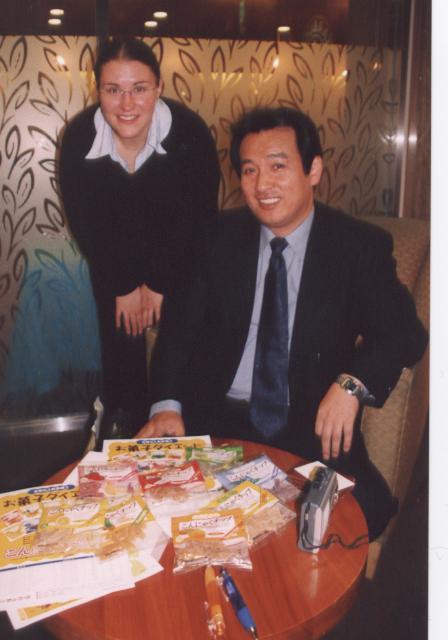
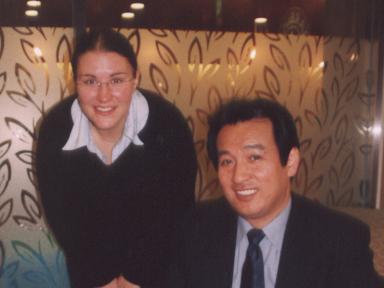
In order to study Sunfoods export readiness an interview with the General Maganger and Trade Representative Hajime Shiraishi took place in Kyoto, Japan and these pictures are from that occation.(2003-04-11)
Competitiveness
Sunfoods asserts that Konnyaku-Chips is a unique product with healthiness as its main advantage. The product is further claimed to contain a low amount of calories, no cholesterol, no lipid and plenty of dietary fibers. Moreover, it is said to taste nice and sweet. It is the contention of Sunfoods that Konnyaku-Chips can be produced in different flavors depending on the market and that the packaging also can be adapted to different targeted markets. However each bundle of plastic sheets used for the Konnyaku-Chips packaging are claimed to results in 54,000 plastic bags and before purchasing 54,000 market adapted packages of Konnyaku-Chips, Sunfoods' management argue that they need to feel confident that they can sell 54,000 bags of Konnyaku-Chips on that specific market. In the USA Sunfoods uses the original Japanese package but a seal with market-adapted text covers some of the original Japanese text. Sunfoods asserts that Konnyaku-Chips' market share in Japan is stable even though Sunfoods uses no commercial or other promoting activities. Sunfoods asserts that the characteristic target customers are women between 14 and 40 out of which some customers buy the chips as a substitute for gum or snacks and others buy it as a dietary supplement. In Japan the chips are said to be distributed trough health related shops, drug stores, fashion clothes shops, the Loft-chain stores and by mail and Internet order. Konnyaku-Chips are claimed to be easy to transport as they weigh little, stay fresh for as long as eight months and because they are not very temperature sensitive.(Shiraishi, Hajime 2003-04-11)