 |
|
|
|
|
|
|
|
|
|
|
|
|
|
|
|
|
|
|
|
|
|
|
|
|
Page 3: making cavities etc. Guitar Building first timer - Keith Gregg |
|
|
|
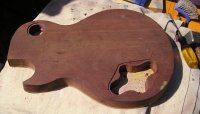
Before drilling into the carved top, a rebate was routed around the control cavities, to accomodate the covers. For the large, irregularly shaped cavity, a sharp chisel was used to straighten the edges of the rebate. This was to provide a solid base for the large cover to rest on.
Then came the very unnerving process of sinking a drill into the carved top. I checked the measurements and positions at least five times for every cavity before putting my precious guitar body near the drill. |
|
|
|
 |
|
|
|
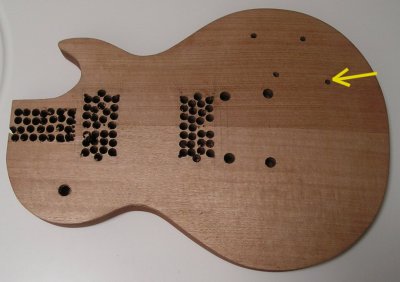
In the end, this was not so bad a process as I had expected. The flat back of the body allowed it to sit securely on the table of my bench-drill. The post-holes for the bridge were drilled for 24 11/16" scale length on the treble side, and 24 13/16" on the bass side. The holes for the pots were drilled from the back, with the front of the body resting on a piece of soft pine, to ensure that the holes were perpendicular to the outer surface. Mistake #4: One of these holes (arrowed) emerged at the wrong place. It was later filled with a mixture of epoxy glue and sawdust, and sanded flat. The error was sufficiently small that the pot-knob would cover the mistake. Phew! |
|
|
|
|
 |
|
|
|
|
|
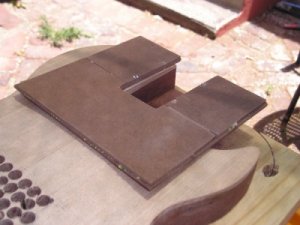
Having this part of the job done was a great relief. But the routing was even more nerve-wracking. A template was made for the neck mortice routing, screwed to the body at the edges where the fingerboard would cover the small screw-holes. The neck mortice turned out to be slightly misaligned, so the small surplus that I had left round the edges was a life-saver. Well, a neck-saver anyway. I was able to carefully chisel the space straight (about a 1 mm correction). |
|
|
|
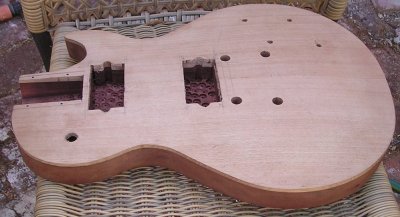
Routing of the pickup cavities was less simple. Because the top was already carved, I couldn't find a stable position at which to fix a routing template. So I used a chisel to clean out the top few millimetres of the space, and then used the space itself as a router guide. This resulted in a reasonably clean cavity, although it will be tidied up with the chisel later.
There has been a lot of discussion of the benefits of a long neck tenon, which increases the neck-to-body contact. I opted to stop the neck tenon just 5 mm short of the neck pickup cavity, rather than join it into a single cavity. My calculations suggested that the 5 mm loss of contact on the sides, would be compensated almost two-fold (in contact area) by the contact between the end of the neck and the back of the mortice. I'm not sure if this is really better, in terms of note sustain, and I'd be interested in other people's views on this. |
|
|
|
 |
|
|
|
|
|
I had drilled the initial holes a little deeper than was really necessary, but chose to leave the drill marks in the bottom of the cavities, rather than remove the extra wood. In the neck mortice, the bottom of the cavity was much cleaner. Fortunate, since the contact between neck and body is very important.
The problem of the forgotten wiring channels was solved using a long drill, which allowed me to drill a channel through the neck mortice into both pickup cavities. The hole in the neck mortice would be filled with epoxy and sawdust. |
|
|
|
 |
|
|
|
|
|
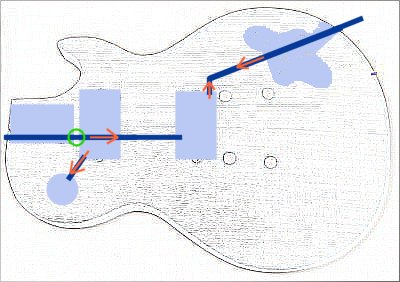
The cavities (light blue) were connected by drilling with a regular drill between the neck pickup and 3-way switch cavities, in the direction shown by the orange arrow. The others were drilled with a very long drill
The green circle shows the hole that would be plugged later. The most challenging was the connection between the control cavity and the bridge pickup cavity. This was done by drilling through the jack-space and control cavity towards the neck, avoiding the bridge post-hole. This was then met by drilling from the pickup cavity to meet the first drilling. To my amazement, the two holes met perfectly. Next time, I hope to avoid these makeshift solutions, but it turned out okay in this case.
Index |
|
|
|
|
|
|
 |
|
|
|
|
|
Next, making the neck. back to page 1, 2. 3, 4, 5, 6, 7 |
|
|
|