 |
|
|
|
|
|
|
|
|
|
|
|
|
|
|
|
|
|
|
|
|
|
|
|
|
|
|
|
|
|
|
|
chronicles of a
first-time guitar builder
(e-mail) |
|
|
 |
|
|
|
|
|
|

|
|
|
|
|
|
The first guitar music I was ever aware of, was by a popular duo of the early fifties, Les Paul and Mary Ford. Recent reading about Les Paul and his career made me very interested in the guitar that Gibson named after him. Having already bought a very satisfying Fender Telecaster, I couldn't really justify the expense of buying a Les Paul. Then I came across the web-page by John Fisher (Jon Tirone) on "How to build a Les Paul guitar, the hard way". John's entertaining and inspiring account of building a complex guitar under difficult circumstances persuaded me that I should try to make myself a Les Paul. Many other web-pages have been helpful in the process, mostly accessed through Project Guitar.com, and I'll mention them along the way. Up front I should express my appreciation for the advice of Perry Ormsby, of Ormsby Guitars who turned out to live just a little way from me in Perth, Western Australia. The Ormsby Guitars page is worth a visit.
After giving it some thought, I didn't just want to build a copy of the Les Paul guitar, but wanted to create a very individual guitar, which could be a tribute to the pioneering nature of Les Paul. |
|
|
|
 |
|
|
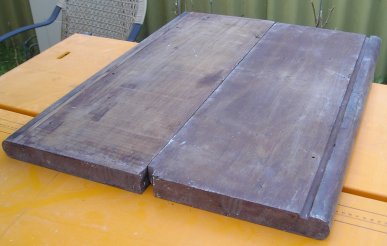
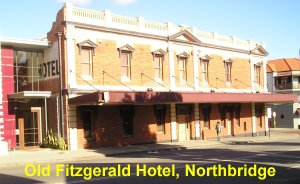
I decided to try using Australian jarrah (Eucalyptus marginata) for the main body of the guitar. I had some pieces of jarrah about 1.5 inches thick. These were shelves in the kitchen of my 105 year old house and allegedly started life as stairs in the pub round the corner (the Old Fitzgerald Hotel, Northbridge). So they are estimated to be around 100 years old... fairly well seasoned. Because jarrah is very dense (around 880 kg/cubic metre) with mahogany(about 450 kg/cubic metre, the body would have to be thinner than the conventional Les Paul. |
|
|
|
|
|
I joined the two pieces using gelatin as "hide glue", based on info from Frank Ford, Being sure to pre-warm the wood before spreading the glue. Once joined I trimmed the wood to about the right size (about 13" by 18") cleaned up the surface and "dressed" the wood to eliminate the slight bow that I hadn't noticed before joining them. Since I needed to thin the wood a little, this was not a serious problem. Mistake #1: I could have taken the wood to the local manual arts college to use their thicknesser to eliminate the bow. Instead, I used my router, with multiple passes to level each side. Then much sanding brought it all to a smooth flat finish. This took about four times longer than it would have taken to go to the college. |
|
|
 |
|
|
|
|
|
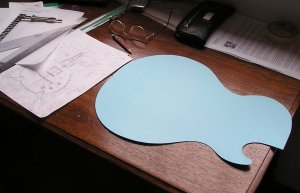
Using photographs converted to line diagrams, I made careful measurements and used French-curves to get a life-size outline of a Les Paul guitar and to cut a template from thin cardboard. |
|
 |
|
 |
|
|
I left the cutaway smaller than it would finally be, figuring that it would be easier to remove surplus wood, than to add anything back later. |
|
|
|
|
|
|
|
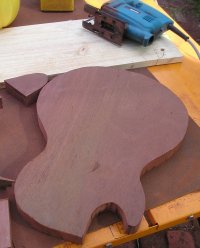
Using the cardboard template, I marked out the general shape on the jarrah blank. I had arranged to use a band-saw at a local workshop to cut out the shape, but decided to try my little jig-saw on the wood. It seemed to cut okay, so I cut out the basic shape. Mistake #2: While cutting the curves with the jig-saw, the blade tended to bend a bit. This meant that the sides of the body were not square to the top. Fortunately, the extra 1/4 inch left around the shape allowed the careful sanding needed to get the edges square. I think the band-saw would have avoided this problem.
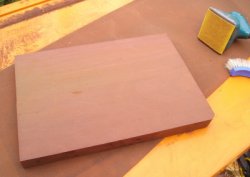
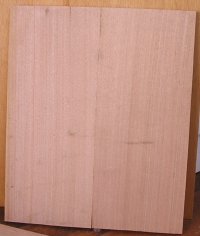
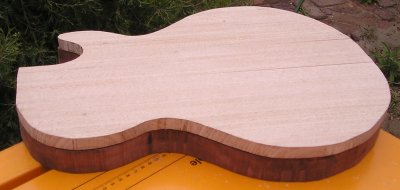
The top was to be made of Tasmanian oak (Eucalyptus regnans, also called Victorian Ash, another eucalypt wood, with straight grain and excellent resonance). Two pieces were glued with "hide-glue" trimmed, sanded and shaped to match the jarrah body. The top was 3/4 inch thick, so I was not too disappointed when I found this also had a slight curve. I flattened it the same way as the jarrah.... lots more routing and sanding. Pictures below show the blank and the cut-out top, placed on the body. |
|
|
|
 |
|
|
|
|
 |
|
|
 |
|
|
|
|
Next, gluing etc Page 2.. INDEX |
|