HOME   |   BACK
 other countries...

  KATHMANDU
NEPAL
  TREKKING
NEPAL
  CAMBODIA
  ANGKOR WAT
CAMBODIA
  VIETNAM
  LAOS
  THAILAND
  MALAYSIA & INDONESIA
  AUSTRALIA
  NEW ZEALAND
  USA WEST
  USA EAST

Vietnam

Population: 77 million
Ave Income: $320 per year
Currency: $1USD = 14,000 Dong


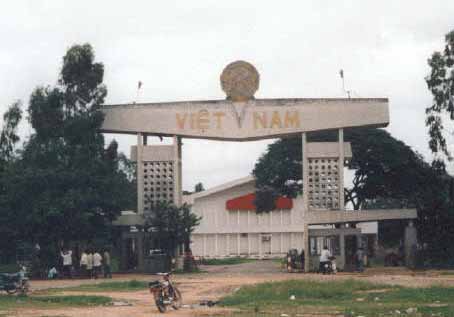
The Vietnamese border
 
It takes a mere five hours to drive from Phnom Penh to Saigon. The official name of the city is Ho Chi Minh, after the founder of the Vietnamese Communist Party, but everyone refers to the downtown central district as Saigon. I couldn't believe the difference as I crossed from Cambodia to Vietnam. All of a sudden the dust tracks and carts disappeared to be replaced with tarmac roads and air-conditioned buses. Infrastructure in Vietnam is one of the best in South-East Asia, and tourists of all budgets seemed to be well-catered for.

Saigon
 
'Saigon' is the central downtown district of Ho Chi Minh City, and is completely chaotic. The traffic is appalling - and the roads are ruled by Honda Dream scooters and of course, bicycles. Everywhere. Millions of them. By chance I found accomodation with a warm and friendly Vietnamese family, in an upstairs room that they rented out for tourists, while they slept on the floor downstairs. (yes, as a supposedly 'responsible' traveller, I did feel guilty) They owned two little yappy white dogs called 'Lucky' and 'Happy', whose names were called constantly, and which I always fell over after coming back to my room at night.
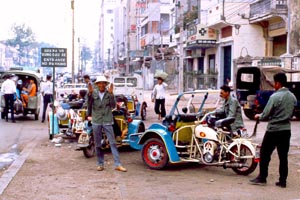
  Cyclo drivers in Saigon
Cyclos in Saigon
(click to enlarge)


I didn't take too many photos of Saigon - not sure why, but I certainly packed a lot in.
Day 1 - visited the Revolutionary Museum full of relics of the 'liberation' of south Vietnam following the American War. Also visited the 'Museum of American War Crimes' which was a shocking depiction of the effects of the war. Although one-sided and biased toward the 'Communist Ideal', the museum was an insight, if only to see how the war was presented from the other perspective, and to the destruction it caused on Vietnam and its' people.
Day 2 -rode on my host's pushbike up to Chinatown, north of central Saigon. Almost got killed fifty times and vowed never again to take to Saigon's streets. There are no laws of the road here, just hooters and luck. Chinatown - Cho Lon - is however very interesting - a maze of streets and markets, mainly of strange foods and live animals. Unfortunately it poured down with rain for most of the time so sat in a cafe and bought food for a woman and her baby begging along the street. Got lost on the way back and inadvertently toured Saigon's suburbs.
Day 3 - explored central Saigon with Yossi and Craig, a couple of guys I'd met on the journey into Cambodia (everyone seems to go the same way round). Very 'Western', high rise blocks and plush tourist shops. Walked down to the docks and looked at the huge yellow river that is the mighty Mekong.
Day 4 - walked around some more; checked out Saigon's nightlife in the evening. At night, especially Sunday nights, all of Saigon's hip youngsters cruise around on their Honda Dreams. A motorbike taxi took me around to check it all out - most people seemed to mill around the city's parks where live bands play and you can try karaoke.

Eventually left Ho Chi Minh City and headed up through the hill station of Da Lat to the popular resort of Nha Trang. Known for it's long sandy beach and tropical weather - and for backpacker's, for the mad boat trip that is Mama Hanh's. Mama Hanh is very unlike other Vietnamese women! Her catchphrase is 'Don't be lazy!' and she will ply you with beer and joints for the duration of her boat trip, which is supposedly a trip out to the islands but turns into a mad fest of drinking, smoking and bobbing around on rubber rings in the water. Advice: take a day out to recover from excess and inevitable sunburn. Oh, and the fresh seafood lunch served on the boat is divine...

Hoi An
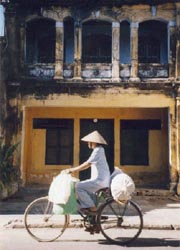
Hoi An, further up the coast, is a beautiful gem of a town. It is known for it's art galleries, historic colonial style buildings (see photo below) and amazing seafood. You can also have silk clothes made for next to nothing in the market by tailors copying designs right out of Vogue. And blissfully, no cars are allowed in the centre of town! A short cycle ride away through villages and rice paddies is an amazing beach. The people here are really friendly. I left with some silk clothes and some traditional rice paper paintings.

Hoi An
Street scene in Hoi An (click to enlarge)

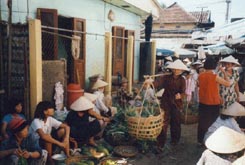
Hoi An market
Hoi An market (click to enlarge)


China Beach
China Beach (click to enlarge)
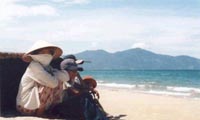
American GI's used to rest up at China Beach, just outside of Hoi An, for R n' R between trips in-country. It is a beautiful deserted stretch of pure white sand. These locals are taking shade by one of the traditional conical boats that are used for fishing.


Hué
The drive from Hoi An to Hue is beautiful. Vietnam remains one of the most intensely green place I have visited, from the countless sprawling paddy fields and misty hillside terraces to the lush deep jungles. The road to Hué winds up along the coastline through villages and dramatic scenery. Hué, in central Vietnam, was not quite as nice as I'd expected, although I probably didn't stay there for long enough. On my first day there I visited the 'Forbidden Purple City' an old walled city once used by the emperor, now a ramshackle collection of untended gardens, grid-patterned streets and colonial buildings. There are plenty of small art galleries in Hué that are worth visiting.


DMZ
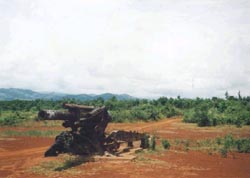
On the second day I took a trip out to the old Demilitarised Zone (DMZ) which saw some of the heaviest fighting during the war. The Ben Hai River marks the official demarcation point between what was once (and some say still is in terms of levels of wealth and economic development) north and south Vietnam. The area still bears the hallmarks of war - the jungle is sparse from the chemicals dropped by US planes, the land is largely unfarmable and there are still very evident craters from bombs. There is still live ordance scattered around the area, and the US continues to provide funding to search for missing GI's in the jungles here. The photo on the right shows the remains of the American Khe Sahn combat base, which was besieged by the North Vietnamese army in 1968 as part of the Tet Offensive. After 75 days and huge loss of life on both sides, the remaining marines were airlifted out, and the resulting victory for the North Vietnamese marked an important turning point in the war. One other interesting visit in this area was to the Vinh Moc tunnels, where a whole village, constantly bombarded with American bombing raids, relocated underground. The tunnels are amazing - it is difficult to believe that families lived in tiny holes cut into the earth, some of which are no higher than one metre.

Khe Sanh combat base
Khe Sanh - click to enlarge

Hanoi
Took the long journey from Hué to Hanoi in the far north. Vietnam's capital is a much nicer place than Saigon, more laid back and with less hustle and bustle. I stayed in the Old Quarter, a maze of streets and shops directed not toward tourists, like Saigon, but everyday life. The main thing on my itinery here was to visit the mausoleum of Ho Chi Minh, the 'Father' of Vietnamese Communism. Uncle Ho (as he is known) is preserved eerily in a glass case for all to see. As the guards take you through to the viewing area, it is explicity forbidden to gesture, laugh or show any disrespect towards Uncle Ho.

Halong Bay
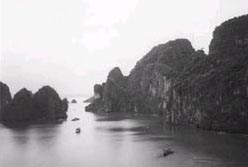
Just north of Hanoi is are the dramatic limestone cliffs and islands of Halong Bay (right). Although this area is quite touristy, the boat trips round the bay are pretty stunning, even if there are no longer traditional junk boats plying the waters.
Halong Bay


Sapa
I decided to take a weekend trip up to the hilltribe area of Sapa, in the very far north of the country, near the border with China. After overnighting on one of the trains - great experience, although my bunk was a little too close to the rotating fan for comfort - I reached the town of Cao Dai, and transferred by truck up to Sapa.

Sapa, the place and the people, is unlike anywhere else in Vietnam. It's high up, and quite chilly, and the locals are made up of hilltribe people dressed in their traditional navy uniform (coloured from vegetable dye) and colourful hats. They are extremely friendly and speak English remarkably well (some of them even with Cockney accents - seriously). Most people go trekking up here as it's pretty remote and you can visit some cool hilltribe villages - but I was on my own, and in the mood to chill out. On my second day there I hired a taxi driver to take me round some of the local villages. Because the roads are pretty poor, most locals get around by Russian 'Triumph-style' heavy-duty motorbikes. My guy spoke no English and had the most badly-stained betel-juice teeth I have ever seen, as well as what appeared to be a cataract in one eye. Nevertheless, the trip turned out to be safe and very interesting!


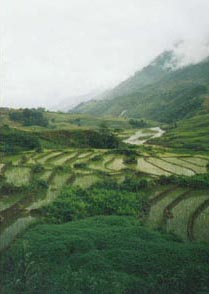
This most northern point of Vietnam is stunningly beautiful! Think huge sweeping green valleys of paddy fields topped by hills reaching into day-long mist. The photo is actually of a huge field of marijuana, which the locals grow for their own consumption. I jumped off the back of the bike at one point and checked out a village, involving a walk down into the valley. With great luck, I stumbled across a hilltribe 'party' in a community hall. One of the great things about the minority hilltribe people is that women are treated on an (almost) equal basis with men (although Vietnam seemed to me one of the more equalitarian societies in Asia) and so I was greeted with a very warm welcome by men and women of this tribe. Because of the language difficulties, I am not sure what they were celebrating, but they all seemed steaming drunk and invited me with much hilarity and eager encouragement, to try the local rice wine brew. Two very potent cups later, and with much back-slapping amongst all party-goers, I beat a hasty retreat back to the bike and spent the hour's drive back to Sapa holding on for dear life. Sapa valley
Fields of marijuana in Sapa valley -
click to enlarge


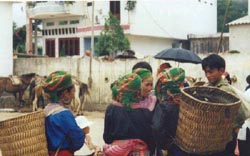
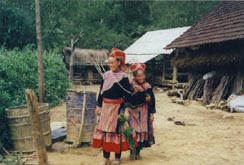
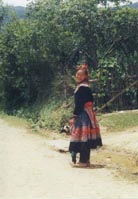
After this, I decided upon a tour to another 'hilltribe' village and colourful market area, Bac Ha. Here I met June from Australia, a retired headmistress taking time out before starting a Uni course. In Bac Ha on market day the surrounding tribes travel down from the hills to trade. The market was a bit of a shocker - especially the meat section - but people-watching is the main activity here, and the colours of the local tribespeople's dress is amazing. Most of the photos below are of the 'Flower Hmong' tribe.

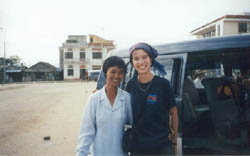
our guide to Bac Ha
with our guide to Bac Ha -
click to enlarge


Bac Ha market
Flower Hmong tribeswomen at the market
Women of the Hmong tribe
Hmong tribeswomen in a village outside Bac Ha
Hmong girl and baby
Hmong girl with child outside Bac Ha


Back in Hanoi, my Vietnamese visa was running out and I decided I had to make a 'break' for the Lao border. The only land crossing open to foreigners was at Lao Bao, which meant a long bus journey back to central Vietnam and staying overnight in the town of Dong Ha, near the old DMZ.

Dong Ha is a shithole. Really. A huge grey town serving as a through-stop for trucks (although there are plenty of military sites to visit outside the town). The only place to stay is the dirty 'Dong Ha Hotel', a giant socialist-looking building practically falling apart where I was the only visitor. Unfortunately I also attracted the attention of the hotel manager and his bunch of drunken lecherous mates who were in the dining room the same time as me - one of the few disadvantages of being a travelling single gal. After about an hour of politely refusing drinks, food and finally, marriage, I finally managed to get rid of them and barricaded myself in my room which I was sharing with surely the largest cockroaches in Vietnam. Ugh. Time to not be here!

In true travelling fashion, the journey to the Lao border was an adventure in itself. Me and my large rucksack were put on the back of a motorbike taxi and driven the two hour trip to the border. Motorbikes are surely the best way to see a country! Providing I guess that the weather and roads are OK. We travelled through some very interesting countryside in the heart of some of the most fought-over land in the War. I passed crater-pocketed farmland, barren hillsides and tiny villages where the children in pristine school uniforms stopped and stared at me. I asked my driver for food and he took me to this cafe owned by his mates, where I ate dubious-looking 'meat' and rice. I gave the driver a decent tip, so thankful was I to have reached this remote border safely. Phew! Next stop: the 'forgotten' kingdom of Laos.


Links
Mainly to do with the war... some really excellent sites that are well worth a visit...

'Award-winning' site with photos and narrative from the War

Photos of areas round the DMZ during the War
Hosted by www.Geocities.ws

1