Kathmandu
Nepal
Population: 22
million
Ave Income: $ 180 per year
Currency: $1US = 75 Nepalese rupees
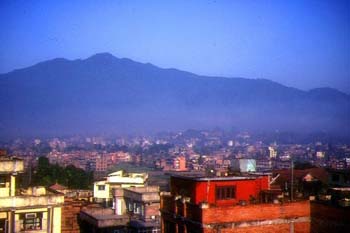
I arrived in Kathmandu in the middle of the night, a taxi driver little more
than 14 years old drove me to Thamel, backpacker central in the heart of old Kathmandu. First stop for me was the Kathmandu Guest House,
or 'KGH' as it is fondly known, the height of backpacker comfort, with 'chill-out' gardens, beauty salon, CNN and newspapers (if you want)
and a general escape from all the mayhem of Kathmandu streets.
Kathmandu: population little more than 500,000; lying in the foothills of the Himalayas, which
can be seen from city rooftops on a clear day. A city where ancient temples are nestled among busy
polluted streets, and beggars, cripples and holy men wander among city markets and shrines. At least, that
was my first impression! The city is centred on Durbar Square, an area of pagoda Hindu shrines
and the ancient palaces. The square is amok with taxi men, rickshaw drivers and saddhus, wandering Hindu
holy men who have given up all their worldly posessions and rely on donations from others to live. Just to note,
one of the many confusing things about Nepal is the way in which Buddhism and Hinduism exist side by side - roughly half the
population are followers of each. Consequently, the shrines and temples worth visiting have a complicated
array of beliefs, gods, deities and history to take in.
I spent about two weeks in Kathmandu in total; it is not enough. It is an amazing place, and whilst on
the 'backpacker trail', tourism does not dominate here in the way it does in some other traveller centres in Asia.
These photos can only give a very general outline of Kathmandu - in reality it is even more of a diverse and historic
city.

| Swayambunath Stupa |
| |
|
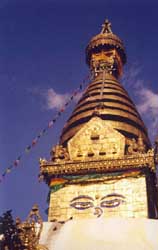
Swayambunath stupa
is a Buddhist pagoda sitting on a hill overlooking the city. It is inhabited
by a horde of aggressive and ugly monkeys. It's also well worth climbing
the hundred-odd steps to get to see the top - not only are the Buddhist
temples interesting to visit, but you get a good idea of the size of the
city. We spent some time wandering round the temple complex before rabid-looking
dogs convinced us to return back to town.
|
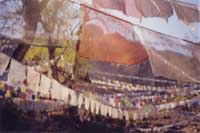
Buddhist prayer flags strung up in Swayambunath temple grounds. It is believed that
with every gust of wind, these prayers are sent heaven-ward. They are strung
up around every Buddhist monastery or shrine in Nepal.
|
Prayer flags - click to enlarge
|
chakra points - click to enlarge
|
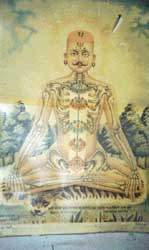
A diagram of the
body's chakra points, a poster hung up outside my room in a guesthouse in
Kathamandu. Everywhere there are meditation, tai-chi, yoga courses available.
Many westerners come to study here for a long period of time, and find places
to live in the city.
|
| There are historic shrines and temples all over
the old quarter of Kathmandu. Most of them are hundreds of years old - while
they would be classed as ancient monuments here, in Kathmandu they used for
everyday purposes, mainly as washing lines. |
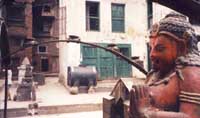
Hindu shrine - click to enlarge
|
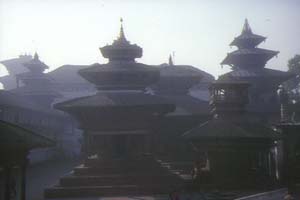 |
Durbar Square,
the 'magical heart of old Kathmandu' is pretty much filled with people at all times of the day. This is the original heart of
Kathmandu, where all the oldest temples and the old Royal Palace are located. In Nepal, you can pretty much clamber over such historic monuments.
I climbed up the steps of one of the pagodas and spent some time watching city life in Kathmandu pass by. |
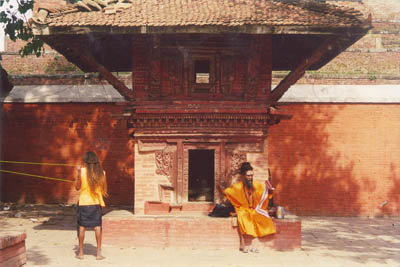
Saddhu holy men in Durbar Square |
| Saddhus are Hindu holy men and
are a common sight all around Nepal, but especially in Kathmandu's Durbar
Square. They are often, but not always, older men, who decide to renounce all
their worldly possessions to devote
their lives to Hindu holy life. They commonly wear yellow robes, walk
around barefoot and smoke hash, and travel from place to place, relying
on donations to live.
|
| Bodnath Tibetan Stupa, Kathmandu |
|
The pagoda of
Bodnath is the focal point for Nepal's exiled Tibetan population. You can
walk on the stupa itself, as the base is rounded topped with the square
base with the all-seeing eyes staring serenely and eerily out at you. As
the afternoon drew to a close, a number of local Tibetans began walking around
the stupa clockwise, chanting Buddhist mantras and spinning the prayer wheels. |
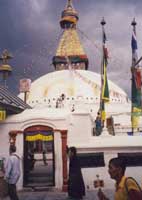
Bodnath Tibetan stupa
- click to enlarge
|
Patan
|
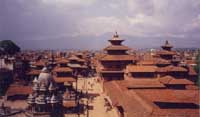
the old square of Patan - click to enlarge
|
The city of Patan lies just
across the river from Kathmandu. It was once a rival city to Kathmandu and had its own
palace and administration. After walking round looking lost for a
while, Sarah and I hooked up with one of the young guides who turned out
to speak near-perfect English, and was a complete mine of information on
the history of the city of Patan and the nearby city of Bhaktapur. One of the most beautiful spots in Patan was
the old garden at the back of the Royal Palace, now completely overgrown, but retaining an element of mystery and beauty.
|
| Whilst in Patan, we were caught
up in a Hindu monsoon festival, involving the construction of a huge wooden
chariot which is pulled through the streets by about 20 Nepalese men. This
yearly festival is calling for good rain during the upcoming monsoon season,
in order that the crops be able to grow. |
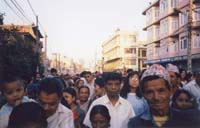
Patan street festival - click to enlarge |
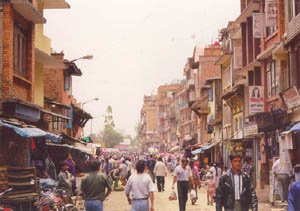
Streetlife in the city of Patan |
| Links |
| www.ktmgh.com - the legendary Kathmandu Guest House |
| |
| ©usethebuddha.productions2002 |
 |
|  BACK
BACK)
)
)
)
)
)
)