Laos is a landlocked country
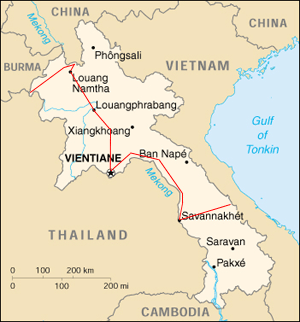
sitting between Burma and Vietnam, and north of Thailand (check the map!).
It is one of the most mysterious and isolated countries in South-East
Asia, with a turbulent recent past since gaining independence from the
French in 1949. Laos has the dubious distinction of being the most bombed
country in the world, for during the Vietnam War, US planes dumped their
unused bombs as they flew back from air raids. Much of the Ho Chi Minh
Trail, used by the Vietnamese Communists to ferry arms and supplies to
their comrades in the south, is also located in the isolated easternmost
provinces of Laos. It was into this region that I crossed over from Vietnam.
I appeared to be the only
foreigner - nay, the only person, crossing the border at Lao Bao that
day. After finding my way to the nearest village, which was really just a small collection of
shacks, I quickly decided to find my way out again. Unfortunately
the last bus to Savannahket, the nearest big town and a day's drive away,
had left much earlier in the day. Fortunately, I bumped into a Japanese backpacker in
the street who would be my saviour of the day. He spoke no English but managed to
negotiate with a Lao truck
driver a lift for both of us, that day, to Savannahket. It was the most
amazing journey, sitting high up in the cab of this truck with a rather
bemused Lao truckie blaring out Lao pop music. The road was unpaved, the country heavily
jungle-fied, and settlements few and far
between. This really is a very remote part of the world! In this area there are apparently large amounts of discarded US tanks and military equipment
left behind to the jungle after operations during the war in neighbouring
Vietnam.
We arrived in Savannahket at night, covered in red dust, our eyes blinking
to the lights of civilisation. Savannahket is a small town in south-central
Laos, sitting on the Mekong river. Many of
the buildings date from French colonial times and the streets are set out in
a grid fashion. It was my first introduction to the friendly people of Laos,
and everywhere I went in the town children would cry out 'Sawasdeeee!' (hello) to me. I also discovered early on that anyone over the age
of 40 is bilingual: they all speak fluent French, a leftover from the days of
French Indochina (although this was no good to me!). I ate every day in the
local caf, always the only customer, where Country n' Western songs would blare
out constantly, and the owner had the highest quiff in South East Asia.
There's plenty to see in southern Laos, but I knew I'd have to travel alone
to see it, and this was a pretty isolated part of the country. Plus I'd heard
of a malaria outbreak in the area of a Hundred Islands, so decided to head
right up to the capital, Vientiane. I shared the bus ride with a Danish guy
and we were subjected to the delights of Laotian roadside food - barbequed cockroaches
and other assorted bugs, sold on kebab sticks, seemed to be the speciality.
At lunchtime, a Japanese guy opened up a fried banana leaf (much food in South
East Asia is cooked and served like this) to reveal barbequed scaly reptile, skin intact.
As we neared the capital Vientiene, I expected the traffic and people flow
to become heavier. However, hardly anyone seemed to be around - but I soon discovered
this is normal for Vientiene. It has a population of only 150,000 and even the
central city square is deserted on a Friday night - very surreal. There is quite
a thriving community of European expats in Vientiane, and consequently a surprising
array of places to eat. I enjoyed my first pizza and bottle of red wine (not
all to myself) in a small French restaurant, with a bill of about $5. This is about as expensive as a meal
can possibly get in Laos.
There's a very rustic 'sauna' in the grounds of a Wat just outside Vientiane, where all the locals go.
You are given an orange robe to change into and sit in a wooden shack above a raging fire of wood and herbs.
It was the hottest place I've ever been - although the locals seemed much more hardy to it than us Europeans.
Vang Vieng
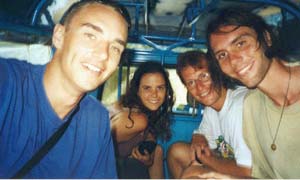
Vang Vieng is a few hour's north of Vientiane. On the bus on the way up there I met Nigel and Debbie and three other English guys who had also only just met.
'Nige' was shaven-headed, covered in tatoos and very outspoken. He managed to joke with and entertain the locals on the bus,
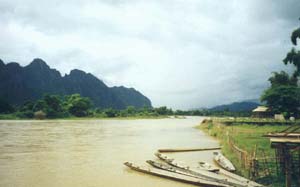
making the journey seem much shorter. Vang Vieng (see photo) is a small town just waking up to the novelty of
backpackers and tourism. It is known for its limestone cliffs and picturesque setting by the river.
I spent a few days here hanging out with my new-found friends. One of the highlights was rubber-ring riding
down the river - a shop in town gives you a heavy-duty ring, and you catch a tuk-tuk upriver, scramble down
the bank and let the torrent take you back to town. Bang lassies1 beforehand are optional.
There are also caves worth exploring. I hired a bike with an English guy wanting to explore this cave that had
only just been 'discovered.' It was way out of town, and half an hour's trek up a creek through thick jungle.
Our guide suddenly turned up when we reached the cave, a little old man who handed us old-fashioned torches
with batteries attached, and led us down a ladder into the cave. I will never enter a cave again.
The 'tour' was meant to last half an hour. We were in there for two hours, our torches died until we only had
one between three of us, the guide then dropped his, and, despite giggling like a maniac, he managed to retrieve it.
Otherwise we'd probably still be in there. Mud and huge spiders were everywhere (I hate spiders).
Our guide, we quickly surmised, was stoned or on opium as he seemed completely lost. When he finally led us
out into fresh air, I am still convinced it was only by chance he found the exit. Never again!
|
 |
|  BACK
BACK