Perhentian Islands |
|
Entering Malaysia by land is particularly daunting if you are coming from a 'live and let live' country like Thailand. On the entry forms you have to sign a declaration that you are not bringing drugs into the country, and the huge red skull and crossbones indicates that the death penalty
will be enforced for those breaking the law. Malaysia is very different from Thailand, in terms of people, culture, development, ooh everything really. It is a Muslim country with a very strong and evident patriarchal culture. It is much more 'westernised' than other South-East Asian countries
and consequently appears much more wealthy. At the border I was fortunate to meet up with Tracey and Steve from Leeds and two Danish guys and we decided to hitch together to Kota Bharu, the nearest town. It is also the jumping off point for the tropical Perhentian islands. Kota Bharu is actually a cool little town with an amazing bazaar where
we all settled down to our first taste of Malaysian cuisine. We were interrupted by the most ferocious electrical storm I've ever been in, it took down an electricity pylon by our hostel and almost caused a huge fire.
|
| |
Perhentian Islands
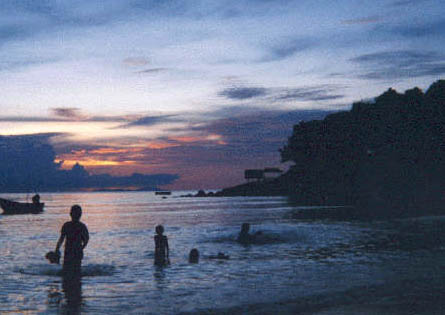
These islands are situated just off Malaysia's east coast. We took a boat and stayed at one of the local beaches where a cluster of huts cater for backpackers and divers that visit the Perhentian's long white beaches and crystal-clear waters.
Diving here is also incredibly cheap, visibility is around 30 metres and the water is oh so warm. I did a number of dives here, including a dawn dive. This really is amazing.
You are taken out and descend into the water just as the sun is breaking over the ocean and islands. Our rather enthusiastic Divemaster proclaimed that at this time, the fish are still 'just waking up'
and there are plenty of them to see. Apart from many different types of fish and coral, we swam with turtles and barracudas.
I was lucky here to meet such a great bunch of people. The days were spent diving and sunbathing, and evenings eating the most amazing barbequed seafood.
A really healthy lifestyle had it not been for the copious amounts of beer drunk every night.
|
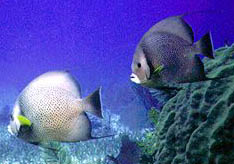
Angel Fish, found in tropical waters |
| |
Singapore
After spending far too much time on beaches, I headed down to stay with my Uni friend Jasmine in Singapore. After months backpacking and roughing it, Singapore has to be the strangest culture shock ever.
Especially as Jas was living in an amazing apartment block right in the centre of town with sauna, pool and beautiful city skyline views. We had such an amazing time too, Singapore's nightlife is 'vibrant' to say the least,
there are some great bars although drinking becomes quite expensive after a while. One of the highlights of a trip to Singapore is the shopping and food. A mix of Malay, Indian and Chinese influence makes Singapore one of the world's culinary centres.
One of the best dishes is 'chicken rice', chicken steamed in all these delicious herbs served with rice. Mmmm.
|
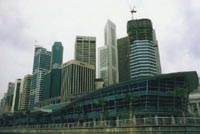
Clifford Quay - click to enlarge |
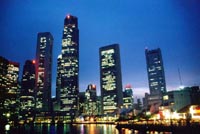
Boat Quay in the heart of Singapore's financial district -
click to enlarge |
| |
Kuala Lumpur
Didn't spend much time here, although it's a perfectly nice place if not a bit hectic. The main adventure was actually getting here from Singapore - I had booked on a coach which broke down halfway there.
We all spent about 2 hours standing by the side of the road while the driver tried to fix the problem, then he decided to give up and sped off on a little scooter that appeared from nowhere. All the passengers, mainly Malaysian, were left
stranded by the side of the road. I ended up teaming up with a Swedish guy and hitching into KL with a fish van.
Lots to see here, including the world's tallest building. Lots of mosques. Food. Unfortunately the hostel I was staying in was crawling with bed bugs so it wasn't the most comfortable stay.
|
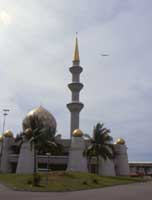
Mosque - click to enlarge |
Cameron Highlands
In central Malaysia, this is a hillstation that the British developed during colonial times. The bus from Kuala Lumpur climbs through high altitude rainforest shrouded in mist.
It was really strange to suddenly arrive somewhere where the climate is like England. In other words, the temperature dropped and it started raining almost as soon as I arrived. Get those geography macs out!
Like most of Malaysia, the cafés and businesses are half Indian and half Chinese. One day I hired a bike and checked out the outskirts of town. I literally rounded a bend and came across the most English-suburbia-like housing I had ever seen.
I could almost have been in New Malden! There was this one road, obviously built by the British before the war - where all the houses were semi-detached with little front gardes, hedges, garden fences and iron gates. The only thing missing were the net curtains.
In fact, you might not know you were in Malaysia were it not for the sarongs and items of clothing hanging outside. Very strange.
The Cameron Highlands are well-known for tea cultivation. This photo shows the workers picking good leaves to be processed into yer PG Tips. You can buy tea and scones in a café overlooking the rainforest. This place was becoming unnervingly like home. Decided to head up to Penang.
Penang
Penang is a small island off Malaysia's west coast. Most visitors just make it to the old city of Georgetown, which is a fascinating blend of British, Indian and Chinese culture. The thing that struck me most about Penang, as opposed to anywhere else in Malaysia, was how everyone lived
together peacefully regardless of family or 'racial' background. As with many fusion cultures, the food was amazing. You can buy tandoori chicken baked in a metal furnace on the side of the road for £1. I met up with Norman from Luxembourg and we spent full days sightseeing.
Sumatra
Population: 224 million (Indonesia total)
Ave Income: $ 2,800 per year
Currency: $1USD = 0.11 Rupiah
Sumatra is Indonesia's largest island and is located off Malaysia's west coast. I took the ferry from Penang to Medan, Sumatra's capital. Indonesia seemed quite a difficult place to acclimatise to after Malaysia's semi-familiar western ways. I was therefore lucky to meet with an English guy
who had been to Sumatra many times. Medan is a pretty horrible place, congested, dirty and over-populated. After driving round Medan for what seemed like hours in the back of a taxi, I finally found the right bus station and managed to get transport straight out of town for the Orang Utan sanctuary of
Bukit Lawang, a few hours south of Medan. Indonesian buses are pre-1970 claptraps, more like a coach, and as usual, will be crammed with as many people, chickens, luggage etc. as possible. A particular feature of Indonesian transport is the 'bus boys' that administer the luggage and alighting on and off the bus.
He will hang off the back doors of the bus, and whilst the bus is in motion, usually going round a sharp bend, he will climb up to the roof luggage racks, and with equal ease, swing back down into the bus.
|
|
I arrived in Bukit Lawang at night, tired and dusty. Bukit Lawang is a small village well-known for it's Orang Utan sanctuary, one of the few places where these animals are protected. It is also reknown, I found out, for the large numbers of lecherous single Indonesian men
who are looking to meet a European woman to marry. This aside, I had a great time here.
The sanctuary is a short walk away, and visitors are herded onto a viewing platform where a park ranger sits
poised with a bucket of water and bananas. In true 'Jurassic-Park' style, the first sign of these
animals approaching is a rustling in the jungle and then these huge animals - and they really are huge -
come into view. |
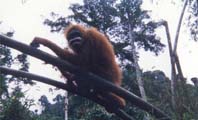
Orang Utan - click to enlarge |
After Bukit Lawang, I headed for the small town of Berastagi, 1300m above sea level. It's pretty much a one-horse town, in an area dominated by Sibayak volcano.
I stayed in the 'Sibayak International Guesthouse' run by 5 very-clued up local women. While the much of Indonesia is Muslim, this is Batak country, a people reknown
for their matriarchal culture and freedom given to women.
I met up (being the only other visitor) with an English guy called Paul and we decided to trek the volcano together. As we gradually hiked up dusty paths through farmland
the shadow of the volcano seemed a far-off goal. The trail was not clearly marked and we saw no-one else on the track, so I was really
glad I hadn't decided to do this on my own! The landscape turned from forest to chalky volcanic dust, and after about 3 hours, we reached the summit.
The volcano itself is no longer active, although the crater is huge and still bubbling and smoking away. After about 20 minutes 'oohing' and 'aahing' at the gigantic crater
the weather suddenly changed and we heard an ominous distant rumble of tropical thunder. Deciding that being stuck on one of the highest points of Sumatra with a tropical electrical storm impending was not a good idea,
we started to hurry down the narrow trail. Very soon the rain started to pour, so hard that it felt like pinpricks on our skin. Despite the weather, and actually because of it, the rainforest around us turned into
a beautiful misty wonderland, the bamboo trees taking on a mystical appearance. Our descent took a third of the time, mainly because we were leaping from one step to the other in the torrential downpour.
By the time we reached the bottom, the rain had almost stopped, and with clothes and packs soaked through, we jumped into the pumping hot volcanic springs at the end of the trek. A perfect end to the day.
Lake Toba
Lake Toba is Sumatra's premier tourist attraction. It is actually a small island in the middle of a volcanic lake, an eruption from 100,000 years ago that made Krakatoa seem like little more than a fart.
There is plenty of accomodation here, although the area was quiet, partly due to presidential elections taking place in Jakarta, and also partly due to the conflict in East Timor that was beginning to develop. Probably not
the best time to visit! However, I had some amazing accomodation in a reconstructed traditional 'Batak' home, a huge cottage on stilts made from wood and with plenty of nooks and crannies. I met Tam and Todd from Manchester, and spent a few
relaxing days walking round the lake, cycling through local villages and admiring Toba's breathtaking scenery.
|
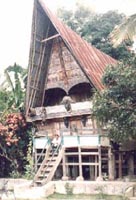
Traditional Batak house -
click to enlarge |
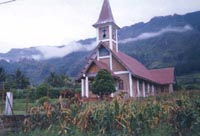
Catholic church, Toba - click to enlarge |
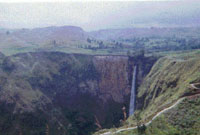
Waterfall flowing into Lake Toba - click to enlarge |
The journey I undertook from Toba to Bukittingi, deep in Sumatra's rainforest centre, was amongst one of the worst travelling experiences on my trip!
The huge bus was crammed with people and animals, there were about 5 of us travellers, and we were made to sit at the back of what seemed like a death trap on wheels.
The trip was overnight, the torrential rain started to pour down as soon as we left, making the unlit roads into mudstreams. The driver appeared to have complete disregard
for all his passengers, careering along the slippery roads like there was no tomorrow. During the breaks he would drink beer with his mates and then get back on and drive. And he also tried
to steal one of the other traveller's luggage. As if this wasn't enough, the Dutch girl Manon developed a bad case of food poisoning, and was ill for the rest of the trip, poor thing.
Sleep was impossible and only my walkman kept me going...
I think I prayed outloud when the first rays of dawn began to appear. The rain eventually stopped, and we neared the hillside town of Bukkitingi.
Accomodation was hard to come by, but I found a small room in a little guesthouse with a bucket of water for washing and a comfy bed.
I had intended to stay longer here, but the long distances travelling round the country were pretty exhausting and I felt like moving on. Fortunately the onward journey was much more pleasant, I had decided to leave Sumatra and
head back to Singapore for a few days. I took a number of buses, crossed the Equator - twice! - to get to a town called Pekanbaru in the middle of nowhere.
I stayed here overnight and woke up at dawn the next morning to get to a port on the island's east coast where I boarded a ferry, which took me to another ferry,
which eventually took me to Singapore by the end of the night. The contrast travelling from one country to the other could not have been more stark. As I left
the rural rainforested island of Sumatra, with it's angry young men, the skyscrapers and lights of wealthy and 'western' Singapore came into view. It was one of the strangest
crossover of cultures I have witnessed. How the relatively poor Indonesians must view the rich island-state of Singapore, showing off it's bright lights on the horizon, is anyone's guess.
I arrived at the immaculately clean port and took an equally clean (and expensive) bus to my friend Jasmine's flat, back to the little luxuries of my own room and hot water.
I was sad to be leaving Asia and all the wonderful experiences I had had here. I would miss the colours, the smells, the cultures, and the people. However, the next part of my trip beckoned: Australia!
|
 |
|  BACK
BACK