HOME   |   BACK
 other countries...

  KATHMANDU
NEPAL
  TREKKING
NEPAL
  CAMBODIA
  ANGKOR WAT
CAMBODIA
  VIETNAM
  LAOS
  THAILAND
  MALAYSIA & INDONESIA
  AUSTRALIA
  NEW ZEALAND
  USA WEST
  USA EAST
Cambodia
Population: 11 million
Ave Income: $60 per year
Currency: $1USD = 3820 Riel


We had been in Bangkok over a week before deciding that more adventure was due and that we'd travel overland into Cambodia to see the Angkor Wat temple complex. Until fairly recently, travel by road into anywhere in Cambodia was very difficult, due to attacks by the Khmer Rouge and bandits. The travel agents along the Ko Sahn Road in Bangkok were quick to advise us however, that the journey had now been made safe, and that visas were very 'cheap, cheeeaap!' We decided to take the 6am train from Bangkok to the Thai border town of Aranyaprathet, and then cross over and take public bus to the Cambodian town of Siem Reap, which is the stopping off point for Angkor. Having talked to other travellers, we surmised that we might be able to do this trip within one day.

 
The Journey

Leaving Bangkok at 6am is a mission in itself as the city at that time of day is in the middle of a very hectic rush hour. Our train rumbled over crossings crowded with waiting cyclos and motorbikes, and past railside shacks whose inhabitants were going about their morning cleansing, praying and cooking just metres from our window. The humidity at that hour is already stifling, but eased as we left the city and journeyed through farmland, villages and jungle until reaching the border later in the morning.

For Asian border crossings, the market town of Aranyaprathet is probably fairly normal, but appeared to me as a seething mass of people and animals in abandoned mayhem. We seemed to be the only travellers amongst the throng. We were stamped quickly out of Thailand, and in the Cambodian entry office, met up, thankfully, with a gaggle of about 10 other Westerners. They seemed to already have transport organised for them, a taxi in the form of an open Toyota Landcruiser where people and rucksacks were thrown in the back together...


Click on pictures to enlarge
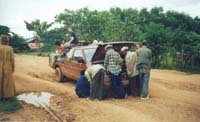
...After sizing up the alternatives - a little Cambodian kid on a moped offering to take us the 12-hour journey to Siem Reap with our rucksacks - we decided to tag along with the taxi group. They turned out to be travelling independent of each other, and were an interesting bunch of people. I talked the most to Yossi, an Isreali guy just out of the army who claimed to want to avoid all other travelling Israelis, and to Craig, an Australian vineyard-owner who took time out every year to travel to the most far-flung places he could think of. There were also a couple of Japanese guys, an Irish girl, an older Dutch couple and a young trendy Danish couple who looked a little bemused by the whole experience. The pic on the left is only 2 hours into the journey: we are all still smiling.


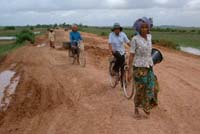
My initial impression of Cambodia was that it was sparsely populated, as we didn't seem to go through many villages. But the ones we did go past were amazing as little children rushed out of the houses to greet our truck with this strange bunch of dusty tourists on the back. The road, more of a dirt track, was awful, full of potholes which the truck slowed for every time, as we lurched around in the back. A few locals were also negotiating the road on bikes and on foot. Along the horizon as far as you could see were paddy fields and the odd giant palm tree.
Click on photos to enlarge


Click on pictures to enlarge
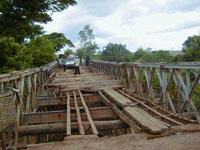
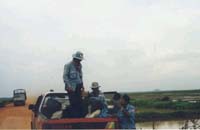
We passed over a couple of battered-looking bridges, and one of the guys in the back pointed out the bullet and mortar marks in the remaining masonry of the bridge. Until as recently as last year, this road and whole district had been the frontline of a bloody civil war waged between government troops and Khmer Rouge guerillas. Most of the bridges however consisted simply of planks of wood, which our driver and the 2 Cambodian guides on the back adjusted before we went over. I have never prayed so much! We passed through many little checkpoints which consisted of a few guys hanging around the side of the road, heavily armed, with a palm branch overhanging the road, to which our driver paid a few hundred Cambodian riel to pass.


There are still millions of landmines left all over Cambodia. These local teams are sponsored by the UN to locate and remove mines. Apparently the Cambodian government used to pay farmers US$1 per day to go out with a stick into their fields and find landmines. Needless to say, there are still many many deaths from unexploded ordnance.

Click on pictures to enlarge


As the sun set, we all jumped out of the truck and ate 'sticky' rice out of bamboo sticks from a roadside shack. We had now been travelling for almost 10 hours in the back of a very crowded and uncomfortable truck. Officially, tourists are not permitted to travel at night on country roads because of the risk of armed bandits. Everyone was becoming a bit frazzled and ratty, and the Irish girl was being hassled by a Cambodian kid. We were eager to reach Siem Reap. Bumping up and down through the night air, in which sleep was impossible, I was surprised by flashes of light and the sounds of firecrackers just behind our truck. Unfortunately these weren't firecrackers but a guy in military fatigues on the back of a moped firing his AK47 in the air to get our truck to stop. All of a sudden, loads of guys in tatty military gear turned up and prowled round our truck as the guy with the gun screamed in Cambodian and pointed the gun at our driver, who had been hauled out of his cab. This was not looking good! Even our Cambodian guides looked scared. I closed my eyes and expected any minute to hear gunshots. Only the Israeli guy, used to years of fighting, looked completely nonplussed. It became clear early on that the 'soldiers' wanted nothing to do with us tourists. Our driver, it appeared, had committed some insult against the angry guy earlier on, and he had pursued us to have a go. Needless to say, it was a pretty terrifying experience in a fairly lawless, dark and dangerous part of the country. Eventually it all calmed down, the driver paid a bribe, and we moved off down the road to Siem Reap, which seemed to me an oasis of light and calm in comparison to the bad country roads!
 
Siem Reap

We stayed five days in the town of Siem Reap, and used it as a base to explore the amazing temples of Angkor. It was a small and peaceful colonial town, and we made friends with our guide from the guesthouse we stayed at, a guy called Heng. He took us round his favourite eateries, Sarah and I perched on the back of his Honda Dream.


Phnom Penh

After three days of wandering goggle-eyed at the amazing Angkor Wat, we took the 'speedboat' down the huge lake of Tonl� Sap to Phnom Pehn. Only when you get to this city does it become apparent that Cambodia is very different from other parts of Asia. It is certainly 'Third World', there's no real infrastructure and poverty is everywhere. I've heard it described as Asia's 'Wild West' or, as one author describes it, a country of 'guns, girls and ganja'. Laws are loosely enforced, and only if you pay the right person. We stayed at Narin's Guesthouse owned by a local police chief and his brother who was in the army - alright there then. There are quite a few tourist attractions in Phnom Pehn, not all of them very wholesome. I'd heard about the shooting range and just had to check it out. You can take a turn on a magazine on an AK47 for $15, throw a hand grenade for �30 or try out a rocket launcher for $40. Call me a wimp, but I chose the relatively smaller AK47 (apparently once you've pulled the pin out of the hand grenade it makes a little 'pop' sound - no waayyy!). There are 30 bullets in a magazine, and like a real girl, I had to take a sit-down in the middle of the firing session. However, I was quite chuffed to hit the target every single time. At the same time, the prevalence of guns in Cambodia is alarming even for worldly eyes I'm sure. The next place I visited was testament to Cambodia's violent past.

I also visited the S-21 Genocide Museum, site of Khmer Rouge torture and inhumane imprisonment conditions. This place is really shocking. The building was originally a high school, a fairly conventional three-block high structure that was turned into a prison when the KR took power in 1975. The classrooms still have bloodstains on the floors and shackles on the walls. There is a huge case of unearthed skulls in one room and the photos of victims in another. The KR basically killed anyone who was vaguely construed a threat to their power - anyone with an education, journalists, children. The whole site has a very eerie feel, and I left feeling physically and mentally shaken. After visiting this place it appears more than ever that Cambodia has a very turbulent and tragic recent past to come to terms with.

I spent quite a bit of time in the FCC - the Foreign Correspondent's Club - in an old colonial building by the river. It's a real hark back to colonial times, with a light, airy balconied bar and laid-back chairs. I hung out with people I'd met on the journey into Cambodia and we shared our experiences of the city to date. Craig said he had witnessed the 'Black Angels', a police collective dedicated to cutting motorbike crime. Apparently two guys ride around, one armed with an AK47, and shoot on sight anyone trying to steal bikes, with a bounty reward of $50. Well, I never witnessed it myself but can well believe it in Phnom Penh...


Links

Cambodia: Beauty and Darkness - an amazing site with huge array of photos.

Cambodia: Beauty and Darkness: The same site as above, but with full histories of Cambodia and lots of other links...
 
�usethebuddha.productions2002
Hosted by www.Geocities.ws

1