

Travel Guide
Slavery was abolished by stages in the 1830s, and between 1839 and 1844 indentured laborers from India were brought in to replace the blacks, many of whom moved to the new free settlements that had developed in the hills. In 1865 there was an uprising, which the British governor Edward John Eyre repressed so severely that he was recalled and put on trial. In the 1930s Sir Alexander Bustamante who later led the country to independence was prominent in a vigorous labor movement. He founded the Jamaica Labour party, while his cousin Norman Washington Manley formed the People's National party. Jamaica is a parliamentary democracy, with a lower house elected by universal suffrage and an appointed senate. It belongs to the Commonwealth, and the head of state is the governor-general, who is appointed by the monarch of England. The prime minister is the leader of the majority party in the House of Representatives. In the late 1970s Jamaica moved toward closer ties with Cuba under Michael Manley, who was prime minister from 1972 to 1980. Under Manley the country was brought to the verge of economic collapse. After 1980 ties with the United States were strengthened with the election of the conservative Edward Seaga. During his term there were problems of overpopulation, limited resources, and inequitable distribution of land and wealth. Manley was again elected prime minister in 1989. A devastating hurricane in September 1988 caused widespread damage. Population (1990 estimate), 2,431,000.
|
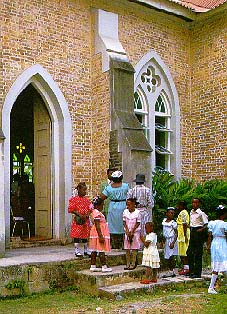 When Christopher Columbus landed in Jamaica in 1494, the island
was inhabited by the gentle Arawak people. During 150 years of Spanish rule, the Arawaks
were virtually exterminated, and African slaves were brought to the island. A British
force invaded successfully in 1655, and Jamaica remained a British colony until 1962. The
slave trade expanded during the 18th century.
When Christopher Columbus landed in Jamaica in 1494, the island
was inhabited by the gentle Arawak people. During 150 years of Spanish rule, the Arawaks
were virtually exterminated, and African slaves were brought to the island. A British
force invaded successfully in 1655, and Jamaica remained a British colony until 1962. The
slave trade expanded during the 18th century. Source: Alan Eyre, Compton’s Interactive Encyclopedia
Got Questions or Comments?!!
Looking For Something? Search!