|
[ Up ] [ Hypoglycemia ] [ Diabetic Foot ] [ Diabetic Eye complications ] [ Diabetes and Kidney damage ] [ Diabetic Neuropathy ] [ Macrovascular complications ] [ Lipid disorder in diabetics ] [ Hypertension in diabetics ] [ Diabetic Ketoacidosis ]
Diabetic Neuropathy.
(Nerve involvement)
 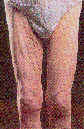 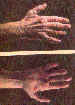
Facial
nerve damage Wasting
of muscles & joint
deformities
(causing
asymmetry of face) (due to damage to nerves supplying
them)
Nerve damage.
 |
High glucose levels can
damage nerve cells by making the nerve cells
swell and scar and by preventing the nerves from sending signals properly. This
can cause numbness and diminish your ability to feel in your feet. | |
Commonest complication
associated with diabetes. |
Cause
|
Poor glycemic control
(sugar control) is the main factor in a diabetic. |
Other contributory factors associated
with an increasing prevalence of diabetic nerve disease are:
-
Increasing
age of patient,
-
Increasing
duration of diabetes,
-
Presence
of cardiovascular disease,
-
Hypertension,
-
Dyslipidemias
and a
-
Positive
smoking history
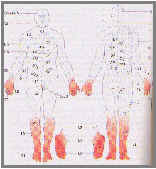
Sensation loss in stocking and gloves areas
(marked red)
Nerve involvement.
Most
commonly distal nerves are affected (sensation loss in stocking and gloves
areas), but motor nerves (responsible for movement of different body parts) and
the autonomic nervous system (responsible for blood pressure control etc.) are
also often involved.
Presentation:
|
Sensation
loss, numbness, sensation of pin prick, tingling sensation. | |
"Burning
feet syndrome" in which patient continuously experience burning
sensation in feet Severe pain in foot can also develop.. | |
Wasting
of muscles due to damage to nerves supplying them. | |
In
severe cases of nerve damage, movement of body parts affected, joint
deformities can develop, ulcers can form especially in limbs which can
become infected and lead to gangrene and loss of limb. | |
Erectile
sexual dysfunction is also common . | |
Damage
to cardiovascular nerves (supplying heart and blood vessels) can lead to
sudden death. |
Clinical
presentations.
Diabetic neuropathy has a varied clinical presentation.
Two
of presentations associated with significant debility are:
-
Distal
Symmetrical Sensorimotor Polyneuropathy.
-
Cardiovascular
autonomic neuropathy.
Distal Symmetrical
Sensorimotor Polyneuropathy.
|
Commonest form of diabetic neuropathy. | |
Manifests in three stages:
Early, Symptomatic, Late. |
Stages
Early.
Usually
asymptomatic (without symptoms), but sensory loss may be detectable.
Symptomatic:
Manifested by sensory loss, often with frank numbness and accompanied by
paraesthesias (increased sensations), most commonly tingling or a sensation of
pin prick; may also be accompanied by pain which in some cases may be severe
enough to present as "Burning Feet Syndrome"
Severe:
It is usually associated with motor involvement and accompanied by disabling
symptoms; high potential for ulceration which may lead to infection, necrosis,
gangrene and loss of limb.
Cardiovascular autonomic
neuropathy.
 |
Possibly,
a leading cause of sudden death. | |
Parasympathetic
damage (failure of heart rate , abnormal ECG) | |
Followed
later by sympathetic damage (marked fall in blood pressure with posture or
failure to increase with exercise) | |
Screening
for the presence of cardiovascular autonomic
neuropathy can be done by testing for heart rate control in response to
deep breathing, or after standing from the lying position and / or
circulatory response to the valsalva maneuver. |
Management neuropathy
| 