|
[ Up ] [ Hypoglycemia ] [ Diabetic Foot ] [ Diabetic Eye complications ] [ Diabetes and Kidney damage ] [ Diabetic Neuropathy ] [ Macrovascular complications ] [ Lipid disorder in diabetics ] [ Hypertension in diabetics ] [ Diabetic Ketoacidosis ]
DIABETIC FOOT
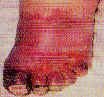
Diabetic foot problems and its prevention.
 |
Foot ulcers and other foot problems are one
of the commonest causes of morbidity (disability), and even mortality (high
death rate), amongst the diabetics in our country. | |
Diabetics account for the second largest
group of people undergoing lower limb amputations (after accidents) in our
country. | |
Foot problems are also the reason for
repeated hospital admissions and prolonged indoor stay. | |
The frequency and the severity of foot problems can be
decreased with adequate foot evaluation and, as importantly,
patient education about foot care | |
All patients at the time of diagnosis and annually, must
undergo a comprehensive foot evaluation which includes a
complete vascular, neurological, musculo-skeletal, skin and
soft tissue examination. | |
This comprehensive evaluation does not necessarily involve
the use of sophisticated, complex and costly equipment; the
use of a simple point based protocol ( given below) allows
delineation of most people at high, or increasing, risk for
the development of foot problems; some patients may require
more sophisticated evaluation. | |
Patients at high, or increasing, risk may require more
frequent evaluations and proactive management. |
Patients with high risk:
|
Patients who walk
barefoot. | |
Patients with diabetic
neuropathy. (nerve damage) | |
Patients with significant
diabetic peripheral vascular disease. (damage to vessels supplying the
limbs). | |
Patients who smoke or use
tobacco in any form. | |
Those with a foot
deformity. | |
Diabetics with a history
of previous ulcers or foot infections. | |
Patients with abnormal
gait. (walk in unbalanced manner). | |
Those with significant
skin and nail infections or deformities. | |
Blind/partially sighted
persons. (increase chances of repeated injuries to foot) | |
Elderly patients;
especially those living alone. | |
Diabetics with chronic
renal failure. (kidney failure). | |
Patients with high
alcohol intake. |
Importantly,
The prognosis
(long term outcome) for the second limb is poor in those who
have had an
amputation of the contra lateral (opposite) limb .
Foot problems presentations:

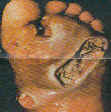

Ulceration-superficial
. Ulceration-deep. Gangrene of digit (toes).
-
Ulceration-superficial.
-
Ulceration-deep.
-
Ulceration-deep with
exposure of bone, muscles, ligaments, tendons.
-
Osteitis (bone
inflammation), abscesses, osteomyelitis (infection of bone)
-
Gangrene of digit (toes).
-
Gangrene of foot
requiring amputation.
Screen tests for diabetic foot problems.
Inspection
 |
For evidence of dry, or excessively moist, skin, hair and
nail abnormalities corns, calluses and infection
| |
For presence of deformities, heel spurs, flat arches, etc.
|
Sensation |
Inquire
for symptoms (numbness in the periphery, etc.)
|
Large
nerve fiber function.
-
vibratory perception at dorsum of the great toe and deep
tendon reflexes
-
light touch
-
position sense
Small nerve fiber function.
Temperature and pain perception thresholds.
Vascular. | Inquire
for symptoms of intermittent claudication (pain limbs while
walking a fixed distance, which can disappear after walking further-due to
damaged blood vessels)
| |
Palpation of pedal pulses.
(pulses of feet)
| |
Brachial to ankle systolic
pressure ratio.
| |
If foot pulses are absent examine
proximal pulses (popliteal and femoral)
|
If necessary, the following tests should be considered :
-
Doppler
studies for blood flow.
-
Arteriography.
All
these investigations may not be necessary in every patient and the
range of investigations should be individualized.
The routine use of a simple point based protocol allows delineation
of patients with high, or increasing risk, for the development of
foot problems.
|
Simple protocol
for judging potential for foot problems
|
|
(Basic
Point Based Protocol)
|
|
Paraesthesia
(increased sensations )
|
no (0)
|
yes (2)
|
|
Hypoesthesia
(decreased sensations)
|
no (0)
|
yes (4)
|
|
Anesthesia
|
no (0)
|
yes (6)
|
|
Veins on dorsum of
foot
|
|
-
Empties
normally on lying flat
-
Distended on lying flat
-
Distended on leg
elevation to 45
|
(0)+
(3)
(6)
|
|
H/O intermittent claudication
|
no (0)
|
moderate (3)
|
severe (6)
|
|
|
H/O rest pain
|
no (0)
|
moderate (3)
|
severe (6)
|
|
|
H/O nocturnal leg pain
|
no (0)
|
moderate (3)
|
severe (6)
|
|
|
Peripheral pulses
|
normal (0)
|
feeble (4)
|
absent (6)
|
|
|
Filling time after blanching of
nail beds By pinching (in seconds)
|
< 5(0)
|
5-10(1)
|
11-15(2)
|
>15(4)
|
|
Skin
and Nail Changes:
|
|
|
Skin: cold/dry/thickened/atrophic/shining/loss
of hair
|
no(0)
|
yes(2)
|
|
Nails: thickened/ingrown/
fungal infections
|
no(0)
|
yes(2)
|
|
Presence of corns
|
no(0)
|
yes(2)
|
|
Presence of calluses
|
no(0)
|
yes(2)
|
|
Based on the points scored, patients are classified into
categories A to E with increasing risk for developing foot
problems.
|
|
A < 5;
|
B 5-10;
|
C 11-15;
|
D 15-20;
|
E >20;
|
|
NOTE: |
All
patients must have foot care education; | |
Patients
in categories C, D and E require intensive foot care
education and corrective therapy is possible; | |
Patients
should be evaluated every six months; if the number of
points increases, need for evaluation for increase and
corrective measures; | |
A
history of a previous foot problem puts a patient in the
high risk category irrespective of points scored; |
|
Foot problems
|
Foot problems can develop quickly in people with diabetes because of poor
circulation, hardening of the arteries, or nerve damage. | |
Poor circulation can
lead to symptoms such as cold feet, leg cramps, shiny or dry skin, loss of hair,
and slow healing. | |
Nerve damage can cause pain, numbness, loss of feeling,
burning, and tingling in the legs or feet. | |
If you have nerve damage and
poor circulation, you are vulnerable to even more serious complications. You may
not be able to feel a small cut or blister on your foot. If the cut or blister
becomes infected, this can lead to a more serious infection called gangrene. | |
If gangrene is not treated soon enough, a section of the foot may need to be
amputated to save the rest of the foot or leg. | |
Your feet will be more prone to dryness, peeling, and cracking, so always
keep them clean and dry. | |
After bathing, dry your feet carefully, especially
between the toes, and apply a thin coating of baby oil or lotion. | |
Do not
put baby oil or lotion between your toes. | |
Similar complications can develop from
ingrown toenails, plantar warts, and puncture wounds. |
Management
of foot problems
|
