The Bible: our reference for Daily Living

One of the first things we need to understand about the Bible is what sort of literature it is. It is definitely not just a scroll which fell out of the sky for mankind to read and obey!

Overall we can say that it is a collection of 66 smaller works*, each of which in themselves are of different genres, and divided into two great periods of composition (which also effect their thematic content): the period before Jesus lived, which we call the Old Testament, and the period beginning from Jesus' birth, which we call the New Testament.

[* Note: There are a few other works, labeled the Apocrypha or Deuterocanonical books, written in the 400 years before Christ, which most sections of the church do not regard as being fully Scripture, lacking the stamp of divine inspiration. However, they are still regarded as being helpful to some extent, especially since they serve to fill out the historical situation in the period before Christ.]

On top of that, many of the authors wrote in different styles, or genres, and these styles need to be taken into account when reading, understanding, and applying what they wrote for our lives today (we do exactly the same when we read a newspaper, interpreting what we read according ot whether it is a cartoon, headlines, editorials, classifieds, articles, etc). Furthermore, for best interpretation, we need to take account of the historical and cultural situation in which the document was written, so that we don't for example confuse metaphors or illustrations with
seemingly similar ones in which we find ourselves in (for example, the biblical expression "his eye is bad" does not mean that the person needed to see a doctor, but rather that he was greedy and stingy, not wanting to see the need of his neighbour). We also need to be strongly aware that we are reading narrative, and should read the text holistically.

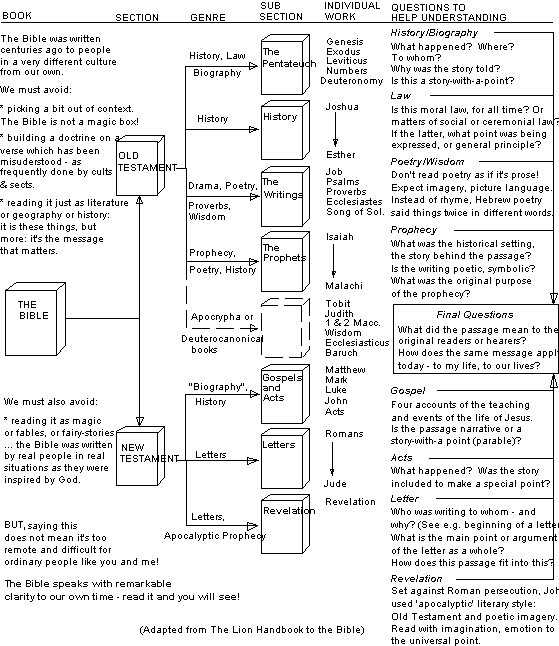
The following diagram serves to illustrate all this:

ifcc.online

Leader's guide
Preface
Introduction
The Gospel
Alpha
Beta
Gamma
Delta
   Scope of Daily Living
   The Bible
   Spiritual reality
   Environment
   Economics
   Socal reality
      Our gender
      Life stages
      Friendship levels
      Finding a partner
      Marriage and Family stage
      Culture
   Political reality
   Religious reality

Epsilon
Zeta
In Summary
Suggested Curriculum
Bibliography

Here follows the content of the diagram in text form:

Book
The Bible was written centuries ago to people in a very different culture from our own.

We must avoid picking a bit out of context.  The Bible is not a magic box!

We must avoid building a doctrine on a verse which has been misunderstood - as frequently done by cults and sects.

We must avoid reading it just as literature or geography or history. It is these things, but more: it's the message that matters.

We must also avoid reading it as magic or fables or fairy stories.  The Bible was written by real people in real situations as they were inspired by God.

But, saying this does not mean it's too remote and difficult for ordinary people like you and me!  The Bible speaks with remarkable clarity to our own time - read it and you will see!

Genre
History
Law
Biography
Drama
Poetry
Proverbs
Wisdom
Apocrypha or Deuterocanonical books
Letters
Apocalyptic Prophecy.

Questions to help understanding
History/Biography
What happened? Where? To whom? Why was the story told?  Is this a story with a point?

Law
Is this moral law, for all time?  Or matters of social or ceremonial law?  If the latter, what point was being expressed, or general principle?

Poetry/Wisdom
Don't read poetry as if it's prose!  Expect imagery and picture language.  Instead of rhyme, Hebrew poetry said things twice in different words.

Prophecy
What was the historical setting, the story behind the passage?  Is the writing poetic, symbolic?  What was the original purpose of the prophecy?

Gospels
Four accounts of the teaching and events of the life of Jesus.  Is the passage narrative or a story with a point (parable)?

Acts
What happened?  Was the story included to make a special point?

Letter
Who was writing to whom, and why? (See, for example, the beginning of a letter).  What is the main point or argument of the letter as a whole?  How does this passage fit into this?

Revelation
Set against Roman persecution, John used 'apocalyptic' literary style: Old Testament and poetic imagery.  Read with imagination and emotion to get the universal point.

Final Questions.  What did the passage mean to the original readers or hearers?  How does the same message apply today - to my life, to our lives?

(Adapted from the Lion Handbook to the Bible)


Furthermore, whilst there were over 40 different authors who composed these works, spanning a period of composition greater than 1500 years, there is a unity of message and power behind the words which can only be attributed to the fact that God was the 'inspirer' behind them all (cf 2 Timothy 3:16). Thus we can legitimately say that the Bible is the product of man
and of God.

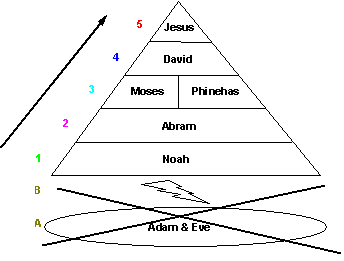
The theme or plot which can be traced through the Bible is that of God wanting to have an eternal fruitful relationship with people. From God's perspective, relationship is grounded and built upon covenants, that is, agreements on how we will relate to each other. And we are able to trace a number of covenants which God initiated in the Bible, as the following diagram indicates:

God's process of renewing relationship with humanity an creation such that sin will ultimately never again interfere: an unfolding series of covenants.

God's original relationship with humanity and creation was shattered by sin.

A.  Origins, purpose, & destiny
B.  What went wrong: Satan & sin
1.  Safe environment
2.  God's promise of love & family security, of blessing, influence, & a future as we obey Him
3.  God's law & standards, plus a means of forgiveness
4.  Godly leadership to drive out the enemies, maintain justice, model Godly values, & occupy the promised land
5.  Deliverance from the real enemies of sin and Satan through faith in Jesus

Now the important thing to realize is that all these covenants in the pyramid point to and are fulfilled in the capstone - the final new covenant which God made with us through Jesus Christ (cf Matthew 5:17-20; Hebrews 1:1-2), in which our sins and associated guilt are truly eternally wiped away through the blood of Jesus (cf Hebrews 10:1-18) and in which we can experience 'new-birth' and have the empowering presence of the Holy Spirit to live lives which fulfill the law (cf Romans 8:13). Therefore understanding and living in accordance with this new covenant is the key for daily living. The detail of this new covenant we find foreshadowed and spoken about in the Old Testament, but fully contained in the New Testament portion of the Bible*.

[* Note: The terms 'Old Testament' and 'New Testament' in themselves mean 'old covenant' and 'new covenant'; all the covenants in the Old Testament are labeled 'old' because with respect to the final one in Christ, that is what they now are!]

So how do we treat and read the Old Testament? It is not redundant, but should be read now as providing paradigms for living, as providing the 'law' which the Holy Spirit is now helping us to fulfill in a non-legalistic fashion, and as providing the background and context for life as we know it today. If we want to understand and apply what we read in the Old Testament for our lives today, it must only be done 'through the eyes' of the New Testament.

Having now provided an overview of how we can use the Bible to help us in our daily living in the political, economic, social, and religious realms, we can begin to make some pertinent comments about our relational living within them.

Hosted by www.Geocities.ws

1