|
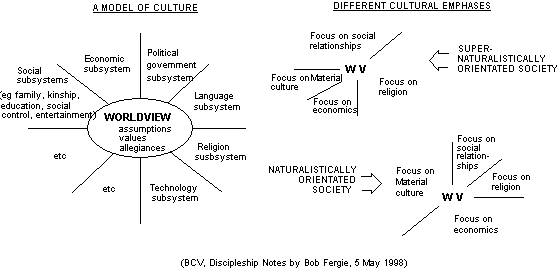
In text form:
A MODEL OF CULTURE
central circle:
WORLDVIEW
assumptions, values, allegiances
around the circle:
Social subsystems (eg family, kinship, education, social control, entertainment)
Economic subsystem
Political government subsystem
Language subsystem
Religion subsystem
Technology subsystem
DIFFERENT CULTURAL EMPHASES
SUPERNATURALISTICALLY ORIENTED SOCIETY
Focus on social relationships (approximately 35%)
Focus on Material culture (approximately 15%)
Focus on economics (approximately 15%)
Focus on religion (approximately 35%)
NATURALISTICALLY ORIENTED SOCIETY
Focus on social relationships (approximately 15%)
Focus on Material culture (approximately 35%)
Focus on economics (approximately 35%)
Focus on religion (approximately 15%)
One obvious aspect of culture that we are faced with today more than ever before is that of urbanization, which is the product of industrialization. No longer are we village people, but dwellers in cities - 85% of Australians are urban dwellers, with 70% in cities. This is fact that Christians themselves must begin to address.
The question faces us as to how to be community in a city. Is it God's will that we walk past countless hundreds of nameless faces every day, travel on buses, trams, and trains without speaking a word, and have friendship bases no longer grounded in our local geographical area but spread thinly all across town, the country, even the world via internet, whilst not even 'seeing' our neighbours, let alone their needs?
I have noted that whilst it is exciting to have friends scattered as such, and whilst when you are young and single you have the energy and resources to be able to travel and communicate over such vast distances, the older you get you realize you just don't have the time or energy or money to do that traveling. And perhaps also the wiser you get you realize that nothing cuts it like face-to-face personal communication. Ultimately you realize that you need to be part of a 'local village', even midst a city.
And how can we do that? In our urban society, in which our neighbours are often from other parts of the planet and we are confronted with such vastly different cultures all on our doorstep, there needs to be some common factor that is powerful enough to unite us.
And that is exactly what the church claims to have - Jesus Christ. We must remember that the church of Jesus Christ is a heterogeneous entity, comprising people from all races, ages, sexes, nationalities, roles, economic function, etc. In Christ there are no boundaries. We are all part of one body, and God is our Father. And the key unifying factor is only that. Our unity is not based on hobbies, leisure pursuits, work interests, etc. Our unity is in Him, and it is only as we seek first the Kingdom together that we can ever hope to live together.
Thus, I suggest that the existence of 'internet churches', or churches comprised of people traveling half way across the city, is less than God's ideal. Yes, to be sure they cater for the current culture and situation of a person, and can be good evangelistic tools to help unbelievers be saved, but God is ultimately looking for more. I believe God will gently lead each believer to ultimately be working towards the existence of a local Christian community, because only that will truly satisfy our deep needs and really touch those other people who live near us.
|
|