|
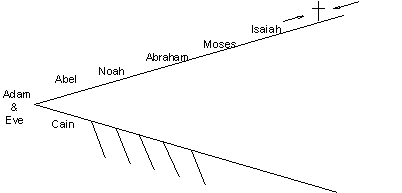
(The two paths of Abel-Cain, above, is derived from Edith Schaeffer's book "L'Abri")
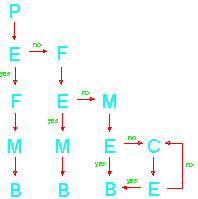
Beta, Gamma, Delta: phase 1
Ephesians & Philippians for an understanding of your identity in Christ, plus Romans 1-8.
Luke-Acts as a prelude to studying Colossians, Galatians, 1 & 2 Corinthians, 1 & 2 Thessalonians, for an understanding of life by the Spirit and not in the flesh and not under law.
Epsilon
In the context of seeking advice from other Christians who know you, and whilst being aware of the desires of your heart, your established abilities, your personality and your experience, study Romans 12, Ephesians 4, 1 Corinthians 12, and 1 Peter 4 (here we find lists of spiritual gifts) and ask God to reveal to you what gifts you have. Then study 1 & 2 Timothy, Titus, and Philemon putting yourself in the shoes of the recipients of those letters and discern how one should exercise the gift one has received.
Beta, Gamma, Delta: phase 2
John as a prelude to studying Hebrews, James, 1 & 2 Peter, 1 & 2 & 3 John, Jude, Revelation, for an understanding that Jesus alone is the Messiah, and that He really is all sufficient, and that we should never swerve away from Him, and that truly in Him we know what God is like!
Zeta
Matthew as prelude to 1 & 2 Timothy, Titus, Philemon, then followed by Romans, putting yourself in the shoes of the writer and the recipients, so that as witnesses, evangelists, and leaders, we know the right use of the law, what the Christian life is, and how / how not to teach and lead in the above.
Whilst having divided the New Testament (NT) up in such a fashion, allow me say that I believe all the elements of alpha through zeta can be found in the four Gospels, in the 'narrative alpha', since Jesus' life necessarily encompassed all these things. He taught concerning the Kingdom of God, He lived it out in practice, and made it possible for us to be a part of this Kingdom through His death and resurrection. We are called to emulate all these things - teach, live, even sacrifice ourselves for others that they may enter the Kingdom - and the rest of the NT is basically extrapolation or application to new converts around the world of all Jesus said and did! Narrative alpha encompasses systematic alpha plus beta through zeta.
(I also sense that in Romans, the systematic alpha, we also have all of alpha through zeta; A being in chapters 1-11, and B,C,D,E,F being in chapters 12-16.)
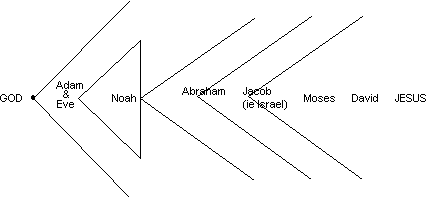
Furthermore, the Gospels are what the whole Old Testament (OT) always looked forward to, always talked about, and always were pregnant with in its narratives, teaching, and prophecies. Thus the OT is never redundant, and always provides for us rich background and never redundant information for living the Christian life. Thus I suggest a few ways to study and read the OT:
a) in the above curriculum, whenever NT passages refer back to or may be 'similarly found' in OT sections, these sections should be read and studied in their OT context, and then full riches will be abundantly added to you in your faith! (especially when the same themes exist).
b) when reading the OT, note and absorb the following things -
the nature of God
the nature of humanity
the nature of world history, the cosmos, the spiritual realm
the nature of how God deals with & relates to mankind.
the nature of the People of God, in times of obedience and disobedience
the nature of the future
the nature of the Messiah & His Kingdom
the nature of the People of God in the Messianic Kingdom
God's righteousness (tseddeq), justice (mishpat) and covenant faithfulness (hesed), the three of which produce shalom.
May God bless your journey into the Christian life!
Allow me to finish with the words King David once said:
"Taste and see that the Lord is good; blessed is the man who takes refuge in Him"
(Psalm 34:8).
|
|