|
|
Home | Versione Italiana | Contacts |
|
Home | Versione Italiana | Contacts | |
|---|
|
|
Why Hydrogen is the right carrier for energy? |
|
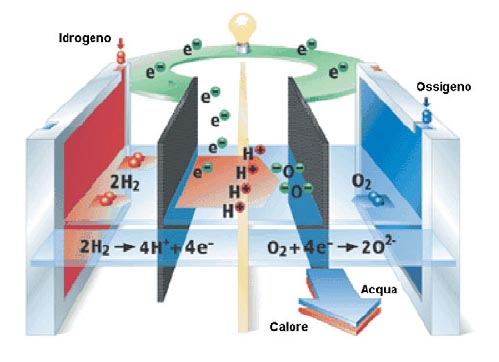
Hydrogen is currently considered the best candidate as an energy carrier in the near future. In fact, hydrogen is a gas that burns in air according to the simple reaction: H2 + 1/2 O2 -> H2O + heat Since the only reaction product consists of pure water, in the case of an internal combustion engine, the only product is represented by the nitrogen oxides that are formed due to the high temperature. Anyway the amount of nitrogen oxides is far less than fossil fuels and there here are no unburned hydrocarbons, sulfur dioxide (present especially in diesel fuel) or carbon dioxide. Hydrogen burns with a not bright flame with a flame temperature stoichiometrically higher than in methane (2400 K against 2190 K). Compared to methane, with hydrogen a triple volumetric amount is needed to get the same calorific value, but the flow velocity is three times higher. The energy required for ignition of hydrogen in air is considerably lower than the methane. Apart from the production of flame and then the energy from the combustion itself, hydrogen is the ideal element for the fuel cell. Invented in 1839, it has returned the subject of research in aerospace applications This subject has been then re-evaluated in the sixties after a century of lapse. A fuel cell is an electrochemical device that converts the energy of hydrogen directly into electricity and heat , without going through cycles of heat and therefore not affected by restrictions imposed on them from thermodynamics. In figure 1.1 is shown schematically the operation of a fuel cell. It basically works similarly to a battery, as it produces electricity through an electrochemical process. Unlike a battery, however, the fuel cell consumes substances from outside and is therefore able to function without interruption, until the system is supplied fuel and oxygen.
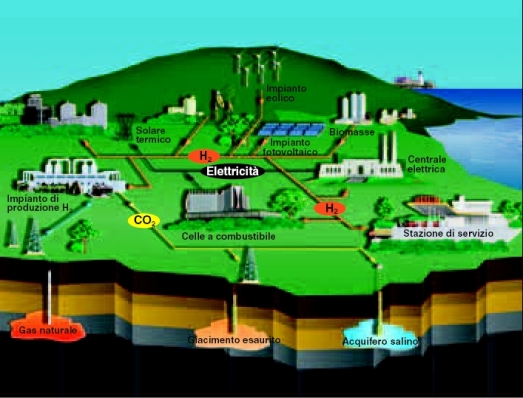
Hydrogen can be produced either from fossil fuels, from renewable energy sources, from nuclear power. As for the production of hydrogen from renewable sources, that is the most clean and that is far more interesting, the processes are essentially two, the production from biomass or water. In the production of hydrogen from biomass none of the processes proposed to date have achieved an efficiency that can be used industrially, even if the promises are good. The production from water can be done through the division thereof into its components (hydrogen and oxygen) through various processes, among which the most efficient is electrolysis. Schematically, the electrolytic process is the reaction: H2O + electricity ->H2 + 1/2 O2 (1.2) You can see immediately that the electrolysis shows exactly the inverse reaction occurring in fuel cells. Therefore, the entire process of production and consumption is environmentally sustainable if, as mentioned above, a corresponding amount of clean electricity is available to power the electrolysis process. One could immediately think of the sun as the source of this energy, exploitable through the use of photovoltaic conversion facilities. The current technology can be considered reliable and adequate, though not yet competitive. Indeed, through the use of photovoltaic, solar energy can produce electrolytic hydrogen and oxygen. As end product of the recombination of hydrogen and oxygen it generates a quantity of pure water almost equal to that of departure, thus closing the cycle with no emissions of pollutant. In principle, therefore, it would be possible to extract from water all the needed hydrogen in order to meet clean energy needs of humanity. The problem now is the cost. By electrolysis of water, it is true that one can virtually obtain pure hydrogen, but only at a price that can be economically acceptable in a still distant era, when the technology will hopefully enable low costs electricity production from renewable sources (or nuclear). The dissociation of water may also be done using thermochemical processes that need high temperature (800-1000 ° C) obtained from different sources (first of all thermal solar energy). Research and development aimed to demonstrate the industrial feasibility of these processes seem to be very interesting. There are other processes already mentioned, still in the laboratory scale, such as photoconversion, which breaks down the water body using biological or synthetic materials, and photoelectrochemical processes, that use as an electric current generated by semiconductors for the same purpose. Figure 1.2 shows a possible system in which hydrogen is produced by more or less from renewable energy sources, storing energy. A proper transport system then allows the easy supply of hydrogen and therefore energy. It can be said, therefore, that hydrogen is in an ideal prospect for a future sustainable energy system, creating an incentive to the widespread use of renewable sources. In the short to medium term, hydrogen could be used in a transition technology that would make fossil fuels compatible with environmental requirements. The development as an energy source, however, requires also the establishment of a wide range of integrated infrastructure, if only to make the use economic and reliable in all the various stages of technological processes (production, confinement of carbon dioxide generated in the process, transport, storage, end-use). In mobile applications there’s the need, not only to develop not only more efficient fuel cells, but also storage systems, transport and distribution networks comparable to those of conventional fuels.
|
|||||||||||