|
|
Home | Versione Italiana | Contacts |
|
Home | Versione Italiana | Contacts | |
|
|
Hydrogen storage |
|
Currently, besides the problem of finding the most efficient and economical way to produce hydrogen, which still hinders the diffusion of this energy carrier, there is the difficulty of storage and transport. Being hydrogen the lightest element, at 0 ° C and a pressure of 1 bar its density is only 0.090 kg * m-3, while at -253 ° C is a solid with a density of 70.6 kg * m-3 . It 'clear that it is not easy to store large masses of hydrogen in gaseous form. With regard to mobile applications, the targets set by the DOE (the Department of Energy of U.S.) in recent years have translated into two numbers: 6.5 wt% (which expresses the percentage of the stored hydrogen mass and the mass of the tank) and 60 kgH2/m3 (which is the ratio of the mass of hydrogen and the volume of the tank). Now these goals are reviewed and articulated over time and specifically, as regards the wt%: 4.5 wt% to 2005, 6.0 wt% to 2010 and 9.0 wt% to 2015. The unfamiliarity with the use of hydrogen as an energy source has raised several concerns regarding safety. Certainly it is to recognize that hydrogen, because of its violent reaction with oxygen, should be treated with some caution. But it is also true that when hydrogen burns is consumed very rapidly, with flames directed upwards and with a thermal radiation of wavelength very low that is easily absorbed from the atmosphere. By contrast, materials such as gasoline, diesel, LPG or natural gas are heavier than air and does not disperse, remaining a source of danger for much longer times. It was calculated, using experimental data, that the burning of gasoline vehicle lasts for 20-30 minutes, while for a hydrogen vehicle does not last more than 1-2 minutes.
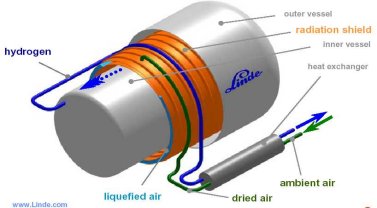
The liquid hydrogen appears very attractive due to its density (70.8 kg/m3, a 1 atm), less for the low temperature boiling point at which the hydrogen must be maintained (-252 ° C). Because of its low critical temperature (-239.9 ° C), liquid hydrogen can be stored only in open systems, because above the critical temperature there can be no liquid phase. The pressure in a closed system at room temperature could reach very high pressures. In addition, to date the major difficulties of this technology are represented by high energy costs during the process of liquefaction and thermal insulation of containers in order to limit losses due to boil off. The rate of boiling from a container of liquid hydrogen depends on the shape, dimensions and thermal insulation of the container itself. The losses can be reduced significantly for large containers (losses of 0.4% per day for a container-type Dewar of 50 m3 and 0.2% for one do 100 m3). Among the supporters of this technology there is the BMW that in 2003 has entered an agreement with General Motors and has developed an automated system for the refueling and has built a small fleet of cars with internal combustion engine fueled by H2. Today, the cryogenic technology have reached a significant level thanks to the development of missiles (Shuttle, Ariane), but some drawbacks are against the statement in vehicular applications: the cost of liquefaction and transport, evaporation and security. Therefore the widespread use of liquid hydrogen is still a concern.
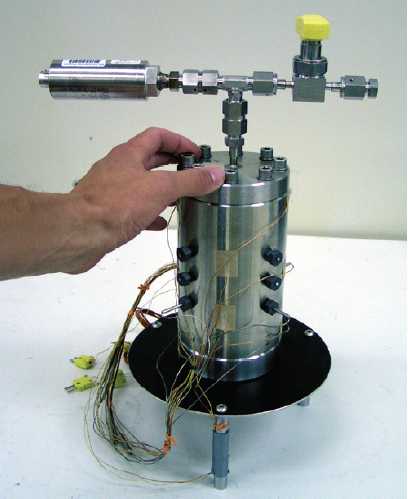
One of the most promising technologies for hydrogen storage, especially for mobile applications, is the storage in solid form, using hydrides. For this purpose metals, intermetallic compounds and alloys are used. Metal hydrides are formed through two steps: the dissociation of hydrogen in molecular hydrogen to the atomic surface and its absorption in the interstitial sites of the structure of the guest compound through diffusion processes. The absorption of hydrogen in the interatomic space (hydrogenation) is an exothermic process, while the release of hydrogen (dehydrogenation) is an endothermic process. When the hydrogen pressure is initially increased, the hydrogen is dissolved in very small quantities in the metal until the metal-hydrogen interactions come to the point of forming the hydride. At this stage, the equilibrium pressure remains constant up to about 90% of storage capacity. The operating pressure increases with increasing temperature. Over and above this limit is necessary to operate with high pressure to achieve 100% capacity. The heat generated during the formation of the hydride must be continually removed to prevent damages to the system. By dehydrogenation instead, the bond formed between metal and hydrogen are broken and reaction is endothermic, that means the reaction needs heat. Initially, the pressure is high and pure hydrogen is released, then reducing further the pressure a plateau is reached as in the case of absorption and the hydride phase is decomposed at constant pressure. The temperature and pressure of these reactions depend on the specific composition of the hydride. The heat of reaction can vary from 9300 to 23250 kJ/kg and the hydrogen pressure can exceed 100 atm. The temperature of dehydrogenation may exceed 500 ° C. Given this wide range of temperature and pressure, the construction of hydrogen storagedevices presents considerable difficulties. In particular, the research is looking for systems that can work in the range of interest for mobile applications (1-10 atm and 20-100 ° C). The container of the hydride must be pressurized and have a sufficiently large area allowing a good heat exchange. The disadvantages are, however, the low percentage by weight of stored hydrogen and the generally the high cost of materials that do not yet permit the construction of storage systems commercially available on a large scale. The operating costs for these systems include those related to operations for cooling and heating during hydrogenation and dehydrogenation. The amount of heat required depends on the type of metal or alloy and its applications. For the future, although it is expected an increase in the cost of materials used, it is estimated that at least very small systems, for use in mobile applications (power laptops for example) can be more efficient and competitive. |
|||||||||||||||