|
|
Home | Versione Italiana | Contacts |
|
Home | Versione Italiana | Contacts | |
|
|
The production of hydrgen from fossil sources |
|
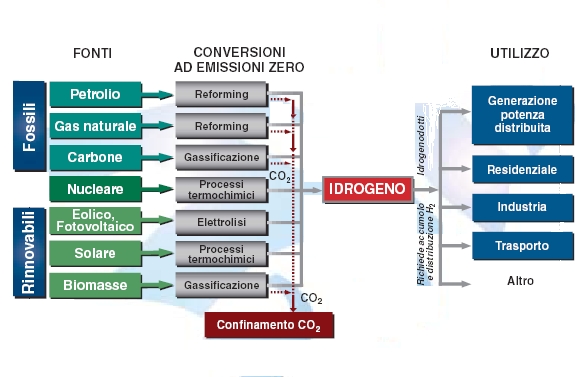
In the industrial production more than the 48% of hydrogen is produced by steam methane reforming (SMR). It is possible to apply this method also in the case of hydrocarbons like ethane. It is not possible using heavier hydrocarbons due to the high level of impurities they contain. About the heavier hydrocarbons, other methods like partial oxidation are more effective. The SMR is a reaction of methane with steam in presence of catalysts. On the industrial scale this reaction needs an operative temperature of 800 °C and a pressure of 2.5 MPa. The first stage consists of the decomposition of methane in hydrogen and carbon monoxide. In the second stage, called “shift reaction”, carbon monoxide and water react to produce carbon dioxide and water. The chemical reaction that occur are the following: CH4 + H2O -> CO + 3H2 (endothermic reacttion) (1.3) Coming out from the "reformer" the CO, reacting with the steam, turns into CO2 that is removed giving pure hydrogen: CO + H2O -> CO2 + H2 (exothermic reaction) (1.4) The neat reaction is then: CH4 + 2H2O -> CO2 + 4H2 (1.5)< The efficiency of the process is about 50-70%. In the traditional steam reforming the hydrocarbons are the source of both chemical energy and thermal energy: about 45% of used hydrocarbons is meant for the production of heat. The SRM is considerably cheap and competitive compared to other production methods like electrolysis . moreover, the SMR involves a reduced impact on environment. Te technology of SMR could be convenient if combined with the supply of vehicles that use fuel cells. An alternative production method is the coal and fossil fuels gasification. The process of gasification consists of partial, non catalytic, oxidation of a solid, a liquid or a gas with the aim of producing a gaseous fuel, mainly constituted of hydrogen, carbon monoxide and light hydrocarbons like methane. By means of gasification the coal is converted, partially or completely, in gaseous fuels that, after purification, can be used as fuels or as reagents in the industrial production of chemicals and fertilizers. Te production of hydrogen by coal gasification is a technology with several commercial applications, but is competitive with the SMR only if the natural gas is too expensive. The involved reactions are the following: C + H2O -> CO + H2 (1.6) With more steam at 500°C and with the help of an iron oxides based catalyst it possible to obtain hydrogen from CO: CO + H2O -> CO2 + H2 (1.7) The overall reaction is then: C + 2H2O -> CO2 + 2H2 (1.8) The gasification of fossil fuels is very interesting from the economical point of view in the regions where the coal is abundant and cheap. It should be taken into account that the production of hydrogen from fossil fuels is to be considered as a bridge towards the production from renewable sources. In fact, this solution leaves unsolved the problems related to the unavoidable depletion of fossil fuels and the additional cost of CO2 confinement. .
|
|||||||||