|
|
Home | Versione Italiana | Contacts |
|
Home | Versione Italiana | Contacts | |
|
|
The hydrogen as future energy carrier |
|
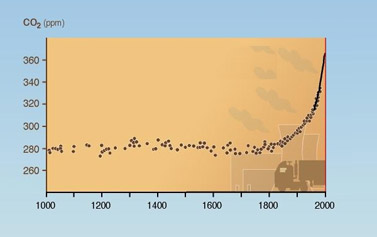
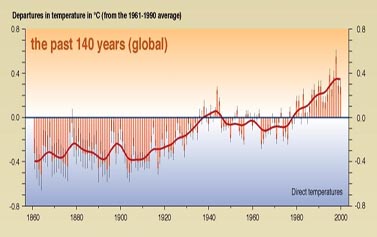
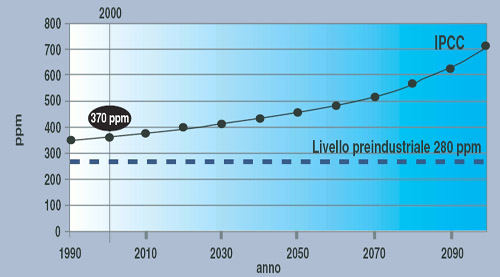
The continuous growth of world population and economic expansion of developing countries, attempting to comply with the standards of the already industrialized countries, are the cause of the increasing demand for energy and the alarming and continuous release of greenhouse gases. The technological challenge of our day is certainly satisfying the energy demand while maintaining the emission of greenhouse gases, especially CO2, as far as not disturbing the environmental balance. In fact, the main cause of global warming is believed to be carbon dioxide, the main end product of the use of fossil fuels during the production of thermal, mechanical and electrical energy. At the beginning of the twentieth century the concentration of CO2 in air was equal to 300 ppm while the current estimate is about 380 ppm (Intergovernmental Panel on Climate Change). From Figures 1 and 2 can be seen as increasing the concentration of CO2 in the atmosphere during the industrial era has affected the global temperature.
The energy carrier that lends itself better for this purpose is considered to be hydrogen. The advantages of hydrogen are different, such a low weight; amount of energy stored well above the current used fuels on a large scale such as diesel, natural gas or gasoline; absence of carbon dioxide, sulfur oxides and particulate in the expelled gases. However, there are still many hurdles to overcome for hydrogen to become the energy carrier of the future. Hydrogen does not occur in nature as molecular hydrogen for immediate use but as one of the most abundant elements on the Earth's crust, it must be extracted from water or hydrocarbons. You should spend some energy that in a certain sense is stored in hydrogen and then converted through systems such as internal combustion engines or the more efficient fuel cells. Besides looking for more efficient conversion systems, a major effort is being done to search for hydrogen storage systems and transport, particularly for vehicular applications. The existing storage systems such as high pressure or liquefaction have several problems for vehicle applications, mainly related to security, quantity of stored hydrogen, in the case of gas at high pressure; or energy necessary to maintain hydrogen in the liquid form, in the case of liquefaction. A good alternative is the storage in solid form as metal hydrides, complex hydrides, carbon nanotubes, zeolites, glass beads. However, research is still needed to obtain better performances of these materials. In particular, the pressure and temperature of operation should remain in the intervals 1-10 atm and 20-100 ° C, respectively. The further difficulty is the weight of these materials, which compared to the amount of stored hydrogen is still too high for efficient mobile applications.
|
|||||||||||||