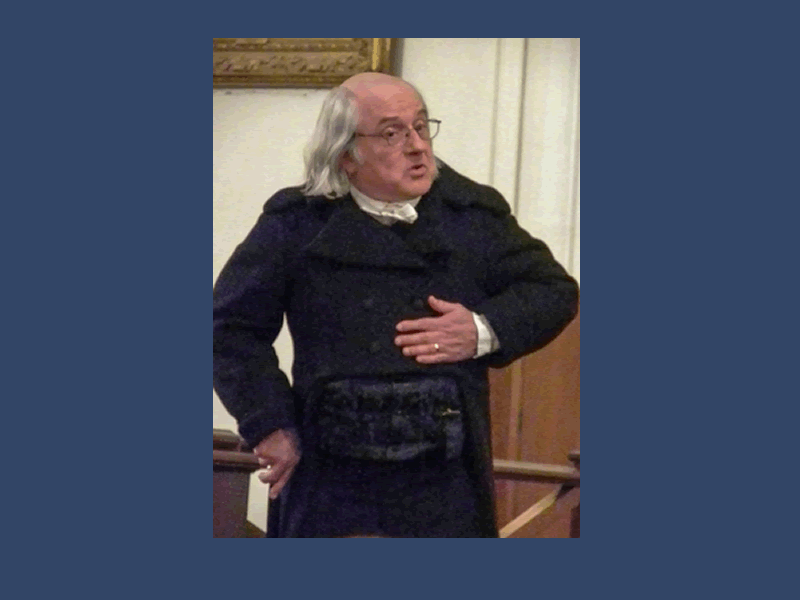
Albert Gallatin on the Matter of Protest
The Exercise of Freedom of Speech
by Ron Duquette, Mr. Gallatin's 21st Century Agent; written September 26, 2017
Over the last six years of portraying Albert Gallatin, I'd like to think that I've gotten some insight into his approach to various matters. One of the essential understandings to have about Albert is his views on "protests."
We have, in the last several weeks more sharply and, the last year less so, seen a series of protests, all of them peaceful, taking place on the playing fields of the National Football League. Players have been "taking a knee" during the playing of the National Anthem. The current holder of the Chief Magistracy - and that's not a mistake in calling him that, for a reason I will explain a bit later - has inserted himself in a divisive manner on the entire business of, initially, whether they should even be allowed to protest, and then, upon strong negative response by not only the organization itself and its members, but by a more generalized public, that the protest is aimed at the flag and its symbolic importance. He misses the point - widely.
Albert Gallatin was involved at three critical junctures of his early life here in America after his immigration here in 1780 in protest. The first was at Harrisburg, PA, in 1788. This was a convention in Pennsylvania called in protest by many who were termed "anti-federalists" because of their opposition to the Constitution which was then in the process of undergoing ratification by the various states. Pennsylvania had rather hurriedly and, some argue, illegally ratified the Constitution, and there were citizens of the Commonwealth who felt that it was seriously deficient, especially because it lacked any statements about the rights of individuals in the face of governmental power and its exercise (eventually developing into what we know as the First Ten Amendments to the Constitution, the Bill of Rights). Gallatin was one of them. However, when in the course of that convention it was argued that we needed to go back to Step 1 and hold another Convention altogether, he argued strongly and firmly against it. His view was that we cannot and must not recreate the entire discussion when something seems wrong about some process of government, but that we must fix it in the context of what system has been devised to do so. In other words, just because the bath water's dirty, don't toss the baby out with it.
Later, between 1791 and 1794, he was involved in the "Whiskey Rebellion," which was taking place in Western Pennsylvania. The first year, he argued that peaceful protest in the form of a memorial to Congress about the reasons for opposing the imposition of an internal tax, the excise on whiskey, was the proper path. The next year, however, he committed what he himself described as his "only political sin," endorsing a far more strongly worded and threatening missive that promised armed rebellion if the tax issue was not addressed. He reconsidered his position, and when in mid-1794 a meeting of his fellow western Pennsylvanians gathered near Pittsburgh, he was chosen to be one of a group of 60 representatives from the larger grouping of over 200 who had met to discuss their response to the Federal government's continuing unwillingness to change the law sufficiently to meet their protests. Over the course of some two hours, he argued that, while the reason for their protest was valid, the means of expressing it - armed rebellion - was not. He eventually convinced enough of the 60 to recommend to the larger convention that they should submit to the government, but take advantage of the means the Constitution provides - specifically, the action of their elected representatives "in Congress assembled" - to change the nature of that governmental action. Despite the danger that ultimately placed him in, he felt that this was a proper means of protest.
His final brush with protest at a high level took place between 1797 and 1799 when, as the Representative from the 12th District of Pennsylvania, he sat in Congress, and the issue was now about the proper means of debate and dissent for the Federal government's actions in prosecuting of the "Quasi-War" with France in that period. Dissent was rampant; meetings were held and documents were written, and the Adams Administration took action in the form of the Alien and Sedition Acts. Gallatin, in Congress, took firm exception to this means of the government addressing itself to the issues raised by the various protests. Because much of the actions of the government were aimed at immigrants - himself among other Congressmen included, one of them being James Lyons of Vermont who was tried, convicted and jailed while still a sitting Member of Congress - this was clearly a means of suppressing all dissent, and that at the highest levels of political discourse in the country. Nonetheless, he continued to bring up the matter in Congress until the Acts were, for the most part, either discontinued or suppressed.
Two principles here are at issue. The first is that of protest in the first place. This nation's foundation is firmly on the principle of protest. It started primarily in 1765 with the passage of laws by Parliament without the consent of the governed. This principle, while we as Americans grasp its importance, was entirely alien to the English as a concept. James Otis of Massachusetts was the first really popular proponent of this idea. Protests later on until armed revolution itself took place occurred at various levels of peacefulness. Some were very violent - the tarring and feathering of customs collectors and, eventually, the resistance to the efforts to take the arms and ammunition from Lexington and Concord sparked war. Others were much more peaceful - the various memorials sent by the Continental Congresses to Parliament to attempt to reason with them, the boycotts of goods coming from England, and so forth.
The second principle, however, is far more important. It's about the reason for the protest. Frivolous issues do not deserve presidential attention - and I would submit we could agree to that. He has far more to concern himself about than whether or not someone seems to disrespect the flag during the playing of the National Anthem. If it is a violation of law, prosecute it. (However, in passing, the prosecution of the violators of the laws for the proper display and respect for the flag should be applied to all violations of those laws, not just the selected matter at issue.) What is disrespectful, in my view, is the continued and studied ignoring of the reason for the protest - that is, the discussion that should be being had about the systematic and systemic abuse of the policing power, especially as it relates to people of color.
The players in the NFL who have chosen to "take a knee" would be defended if it were in the exercise of their First Amendment right to the practice of their religious beliefs. However, let that exercise be in the defense of the right of free speech, and suddenly it is emotionally dismissed as improper. (Again, this last week, many of those, if not most, who "took the knee" also covered their hearts with their hands, so continuing to express a measure of respect for the symbol of the nation - THEIR nation.) Parliament said the same thing in the late 1760s and the early 1770s. We should be prepared to endorse peaceable protest if it leads to a necessary conversation and rethinking of our attitudes and, to be hoped, a change in our behaviors if needed. The unwillingness to have that conversation, necessary as it is, does us no credit. The Chief Magistrate, whose duties among others, is the defense of that national set of laws known as the Constitution - First Amendment and all - does not exercise his responsibilities suitably by his social media protest. With issues of peace and nuclear war in the background, and other matters of great moment facing the nation, his attempts to diminish the right of people to protest peaceably does him no credit at all.
And I believe Mr. Gallatin would be in agreement.